
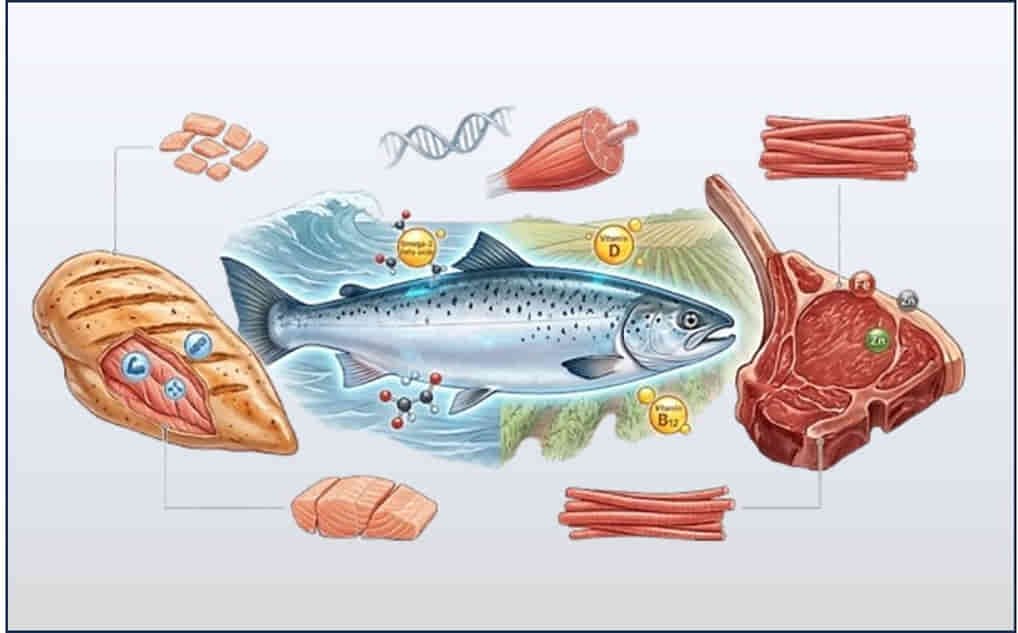
For centuries, our dinner plates have been divided into two camps, “meat” on one side and “fish” on the other. Ask someone, “Do you eat meat?” and many people happily reply, “No, I only eat fish.” But here comes the biggest culinary plot twist. Science says fish is meat. Surprised? Think of it like this. A mango and an apple look different, taste different, and grow differently, yet both are fruits. In the same way, beef, chicken, mutton, and fish may look and taste different, but they all belong to the same biological family called meat because they are the edible muscles of animals.
For generations, tradition whispered, “Fish is different.” Biology politely replies, “Not really.” As the old proverb says, “Truth stands the test of time.” Sometimes science simply pulls away the curtain hiding an old misunderstanding.
So why did people separate fish from meat in the first place? The answer lies more in history than in biology. Many ancient religious traditions allowed people to eat fish during fasting while avoiding meat from land animals. Slowly, culture built an invisible wall between the two. From a biological point of view, however, fish muscles and land animal muscles are made of the same basic building blocks, proteins, muscle fibres, connective tissue, water, and fats.
The difference lies in their structure. Fish muscle fibres are shorter and arranged in small blocks, almost like tiny Lego bricks, while muscles in chicken, mutton, or beef are long fibres held together by stronger connective tissues. That is why fish flakes apart with a fork, while meat often needs chewing. Fish almost seems to say, “I will melt before you even bite me.”
At the BSc level, the chemistry becomes even more fascinating. Fish have adapted to life in cold water, so their fat remains liquid even at low temperatures. These fats are rich in polyunsaturated fatty acids, especially Omega 3 fatty acids such as EPA and DHA, which support brain function and heart health. Unlike many red meats that contain larger amounts of saturated fat, fish stores more unsaturated fats, making it nutritionally unique.
Fish also serves as an excellent source of Vitamin D and Vitamin B12. Vitamin D enters the marine food chain through phytoplankton that capture sunlight, while Vitamin B12 originates from bacteria present in aquatic ecosystems before moving through the food chain. In simple words, the ocean works like a giant nutrient factory, and fish become its delivery vehicles. It is no surprise that nutritionists often call fish “brain food.”
At the MSc level, the distinction between fish and terrestrial meat becomes one of comparative muscle physiology rather than biological classification. Fish skeletal muscle contains shorter myotomes separated by collagen-rich connective tissue called myocommata, resulting in lower mechanical toughness and greater digestibility. Its lipid composition is dominated by long-chain omega 3 polyunsaturated fatty acids, which maintain membrane fluidity in cold aquatic environments and provide important cardiovascular and neurological benefits to humans.
Chicken remains an excellent lean protein source with a high protein-to-fat ratio, making it ideal for muscle growth, while mutton supplies abundant haem iron, zinc, and Vitamin B12 but also contains higher concentrations of saturated fats. Nutritionally, each has its own strengths. Fish may not always win the protein race, but it certainly leads the marathon for heart and brain health. Science therefore concludes that fish is biologically meat, yet nutritionally it occupies a special place of its own. Like members of the same family with different personalities, all meats nourish us differently, but fish brings unique biochemical gifts to the table.


