
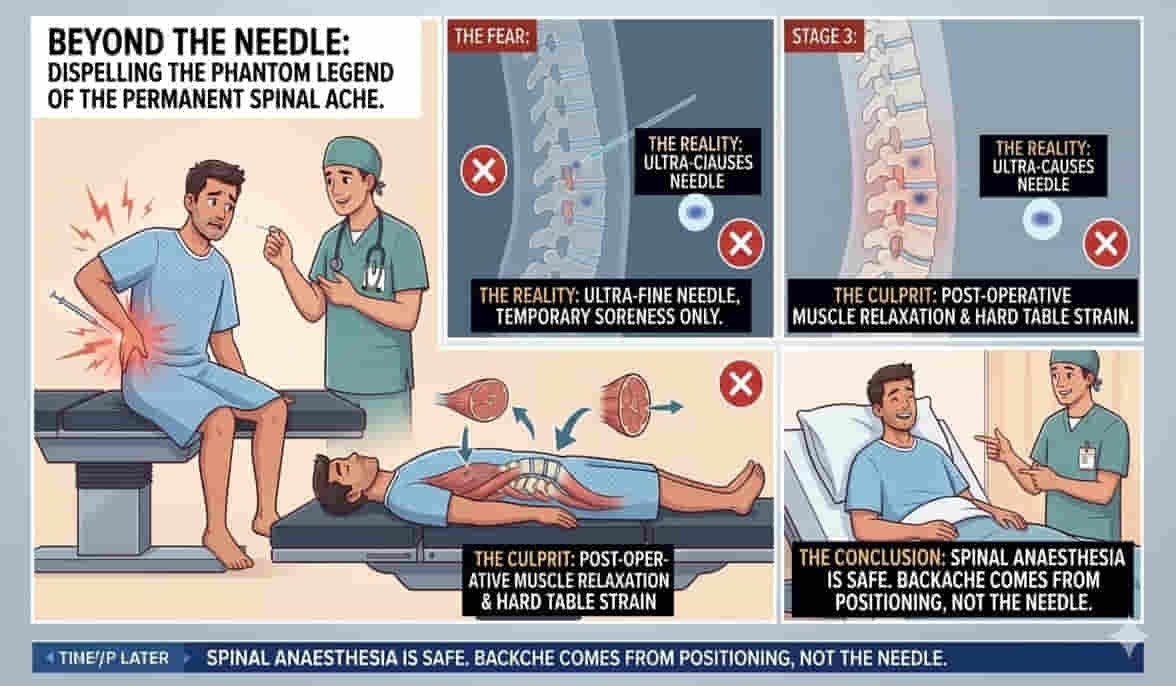
Inside the sterile, fluorescent-lit corridors of the public hospital, an all-too-familiar battle of wills is playing out. A surgical team stands ready, their instruments gleaming under the heavy overhead lamps. On the operating table lies Mr.X, a 34-year-old construction worker whose livelihood depends entirely on the strength of his spine.
The anesthetist steps forward, holding a needle fine as a strand of hair. “We will give you spinal anaesthesia,” the doctor explains gently. “It is the safest path for your surgery.”
Mr.X stiffens, his eyes widening with genuine fear. He shakes his head vigorously, refusing to lie down. “No, sahib,” he pleads. “If you pierce my spine, I will never lift weights again. My family will starve.”
This is the phantom menace haunting operating theatres across the nation. A deeply entrenched, fiercely guarded myth whispers among the working class: a needle to the spine leaves a man broken forever. Driven by this terror, thousands of heavy labourers are refusing spinal anaesthesia, blindly demanding to be put completely under unaware that they are fighting a ghost.
The Phantom Pain
For decades, the blame for post-operative backaches has been pinned squarely on the anesthetist’s needle. It is a logical, yet deeply flawed conclusion. To the untrained mind, a needle in the back must equal pain in the back.
Yet, medical science tells a radically different story. Extensive, large-scale clinical trials have shattered this myth, proving that chronic, long-term backache is entirely unrelated to spinal anaesthesia.
The reality is microscopic. The needles used today are so incredibly thin that they pass through tissue like a whisper. While they may leave a minor, bruising sensation at the injection site for a mere two to three days, they leave absolutely no permanent footprint on the bones, discs, or nerves.
Like the fleeting “spinal headache” a well-known, temporary side effect that vanishes once internal fluid pressures rebalance the localized soreness of a spinal injection is a temporary visitor, not a permanent resident.
The Real Culprit Unmasked
If the needle is innocent, why do so many labourers wake up from surgery clutching their lower backs in agony?
The answer lies not in the medicine, but in the profound vulnerability of the human body under sedation. When a patient is wheeled into the operating room, they are placed on a flat, unforgivingly hard surgical table. As the anaesthetic takes hold, it completely paralyzes and relaxes the paraspinal muscles.
Without those muscles holding the body in alignment, the spine loses its natural, protective curve. For hours, the entire weight of the torso stretches and strains the delicate lumbar ligaments against the hard table.
For a heavy labourer, the operating table is a perfect storm. Their spines are already battlegrounds worn down by years of hoisting cement sacks, lifting iron rods, and enduring daily micro-tears. When you subject that pre-existing strain to hours of unnatural flatness, and follow it with days of immobile post-operative bed rest, the mechanical structure of the back rebels.
In a twist of medical irony, studies reveal that patients who undergo general anaesthesia suffer from post-operative backaches at almost identical rates. The culprit is the position on the table, not the injection in the back.
Breaking the Chains of Fear
By letting this myth dictate their medical choices, labourers are forcing doctors to opt for general anaesthesia, which carries a higher baseline of systemic risks. The tragic irony is stark: in their desperate bid to protect their backs and secure their livelihoods, these vulnerable workers are running away from the safest option available to them.
The needle is not the enemy. The myth is. And until the truth echoes as loudly as the rumor, the ghost in the operating room will continue to rob men of the painless recovery they rightfully deserve.


