
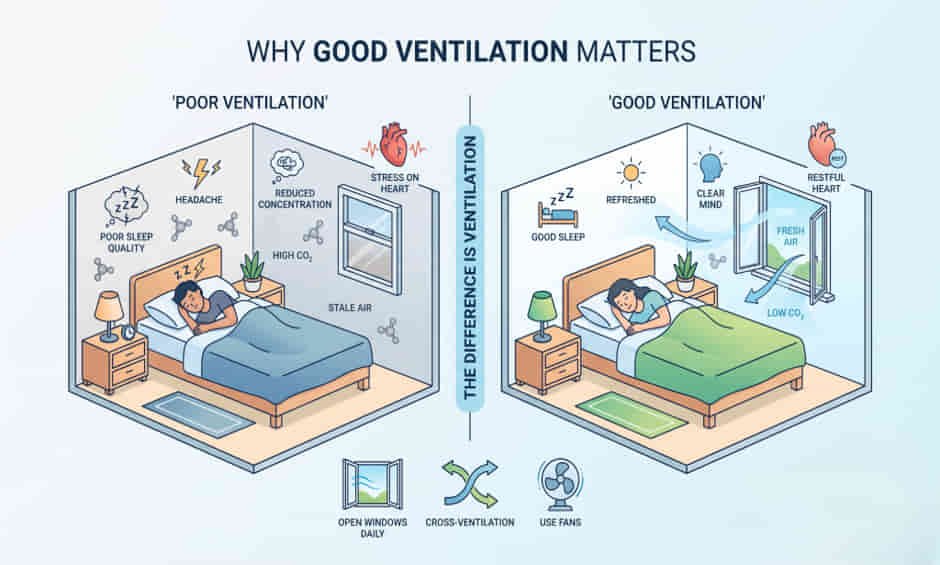
Have you ever walked into a closed room and felt that the air was “heavy”? It may seem like nothing, but your room could be quietly asking for a breath of fresh air. We often worry about pollution outside, from traffic, smoke, and dust, yet we forget that the air inside our homes can sometimes be even more unhealthy. Think of your bedroom as a water bottle. If you keep drinking from it without ever refilling it, sooner or later it runs dry. The same happens with air.
Every breath you take uses fresh oxygen and releases carbon dioxide (CO₂). Without proper ventilation, your room slowly becomes like a crowded bus with all the windows shut. As the saying goes, “Fresh air is nature’s best medicine.” While your body sleeps peacefully, the air around you may silently whisper, “I’m running out of freshness.”
From a biology point of view, every cell in your body needs oxygen to produce energy through a process called cellular respiration. As a by-product, your body releases carbon dioxide, which you breathe out. In a poorly ventilated room, this CO₂ slowly builds up because fresh outdoor air cannot replace the stale indoor air. The levels found in homes are usually not dangerous, but they act like a warning light on a car dashboard, telling you that the room needs better airflow.
Studies have shown that sleeping in such conditions may lead to poorer sleep, morning headaches, tiredness, reduced concentration, and lower mental performance. Some researchers have also observed slight increases in heart rate and changes in heart rate variability, suggesting that the body’s “fight or flight” system may become mildly active instead of allowing the heart to enjoy complete rest. In simple words, your heart may be saying, “I wanted a peaceful night, but I’m still on duty.”
| “Fresh air is the silent partner of good health. We may not see it, but every deep breath reminds us that the simplest things in life often have the greatest power to heal.” |
Many people believe that switching on the air conditioner solves the problem. Ironically, a cool room is not always a healthy room. Most split air conditioners simply recycle the same indoor air instead of bringing in fresh outdoor air. It is like washing the same glass repeatedly without changing the water. The room feels cool, but the air may still be stale. From an environmental science perspective, poor ventilation also allows indoor pollutants such as volatile organic compounds (VOCs), moisture, allergens, and fine particles to accumulate.
These pollutants, together with higher CO₂ levels, can reduce indoor air quality and affect cognitive performance. Good ventilation, through cross-ventilation, mechanical ventilation, or Energy Recovery Ventilators (ERVs), helps dilute these pollutants while maintaining thermal comfort and energy efficiency.
At a more advanced level, ventilation is now recognised as a key component of healthy building design. Researchers no longer see indoor CO₂ merely as a gas, but as a practical indicator of how effectively fresh air is replacing stale air. Although the CO₂ itself at normal indoor levels is unlikely to cause serious harm, it often signals the accumulation of other pollutants that may influence sleep quality, cardiovascular function, cognitive ability, and overall well-being.
Modern ventilation standards therefore focus on maintaining adequate air exchange rates rather than simply controlling room temperature. After all, our homes should behave like healthy lungs, constantly taking in fresh air and breathing out stale air. We spend nearly one-third of our lives sleeping. Giving our bedrooms the gift of fresh air is not a luxury, it is an investment in better health, sharper thinking, and more refreshing sleep.


