
Imagine driving a car where you must constantly press the accelerator and brake every few minutes. If you slow down too much, the engine stalls. If you speed up too much, you risk losing control. That is what living with Type 1 diabetes can often feel like. Every meal, every walk, every stressful moment, and even a good night’s sleep can change blood sugar levels. Millions of people spend their days checking glucose levels, calculating insulin doses, and worrying about sudden highs or dangerous lows. It is like trying to balance on a tightrope while carrying a bucket full of water, one wrong move can upset everything. But what if someone whispered, “Relax, I’ll take over from here.”
That is precisely the promise of the artificial pancreas. Despite its futuristic name, it is not a robotic organ transplanted into the body. Instead, it is an intelligent companion that quietly watches over blood sugar, making hundreds of tiny decisions every day so that people with diabetes don’t have to.
To understand why this technology is so exciting, we first need to appreciate the remarkable job performed by a healthy pancreas. This small organ, tucked behind the stomach, behaves like the body’s master traffic controller. Every time we eat, glucose enters the bloodstream, and the pancreas immediately senses the rise. It then releases insulin, the hormone that tells body cells, “Open your doors; fuel has arrived!” As glucose enters the cells, blood sugar returns to a healthy level.
In people with Type 1 diabetes, however, the body’s immune system mistakenly destroys the insulin-producing beta cells in the pancreas. Without these cells, the body’s natural control system falls silent. Patients must therefore measure their blood sugar several times a day and manually inject insulin. As the saying goes, “Prevention is better than cure,” but in Type 1 diabetes, prevention isn’t possible, careful management becomes the key to living a healthy life.
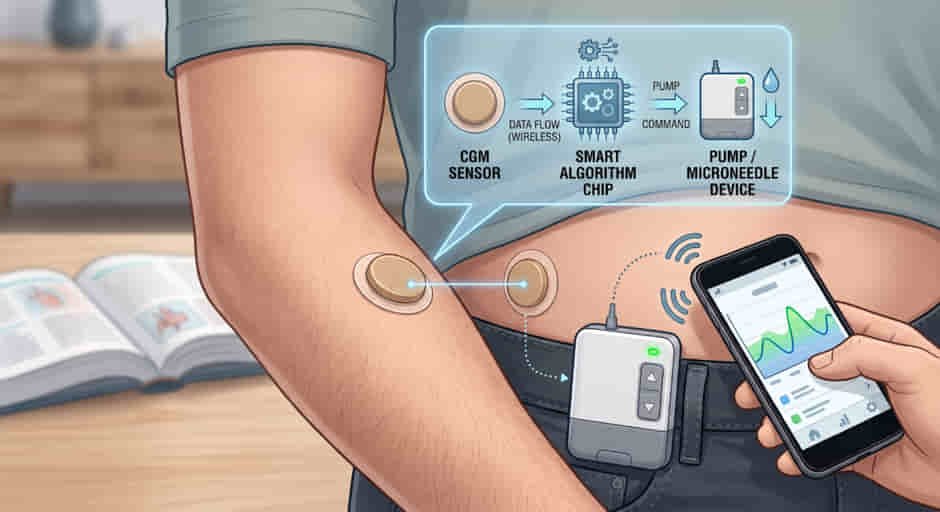
The artificial pancreas recreates this natural feedback loop using three integrated technologies. A Continuous Glucose Monitor (CGM) acts as the system’s eyes, measuring glucose levels every few minutes through a tiny sensor placed beneath the skin. An insulin pump serves as the hands, delivering carefully measured amounts of insulin through a thin tube or patch. The real genius, however, lies in the control algorithm, the system’s brain. Like an experienced orchestra conductor ensuring every instrument plays in harmony, the algorithm continuously analyses glucose readings, predicts future trends, and instructs the pump exactly how much insulin to deliver.
Modern systems use sophisticated closed-loop control algorithms, allowing insulin delivery to adjust automatically with minimal patient intervention. Researchers are also exploring microneedle-based patches, which combine glucose sensing and insulin delivery into a painless, compact device, while another exciting approach, the bioartificial pancreas, encloses living insulin-producing cells inside protective capsules that shield them from immune attack while allowing them to sense glucose and release insulin naturally.
| “The greatest medical breakthroughs don’t always replace the human body — they teach technology to work with it. The smartest machines are those that quietly restore what nature once did effortlessly.” |
From a postgraduate perspective, the artificial pancreas represents the convergence of endocrinology, biomedical engineering, artificial intelligence, control systems engineering, biomaterials science, and regenerative medicine. Current hybrid closed-loop systems employ advanced predictive algorithms, including Model Predictive Control (MPC) and adaptive machine-learning strategies, to minimise both hyperglycaemia and hypoglycaemia while maximising Time in Range (TIR), a key clinical indicator of glucose control. Meanwhile, bioartificial pancreas research focuses on immune-isolating encapsulation technologies, hydrogel biomaterials, stem-cell-derived β-cells, and immune-modulatory coatings designed to restore physiological insulin secretion without lifelong immunosuppression.
Scientists are even investigating dual-hormone systems that deliver both insulin and glucagon, more closely replicating the endocrine function of a healthy pancreas. Although challenges such as device longevity, sensor accuracy, immune compatibility, and long-term safety remain, the trajectory is unmistakable. The artificial pancreas is evolving from a sophisticated insulin delivery device into an intelligent biological partner. In doing so, it brings medicine one step closer to a future where diabetes is managed not by constant human calculation, but by technology that quietly restores the body’s own rhythm, proving once again that the finest innovations are those that make life feel wonderfully ordinary again.


