
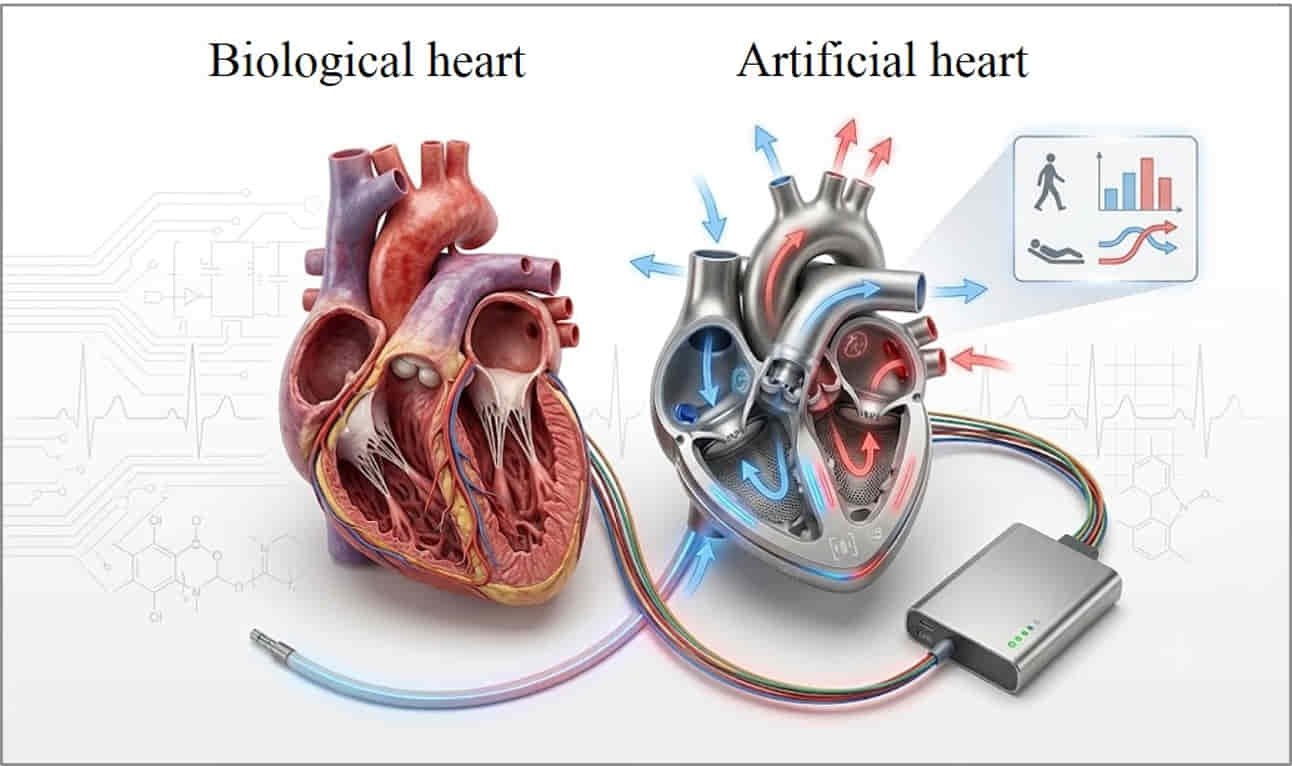
Imagine if a failing heart could be replaced not by another human heart, but by a machine that beats, adapts, and keeps you alive. It may sound like science fiction, but this vision is steadily becoming reality. Every year, thousands of people with end-stage heart failure are placed on transplant waiting lists, hoping that a suitable donor heart will become available before time runs out. Sadly, the demand far exceeds the supply, and many patients never receive the life-saving transplant they need. For decades, scientists and engineers have pursued what many considered the “holy grail” of biomedical engineering, a fully functional artificial heart capable of completely replacing the human heart.
Today, one of the most promising breakthroughs comes from France, where researchers have developed a fully implantable artificial heart designed to do far more than simply pump blood. Like a skilled orchestra conductor responding to every change in the music, this device continuously adjusts its performance to match the body’s ever-changing needs, offering new hope to patients who have run out of options.
To understand why this innovation is so remarkable, it helps to know how the human heart works. The heart is a muscular organ with four chambers that contracts about 100,000 times every day, pumping oxygen-rich blood to every organ in the body. During exercise, climbing stairs, or even emotional stress, the heart automatically beats faster and pumps more blood to meet the body’s increased demand. Earlier artificial heart devices and mechanical pumps could support circulation, but many functioned at relatively fixed speeds and mainly assisted the heart rather than replacing it completely.
The new artificial heart is different. It is designed to replace both the left and right sides of the heart and contains tiny electronic sensors that continuously monitor blood flow and pressure. Think of it as a smart autopilot rather than a simple motor. If the patient starts walking or exercising, the sensors detect the increased demand and automatically boost blood flow. When the person rests or sleeps, the pump slows down, closely mimicking the behaviour of a healthy biological heart instead of operating like a rigid mechanical machine.
From a biomedical engineering perspective, the device represents a sophisticated integration of mechanical engineering, biomaterials science, sensor technology, and physiological control systems. The artificial heart uses biocompatible materials, reducing the likelihood of adverse immune reactions and minimizing damage to blood cells during circulation. Embedded pressure and flow sensors continuously collect physiological data, while onboard control algorithms dynamically adjust pump output to maintain cardiac output appropriate for the patient’s metabolic requirements.
Unlike ventricular assist devices (VADs), which support only one weakened ventricle, this Total Artificial Heart (TAH) replaces the entire pumping function of both ventricles. Power is supplied through an external battery connected via a percutaneous driveline, allowing continuous operation for extended periods while patients perform many normal daily activities. Although carrying an external power source remains a limitation, advances in battery technology and energy efficiency continue to improve patient mobility and quality of life.
| “The heart is more than a pump — it is the rhythm that keeps life in motion. When nature cannot provide a second chance, human ingenuity strives to build one.” |
At the postgraduate level, this innovation highlights the growing convergence of systems physiology, biomechanics, computational control, and regenerative medicine. One of the greatest challenges in artificial heart design is not generating sufficient blood flow but reproducing the remarkable adaptability of the native heart while minimizing complications such as thromboembolism, haemolysis, infection, device wear, and mechanical failure. Modern artificial hearts therefore employ sophisticated closed-loop physiological control systems, enabling real-time modulation of pump performance in response to changing preload, afterload, and metabolic demand.
Ongoing clinical trials are evaluating long-term durability, biocompatibility, and patient survival while researchers work to develop wireless energy transfer systems, eliminate transcutaneous cables, and incorporate advanced biomaterials that further reduce clot formation. Although donor heart transplantation remains the gold standard for many patients, artificial hearts are rapidly evolving from temporary “bridge-to-transplant” devices into potential destination therapies. If these technologies continue to prove safe and effective, they could fundamentally transform the treatment of heart failure, ensuring that a patient’s chance of survival is determined not by the availability of a donor organ, but by the remarkable union of engineering and medicine.


