
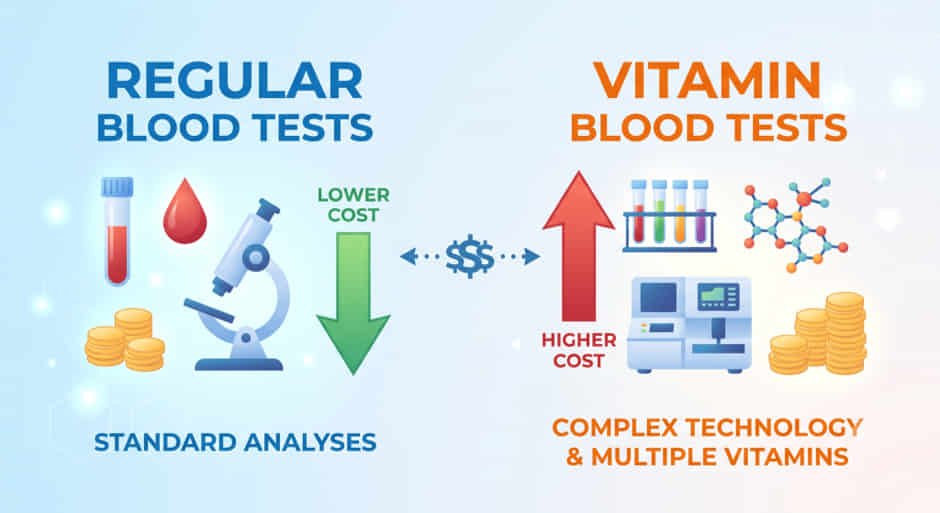
If you’ve ever compared the prices of blood tests, you may have noticed something curious. A simple blood sugar or cholesterol test is often quite affordable, while tests for vitamin D, vitamin B12, or folate can cost several times more. At first glance, this seems puzzling. After all, the laboratory draws the same small tube of blood, so why should one test cost so much more than another? The answer lies in what scientists are looking for. Imagine trying to spot a lighthouse on a sunny afternoon versus trying to find a single glowing firefly in a vast forest at night.
Measuring blood sugar is like spotting the lighthouse, glucose is present in relatively large amounts and is easy to detect. Measuring vitamins, however, is like finding the tiny firefly. They exist in minute concentrations, and detecting them accurately requires far more sophisticated technology, careful laboratory procedures, and highly trained experts. In other words, you’re not paying for the blood sample, you’re paying for the extraordinary precision needed to read its hidden chemical story.
Routine blood tests are designed to measure substances that are naturally abundant in the bloodstream. Glucose, cholesterol, triglycerides, and many electrolytes are present in concentrations that standard laboratory analyzers can detect quickly and reliably. These automated machines process hundreds to thousands of samples every day, much like a high-speed supermarket barcode scanner rapidly identifying products. Vitamin molecules are different. They occur in tiny quantities, often measured in nanograms or picograms per milliliter, amounts so small they are equivalent to finding a pinch of salt dissolved in an Olympic-sized swimming pool.
Detecting such minute levels requires highly sensitive laboratory methods. Many vitamin tests rely on immunoassays, where specially designed antibodies recognize and bind only to the vitamin of interest, much like a lock accepting only its matching key. Other vitamins are measured using liquid chromatography–tandem mass spectrometry (LC-MS/MS), one of the most advanced analytical techniques available in modern clinical laboratories. These technologies are significantly more complex, expensive, and time-consuming than the instruments used for routine blood chemistry.
| “The true value of a test lies not in the drop of blood it uses, but in the precision with which it uncovers the invisible. In science, finding a needle in a haystack is often far more challenging than counting the hay.” |
From a laboratory science perspective, vitamin analysis presents additional analytical challenges. Vitamins often exist in multiple chemical forms, can degrade when exposed to light, heat, or prolonged storage, and are present within a complex mixture of proteins, fats, and other molecules circulating in blood. Before analysis, many samples require careful preparation, including protein precipitation, extraction, purification, or derivatization, to isolate the vitamin from interfering substances.
In LC-MS/MS, compounds are first separated by liquid chromatography, then identified and quantified based on their unique mass-to-charge (m/z) ratios inside a mass spectrometer. This process provides exceptional sensitivity and specificity but demands costly instrumentation, specialized maintenance, expensive calibration materials, and highly trained clinical laboratory scientists. Unlike routine glucose analyzers that can continuously process hundreds of samples per hour, vitamin assays generally require more technical expertise and longer processing times.
At the postgraduate level, the higher cost also reflects the rigorous demands of analytical quality assurance. Clinical laboratories must ensure that every vitamin measurement meets strict standards for accuracy, precision, sensitivity, specificity, reproducibility, and traceability. Instruments are regularly calibrated using certified reference materials, internal quality-control samples are analyzed with every batch, and laboratories participate in external quality assessment (EQA) programs to verify that their results agree with those of other accredited laboratories worldwide. Furthermore, vitamin tests are ordered far less frequently than routine blood counts or glucose tests, meaning laboratories cannot spread the cost of advanced equipment across millions of daily analyses.
Consequently, each individual test carries a greater share of the operational expense. As the saying goes, “precision comes at a price.” The higher cost of vitamin testing is therefore not a reflection of drawing more blood, but of the remarkable scientific effort required to accurately measure some of the smallest yet most biologically important molecules circulating in the human body.


