
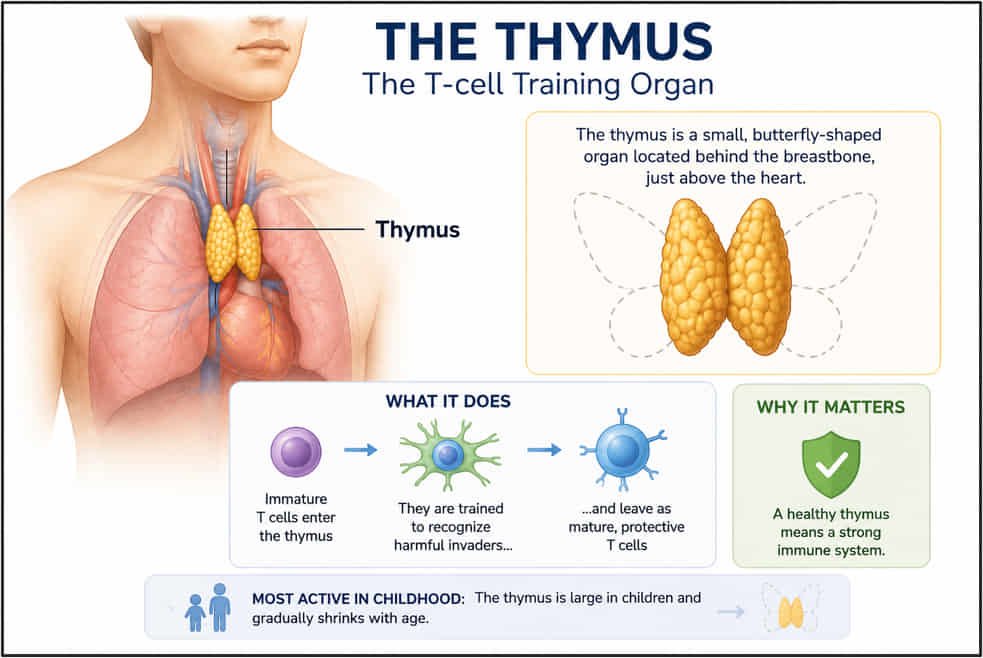
If you’ve ever heard the saying “don’t judge a book by its cover,” the thymus is living proof. Tucked quietly just above the heart, this small, butterfly-shaped organ spent centuries hiding in plain sight. Because it is large in children but shrinks dramatically after puberty, scientists once believed it was little more than an evolutionary leftover, a biological relic that had outlived its usefulness. Like an old factory assumed to be abandoned, the thymus was thought to have closed its doors long ago. Yet appearances can be deceiving. Today, this once-dismissed organ has emerged as one of the immune system’s greatest hidden heroes, with scientists now exploring whether it could help not only fight disease but also slow certain aspects of biological aging. The organ that was once forgotten may now be taking center stage in one of medicine’s most exciting stories.
For decades, researchers focused on better-known immune organs such as the bone marrow, spleen, and lymph nodes, while the shrinking thymus was largely ignored. That changed dramatically in the 1960s, when pioneering immunologists discovered that the thymus is the “training academy” of T lymphocytes, or T cells, the immune system’s elite soldiers. Every immature T cell enters the thymus much like a recruit entering a military academy. Here, it undergoes rigorous training, learning to distinguish dangerous invaders such as viruses, bacteria, and cancer cells from the body’s own healthy tissues. Only the best-trained cells graduate. Some become helper T cells, which coordinate immune responses, while others become killer T cells, which hunt down infected or cancerous cells. Without this training, the immune system would either fail to fight infections or mistakenly attack the body’s own organs. Overnight, the thymus went from being biology’s forgotten organ to one of the most important architects of adaptive immunity.
But the thymus still had another surprise waiting in the wings. Scientists began asking a bold question: What if the shrinking thymus isn’t just a sign of aging, but one of its causes? The idea sounded almost like science fiction. In 1996, cryobiologist Gregory Fahy became convinced that restoring thymus function might strengthen the immune system and promote healthier aging. Inspired by promising animal studies, he began exploring whether growth hormone could regenerate the aging thymus. At the time, many researchers considered the idea a long shot. Yet, as the saying goes, “fortune favors the bold.” What started as an unconventional hypothesis gradually inspired years of research into whether reviving this tiny organ could improve human health. Scientists now recognize that the thymus doesn’t simply disappear after childhood, it continues producing new T cells throughout adulthood, although at a much slower pace. Preserving this function could help the immune system remain younger and more resilient for longer.
Recent research published in Nature journals has given this idea an exciting boost. Using artificial intelligence, scientists analyzed routine CT scans from 3,476 cancer patients receiving immunotherapy and developed a “thymic health” score to estimate how well each patient’s thymus was functioning. The findings were striking. Patients with healthier thymuses responded better to immunotherapy, experienced slower cancer progression, and lived longer, even when traditional cancer biomarkers predicted otherwise. They also possessed a richer diversity of T cells and stronger immune activity, suggesting that the adult thymus continues to influence health far more than previously believed. While these findings still require further clinical validation, they hint at a future in which doctors may evaluate not only a tumor but also the health of a patient’s thymus before choosing treatment. More broadly, the research reminds us that big discoveries often come in small packages. Once dismissed as a fading organ, the thymus is now emerging as a potential key to precision medicine, healthier aging, and perhaps one day, extending our years of healthy life.
Reference:
Bernatz S. et al. Thymic health and immunotherapy outcomes in patients with cancer. Nature (2026).


