
You’re sitting outdoors with a group of friends on a pleasant evening. By the time everyone heads home, you have half a dozen itchy mosquito bites while everyone else seems perfectly fine. It may feel as though mosquitoes have declared you the evening’s buffet, but is that really what’s happening?
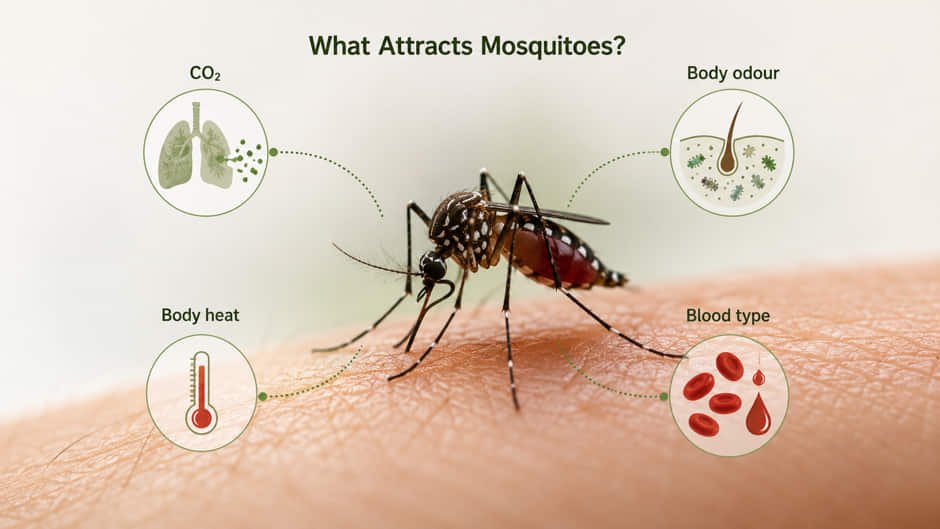
Surprisingly, yes. Female mosquitoes, which need blood to produce eggs, are remarkably skilled at finding certain people. They don’t simply bite at random; instead, they follow a trail of clues, almost like detectives tracking down a suspect. The first clue is carbon dioxide (CO₂). Every time you exhale, you release a cloud of CO₂ into the air. Mosquitoes can detect this gas from several metres away, using it as a sign that a potential meal is nearby. People who naturally produce more carbon dioxide, such as taller adults, pregnant women, or those who have just exercised, often attract more mosquitoes because they release larger amounts of this invisible signal.
Once mosquitoes fly closer, they switch from following CO₂ to analysing your unique body odour. Although we may all smell “normal” to ourselves, our skin carries millions of harmless bacteria that break down sweat into hundreds of different chemicals. Think of these bacteria as tiny perfume makers, creating a scent that is unique to each person. Some of these chemicals, including lactic acid, ammonia, and carboxylic acids, are especially attractive to many mosquito species. This is one of the main reasons why some people are bitten far more often than others.
Body temperature also plays a role. Warm skin is easier for mosquitoes to detect, so people who have been jogging, exercising, or simply have naturally warmer skin may stand out more clearly. Increased blood flow near the skin’s surface can make the target even easier to find.
What about blood type? You’ve probably heard that mosquitoes love people with Type O blood. Some studies do suggest that individuals with Type O receive slightly more bites than those with Type A or B. However, scientists believe this effect is much smaller than the influence of body odour, carbon dioxide, and body heat.
Can you make yourself less attractive to mosquitoes? You can’t change your genes or your natural body chemistry, but you can make it harder for mosquitoes to find you. Wearing long-sleeved clothing, using EPA-approved insect repellents, removing standing water where mosquitoes breed, and sleeping under mosquito nets or using window screens are among the most effective ways to reduce bites.
So, the next time mosquitoes seem to single you out, don’t blame “sweet blood.” They’re responding to an invisible combination of the carbon dioxide you exhale, the chemicals produced by your skin, your body temperature, and even the microscopic organisms living harmlessly on your body. To a mosquito, you’re not unlucky, you’re simply giving off the strongest signals.


