
Losing a permanent tooth has always seemed like a one-way journey. Unlike a lizard that can regrow its tail or a shark that continuously replaces its teeth, humans get only two sets of teeth in a lifetime. Once an adult tooth is lost, it never grows back naturally. For decades, dentists have relied on implants, bridges, and dentures to restore missing teeth. These treatments work remarkably well, but they are still artificial replacements rather than living teeth.
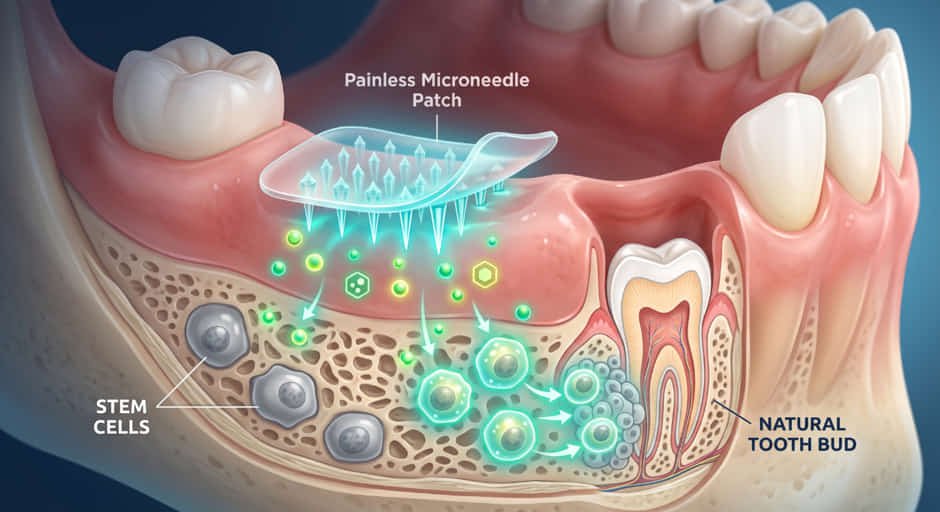
Now imagine visiting the dentist one day and, instead of receiving an implant, being given a tiny patch that encourages your body to grow a brand-new tooth. It may sound like science fiction, but researchers in South Korea are working to make this idea a reality. Their latest innovation is a painless microneedle patch. At first glance, it looks like an ordinary patch, but its surface is covered with microscopic needles so tiny that they can deliver medicine into the gums with little or no discomfort. Think of it as a highly targeted delivery service. Rather than drilling into the jaw or placing an artificial tooth, the patch delivers biological molecules precisely where they are needed.
The real magic lies in what these molecules do. They awaken the body’s own stem cells, remarkable cells that can transform into many different types of tissues. You can think of stem cells as blank pages waiting for instructions. When they receive the right biological signals, they can begin building specialised tissues. In this case, researchers hope to persuade them to recreate the complex structures needed to form a natural tooth. Interestingly, scientists are borrowing ideas from nature itself. Before birth, our teeth develop through a carefully coordinated series of biological signals, much like following a detailed architectural blueprint to construct a building. Researchers are attempting to recreate some of these same developmental instructions so that the body can rebuild what was once thought impossible.
This represents a major shift in dentistry. Today’s treatments mainly focus on repairing or replacing damaged teeth. Fillings seal cavities, crowns protect weakened teeth, and implants replace missing ones. These procedures have transformed dental care and remain highly successful, but none of them actually encourage the body to regenerate a living tooth.
The idea of helping the body repair itself is part of a rapidly growing field called regenerative medicine. Similar strategies are already being explored to repair damaged skin, regrow cartilage after injuries, and even restore tissues in organs such as the heart and liver.
Although tooth regeneration is still in the research stage and will require years of testing before it reaches dental clinics, it offers an exciting glimpse into the future. One day, losing a tooth might not mean replacing it with an artificial one, it could simply mean giving your body the tools it needs to grow a new one.


