
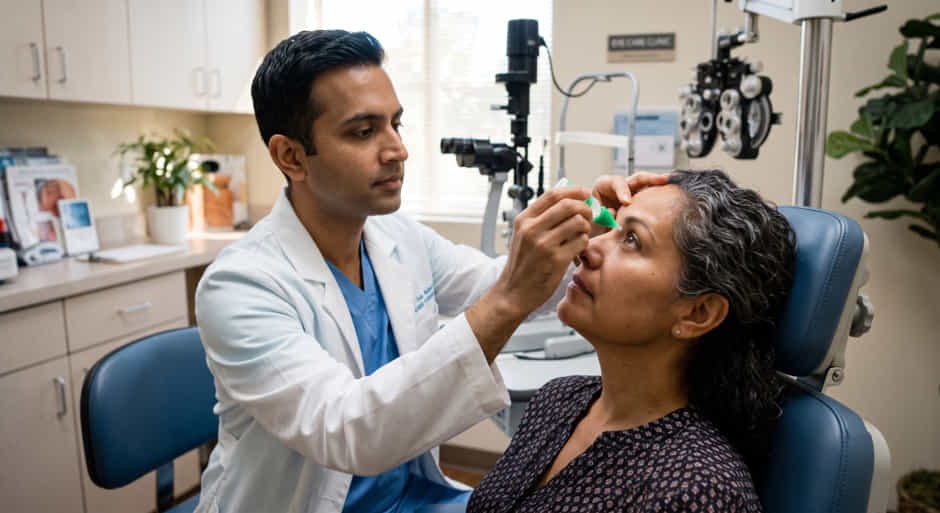
Imagine waking up, putting a few drops into your eyes, and reading a text message or a restaurant menu without reaching for your reading glasses. It sounds like something from a science-fiction movie, but it’s becoming a reality for many people with presbyopia, the age-related difficulty in seeing nearby objects that usually begins after the age of 40.
Several prescription eye drops for presbyopia have already been approved in some countries, and researchers are developing newer versions that may last longer and work for more people.
To understand how these drops work, it helps to know why presbyopia happens in the first place. Inside each eye is a transparent, flexible lens that changes shape to focus on objects at different distances. Think of it as the autofocus system in a camera. When you’re young, the lens easily adjusts to bring nearby words or objects into sharp focus. But as we age, the lens gradually becomes stiffer and less flexible. It struggles to change shape, making close-up tasks such as reading a book, sewing, or checking a phone screen more difficult.
Interestingly, most of these eye drops don’t actually make the lens flexible again. Instead, they use a clever optical trick called the pinhole effect.
Have you ever looked through a tiny hole in a piece of paper and noticed that blurry objects suddenly appear sharper? That’s because a smaller opening blocks scattered light rays and allows only the most focused rays to enter the eye. These eye drops work in a similar way by slightly shrinking the pupil. The smaller pupil increases the depth of focus, allowing nearby objects to appear clearer while usually preserving good distance vision.
The effect often begins within minutes and typically lasts for several hours, depending on the medication. For many people, this can be enough to comfortably read, use a computer, browse a smartphone, or enjoy hobbies without constantly switching to reading glasses.
However, these drops are not a cure for poor eyesight. They mainly help people with presbyopia and do not correct conditions such as myopia (short-sightedness), hyperopia (long-sightedness), or astigmatism. Like any medication, they can also cause side effects, including headaches, temporary eye irritation, or difficulty seeing in dim light because smaller pupils allow less light into the eye.
So, can eye drops replace your glasses? For some people and for certain situations, they certainly can, but only temporarily. They don’t reverse ageing or permanently restore the eye’s natural focusing ability. Even so, these medications represent an exciting advance in vision care, offering millions of people another option for managing age-related changes without surgery. Sometimes, a few tiny drops really can make a big difference, just not in the magical way the headlines might suggest.


