
At first, it sounds impossible. How can one baby have DNA from three different people? Is it science fiction? A cloning experiment? Or something straight out of a movie?
The truth is even more fascinating. It’s a medical technique designed not to create “three-parent babies,” but to prevent children from inheriting devastating genetic diseases. To understand how it works, imagine every cell in your body as a tiny city. Like every city, it needs a power station to keep everything running. Those power stations are called mitochondria. They generate the energy that powers our muscles, brain, heart, and other organs.
Mitochondria are unusual because they carry their own small set of DNA, known as mitochondrial DNA (mtDNA). Unlike the DNA stored in the cell’s nucleus, mitochondrial DNA is inherited only from the mother. If a mother carries harmful mutations in her mitochondrial DNA, she can unknowingly pass them to her children. The consequences can be severe. Since organs such as the brain, heart, muscles, and liver need enormous amounts of energy, faulty mitochondria can lead to serious, life-threatening disorders. Unfortunately, many mitochondrial diseases still have no cure.
So, how can doctors stop these diseases from being passed on?
The answer is Mitochondrial Replacement Therapy (MRT), a highly specialized form of in vitro fertilization (IVF).
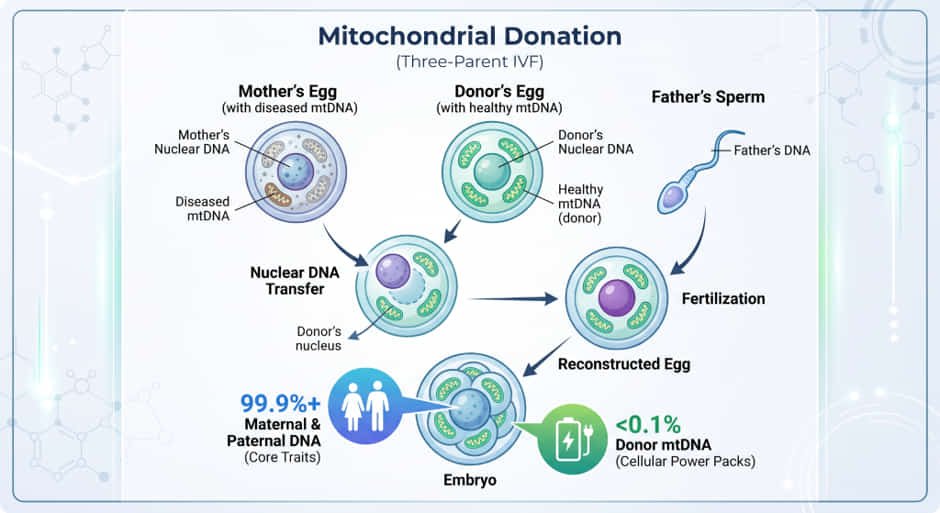
During the procedure, doctors remove the nuclear DNA from the mother’s egg. This DNA contains almost all the genetic information that determines characteristics such as eye colour, height, facial features, and countless other inherited traits. They then place this nuclear DNA into a donor egg that contains healthy mitochondria but has had its own nuclear DNA removed. Finally, the reconstructed egg is fertilized with the father’s sperm.
The resulting embryo receives more than 99.9% of its DNA from its biological mother and father. Less than 0.1% comes from the donor, and that tiny contribution consists only of healthy mitochondrial DNA, the cell’s energy-producing machinery. The donor does not contribute the genes that shape a child’s appearance, personality, or identity.
This breakthrough is the result of decades of research by scientists including Dr. Mary Herbert, Dr. Doug Turnbull, Dr. Shoukhrat Mitalipov, and Dr. John Zhang. It offers hope to families affected by inherited mitochondrial diseases, giving them the chance to have genetically related children while greatly reducing the risk of passing on these devastating conditions.
Like many advances in genetics, MRT also raises important ethical and regulatory questions. Yet it represents a remarkable shift in modern medicine, from treating disease after it appears to preventing it before a child is even born. As the saying goes, “A stitch in time saves nine.” In this case, replacing less than one-tenth of one percent of a baby’s DNA may prevent a lifetime of suffering, proving that sometimes the smallest genetic change can make the biggest difference.


