
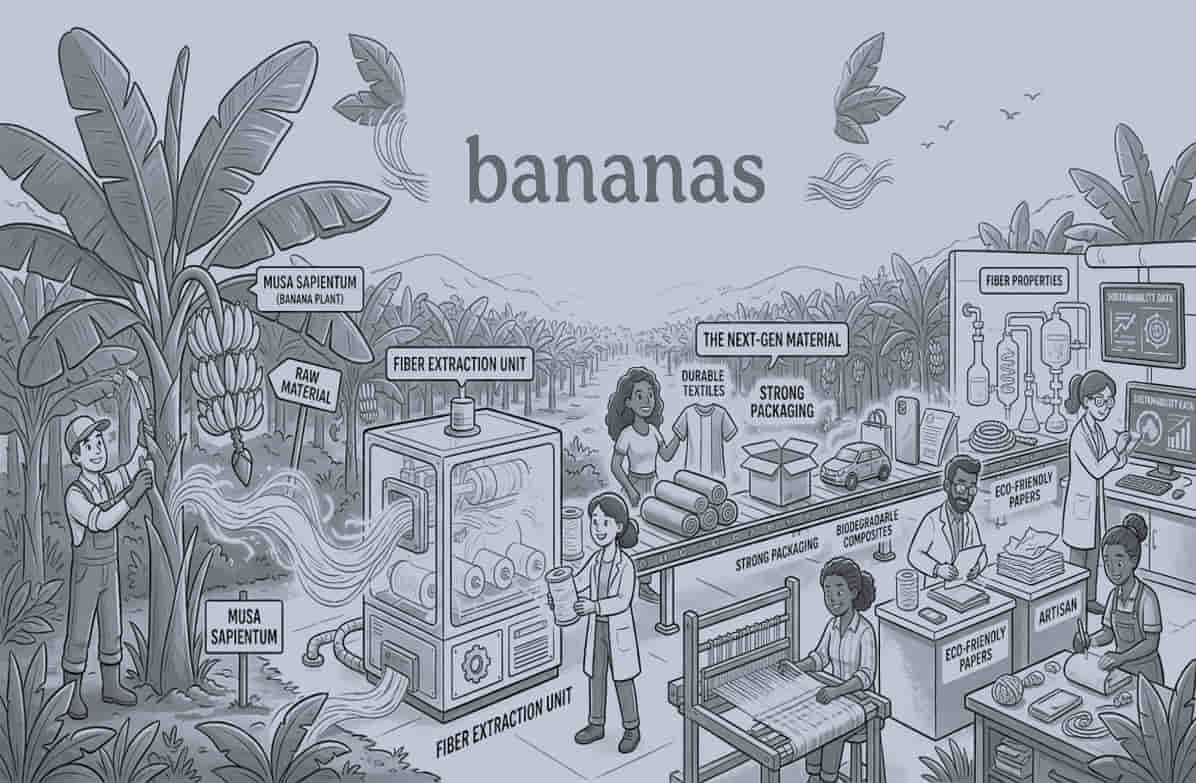
Every year, after harvesting bananas, farmers chop down the plant and move on to the next crop. What remains is the pseudostem, the thick, trunk-like structure that looks like a tree trunk but isn’t one. For decades, this bulky leftover has been treated as little more than farm waste, often left to rot or burned in the fields. But here’s the twist: this “trash” is actually hiding a treasure. Inside the pseudostem are incredibly strong natural fibers, much like finding valuable threads woven into what appears to be an ordinary rope. As the old saying goes, “One person’s trash is another person’s treasure.” Scientists, engineers, and designers are now giving this overlooked material a second chance, discovering that banana fiber is tough, lightweight, biodegradable, and surprisingly versatile. Instead of ending its journey in a pile of agricultural waste, the humble banana plant is beginning a remarkable second life, one that could reshape industries ranging from fashion to construction and even aerospace.
For centuries, banana fiber has quietly been woven into traditional textiles in countries such as India and Japan. Today, however, it is stepping onto the global stage as a sustainable alternative to conventional fabrics and even leather. Think of it as the underdog finally getting its moment in the spotlight. Fashion brands are transforming banana fiber into sturdy fabrics for handbags, shoes, home décor, and clothing that are both durable and breathable. Unlike cotton, which requires large amounts of farmland, irrigation, and pesticides, banana fiber comes from a part of the plant that would otherwise be discarded. In other words, it is recycling at nature’s own workshop. Every bag or fabric made from banana fiber means less agricultural waste and fewer synthetic materials ending up in landfills. It’s a classic case of “making silk from straw,” turning something ordinary into something valuable without demanding extra natural resources.
The story doesn’t end with fashion. Builders and engineers are discovering that banana fiber is much more than a pretty fabric, it can also strengthen construction materials. Mixed into eco-friendly composite boards or even certain types of concrete, the fibers act much like the steel rods hidden inside reinforced concrete, helping improve strength while keeping the material lightweight. These composite panels also provide natural insulation against heat and noise, making homes more comfortable and energy-efficient. At the same time, using banana fiber reduces the need to burn leftover pseudostems in fields, a practice that releases smoke and air pollutants. Even the automobile industry has joined the journey. Manufacturers are exploring banana-fiber composites for car interiors such as door panels, dashboards, and trims because every kilogram shaved off a vehicle helps improve fuel efficiency and reduce emissions. It’s the familiar idea that “every little bit counts,” and lighter vehicles can make a meaningful difference over millions of kilometres on the road.
Perhaps the most fascinating chapter is still being written. Researchers are investigating whether banana fiber could one day contribute to aerospace materials, where every gram matters. While no banana-fiber component has flown into space yet, scientists are studying natural-fiber composites as lightweight fillers and insulating materials because they combine low weight with good mechanical properties and are kinder to the environment than many synthetic alternatives. Whether or not banana fiber eventually reaches orbit, its journey from farm waste to advanced materials is already extraordinary. Few materials can honestly claim to travel from a banana field to a designer handbag, a modern building, a car, and perhaps someday even a spacecraft. It is a powerful reminder that innovation doesn’t always begin in a high-tech laboratory. Sometimes, the next big breakthrough is hiding in plain sight, waiting for someone to look at yesterday’s waste with tomorrow’s imagination.


