
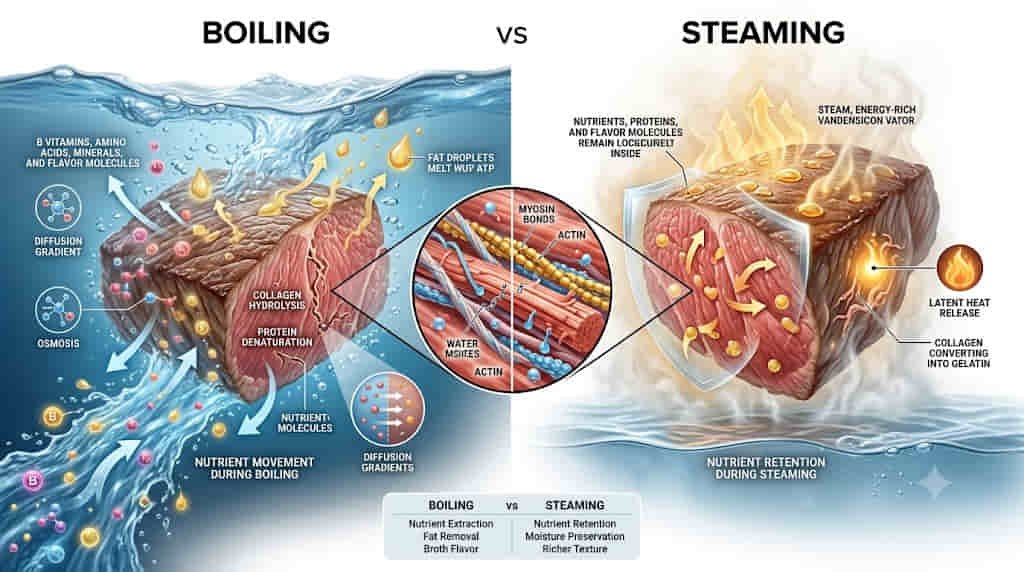
Every time you place a piece of meat into a pot, an invisible battle begins, one that no kitchen camera can capture. To the naked eye, it may seem as though the meat is simply cooking, but beneath the surface, billions of molecules are locked in a fierce tug-of-war. Imagine boiling water as a rushing river and steam as a silent warrior. Both fight the same battle at 100°C, yet each follows a completely different strategy. The boiling water shouts, “Come with me!”, pulling flavours, vitamins, and juices into the surrounding broth. Steam, on the other hand, whispers, “Stay where you belong,” protecting much of the meat’s natural goodness.
As the old proverb says, “Different roads lead to different destinations.” Likewise, boiling and steaming may cook the same meat, but they create two remarkably different dishes. In the kitchen, heat is not merely cooking, it is negotiating with chemistry.
The secret lies in how heat travels. Water and steam may share the same temperature, but they do not carry the same amount of energy. When liquid water boils, it transfers sensible heat, warming the meat gradually through conduction and convection. Steam, however, carries an additional reserve called the latent heat of vaporization. Think of steam as a delivery truck loaded with hidden cargo. The moment it touches the cooler meat, it condenses back into water and unloads this stored energy almost instantly.
This makes steaming surprisingly efficient despite operating at the same temperature as boiling. At the same time, the surrounding environment changes the chemistry of the food. During boiling, the meat is immersed in water, allowing diffusion and osmosis to act like eager shopkeepers, pulling water-soluble vitamins, minerals, amino acids, glutamate, and flavour compounds into the cooking liquid. During steaming, there is no large pool of water to steal these nutrients. The meat keeps most of its natural chemical treasure safely locked inside.
At the molecular level, the real drama unfolds within the proteins. Muscle proteins such as myosin begin to denature at around 50-55°C, while actin follows at approximately 66-70°C. Denaturation is rather like unravelling a tightly knitted sweater, once the threads loosen, the original structure can never fully return. As these proteins contract, they squeeze water from the muscle fibres. If boiling is too vigorous or prolonged, excessive protein coagulation may leave the meat dry and rubbery.
Meanwhile, collagen, the tough connective tissue that makes inexpensive cuts chewy, slowly undergoes hydrolysis, breaking down into soft gelatin in the presence of prolonged heat and moisture. This is why boiling remains the preferred method for preparing soups, curries, and slow-cooked stews. Interestingly, neither boiling nor steaming produces the rich brown crust associated with grilled meat because both methods remain limited to 100°C. The celebrated Maillard reaction, responsible for roasted flavours and golden-brown colour, demands temperatures above 140°C and a relatively dry surface.
| “Cooking is chemistry dressed as comfort food. Every meal is a silent conversation between heat and molecules, where the smallest reactions create the biggest flavours.” |
From an advanced biochemical perspective, boiling and steaming represent two fundamentally different mass-transfer systems. Boiling creates a large external solvent that establishes concentration gradients, promoting the diffusion of water-soluble micronutrients, peptides, nucleotides, and flavour molecules into the cooking medium. Steaming largely eliminates this solvent-driven extraction, preserving intracellular solutes while delivering heat primarily through latent heat released during condensation.
Summary of Chemical Mechanisms:
| Chemical Property | Steaming Meat | Boiling Meat |
| Dominant Heat Mechanism | Latent heat of vaporization via condensation | Sensible heat via liquid convection |
| Mass Transfer (Leaching) | Minimised; nutrients and flavor molecules stay locked inside | Maximised; water-soluble solutes diffuse into the water |
| Collagen Hydrolysis | Slower; limited by surface moisture availability | Faster; accelerated by continuous solvent submersion |
| Lipid Behavior | Melts but remains largely bound to the meat matrix | Melts and separates into the surrounding liquid |
Lipid behaviour also differs significantly. During boiling, melted triacylglycerols separate from the meat and float to the surface, allowing visible fat removal. In steaming, the liquefied lipids largely remain associated with the muscle fibres, contributing to improved mouthfeel without additional cooking fat. Neither technique is universally superior, they simply serve different culinary purposes. If the goal is a nutrient-rich soup or tender braised meat, boiling is the wiser choice because the escaped nutrients enrich the broth. If the aim is to preserve the meat’s natural flavour, vitamins, and texture, steaming takes the crown. After all, the kitchen is not merely a place where food is cooked, it is a laboratory where every pot performs an elegant experiment in biochemistry.


