
When most of us think of Vitamin C, the first things that come to mind are oranges, immunity, and keeping the common cold at bay. But this humble vitamin is far more than just the body’s “cold fighter.” Imagine your brain as a bustling city that never sleeps, with billions of nerve cells constantly sending messages like speeding trains on an endless railway network. To keep this city running smoothly, every signal must arrive on time and every station must remain in good condition.
Vitamin C works like an unsung maintenance engineer, quietly repairing damage, protecting delicate machinery, and ensuring that communication never breaks down. It rarely steals the spotlight, yet without it, the brain’s performance could gradually suffer. As the old saying goes, “An ounce of prevention is worth a pound of cure.” In many ways, Vitamin C exemplifies this wisdom by helping protect the brain long before problems become visible.
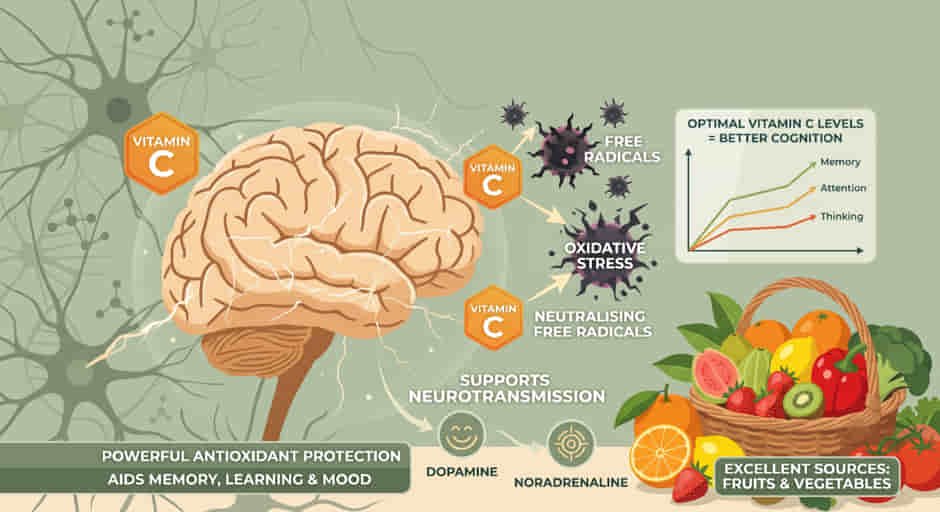
Your brain accounts for only about 2% of your body weight, yet it consumes nearly 20% of the body’s energy, making it one of the most metabolically active organs. Naturally, such intense activity produces waste products called free radicals, unstable molecules that behave like tiny sparks flying from a busy factory. Left unchecked, these sparks can damage the brain’s cells through a process known as oxidative stress. Fortunately, Vitamin C steps in like a dedicated firefighter, neutralising these harmful molecules before they can cause lasting harm. But its role doesn’t end there.
It also helps produce important neurotransmitters, including dopamine and noradrenaline, the brain’s chemical messengers. If these molecules could speak, they might say, “We’re the postal service of your nervous system, carrying messages that help you think, learn, remember, concentrate, and even feel happy.” Without adequate Vitamin C, this communication network may not function as efficiently as it should.
| “A healthy brain is not built by grand miracles but by countless small choices made every day. Sometimes, the simplest nutrients become the quiet guardians of our greatest thoughts.” |
From a biological perspective, Vitamin C, or ascorbic acid, is one of the brain’s most abundant antioxidants, with concentrations in certain brain regions exceeding those found in many other organs. It actively participates in maintaining redox homeostasis, protecting neurons from oxidative injury caused by highly reactive oxygen species (ROS). Beyond its antioxidant role, Vitamin C serves as an essential cofactor for enzymes involved in the biosynthesis of catecholamine neurotransmitters, particularly the conversion of dopamine into noradrenaline by dopamine β-hydroxylase.
It also contributes to collagen synthesis, helping maintain the integrity of cerebral blood vessels and the blood-brain barrier, which acts as the brain’s highly selective security checkpoint. Recent observational studies have reported that individuals with adequate Vitamin C status often perform better on assessments of memory, attention, executive function, and cognitive processing speed. Although these findings demonstrate an association rather than direct causation, they strengthen the growing evidence that optimal nutritional status contributes to healthy brain ageing.
At the postgraduate level, Vitamin C emerges as a multifunctional neuromodulator with implications extending beyond simple antioxidant defence. Neurons actively accumulate ascorbate through the Sodium-dependent Vitamin C Transporter 2 (SVCT2), enabling intracellular concentrations far higher than those found in plasma. Within the central nervous system, Vitamin C regulates glutamatergic neurotransmission, modulates N-methyl-D-aspartate (NMDA) receptor activity, supports mitochondrial bioenergetics, and helps preserve synaptic plasticity by limiting oxidative damage to neuronal membranes and proteins.
Experimental studies further suggest roles in epigenetic regulation through TET dioxygenases involved in DNA demethylation, linking Vitamin C to neuronal differentiation and gene expression. Researchers are also investigating whether maintaining adequate Vitamin C status may reduce the progression of neurodegenerative disorders such as Alzheimer’s and Parkinson’s disease by mitigating chronic oxidative stress and neuroinflammation. While Vitamin C is not a cure for these conditions, it illustrates a profound truth in biology: the health of the mind begins long before disease appears. After all, the brain may be the body’s command centre, but even the greatest commander depends on a reliable supply line.


