
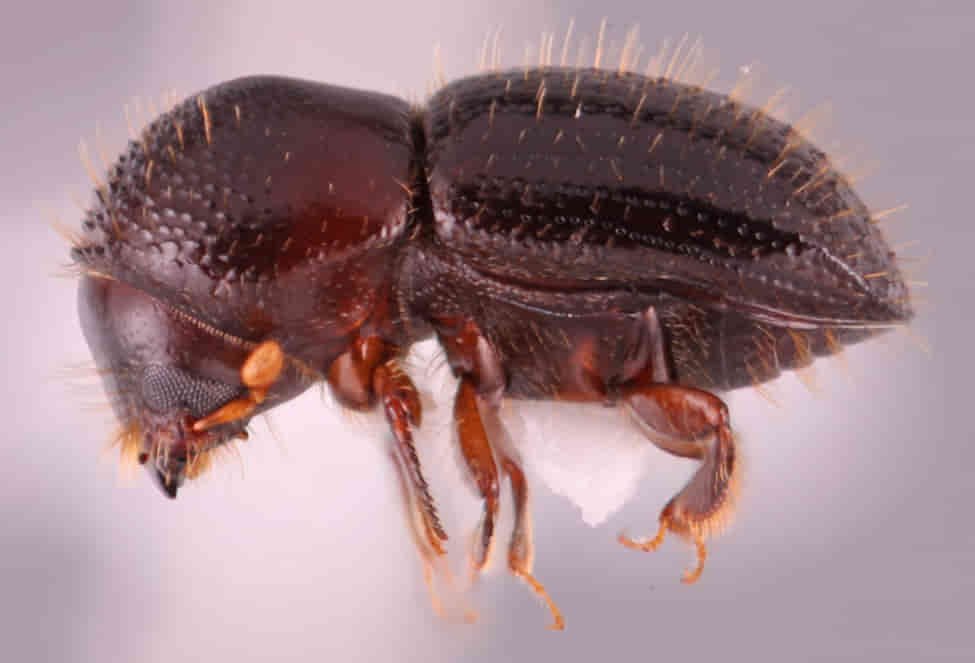
A tiny beetle, barely larger than a sesame seed, is silently turning thriving city landscapes into graveyards of trees. It may look harmless, but the polyphagous shot-hole borer (Euwallacea fornicatus) is proving that “size doesn’t determine strength.” Like a burglar who sneaks into a house through a tiny crack and unlocks the door for an accomplice, this invasive insect bores into tree trunks and secretly invites an even deadlier partner, a disease-causing fungus. Together, they launch a devastating two-pronged attack that can kill even large, healthy trees.
Urban forests are often called the “green lungs” of our cities because they cool neighbourhoods, filter polluted air, store carbon, reduce flooding, and provide homes for birds, butterflies, and countless other creatures. When these silent guardians fall, cities lose far more than shade, they lose one of their strongest natural allies against climate change. As the old proverb says, “Little drops make the mighty ocean,” and likewise, one tiny beetle can trigger enormous ecological consequences.
Originally native to Southeast Asia, the polyphagous shot-hole borer has now established itself in North America, Europe, Africa, the Middle East, and Australia, hitching rides through global trade and the movement of infested wood. Unlike many insects that feed on a single host, this beetle is remarkably polyphagous, meaning it can attack more than 600 tree species, including many commonly planted in urban areas. The female beetle drills tiny tunnels into the trunk and lays her eggs deep inside the wood, where the developing larvae remain safely hidden from predators and insecticides. If the beetle could speak, it might boast, “You’ll never find me where your sprays can reach.” This hidden lifestyle makes the pest extremely difficult to control. Urban landscapes, where native and ornamental trees grow closely together like crowded apartment buildings, provide the perfect neighbourhood for the beetle to spread rapidly from one tree to another.
The beetle’s greatest weapon, however, is not its drilling ability but its partnership with a symbiotic pathogenic fungus, usually belonging to the genus Fusarium. As the beetle tunnels into the wood, it carries fungal spores inside specialised structures called mycangia and introduces them directly into the tree’s xylem, the vascular tissue responsible for transporting water and dissolved minerals from the roots to the leaves.
The fungus rapidly colonises these water-conducting vessels, causing vascular wilt and progressively blocking the tree’s internal plumbing system. Imagine a city’s entire water supply being clogged by concrete, no matter how healthy the buildings are, life soon grinds to a halt. Deprived of water and nutrients, branches begin to die back, leaves wilt, the canopy thins, and eventually the entire tree succumbs. This deadly partnership between insect and fungus is a classic example of a vector-pathogen interaction, making the polyphagous shot-hole borer far more destructive than ordinary wood-boring insects.
| “The mightiest forests are not always felled by the strongest storms. Sometimes, the greatest threats arrive quietly, hidden beneath the wings of something no bigger than a grain of rice.” |
From an ecological and plant pathology perspective, this invasion illustrates the growing challenges posed by biological invasions in an era of globalisation and climate change. Increased international trade, warmer temperatures, and expanding urban green spaces have created ideal conditions for invasive pests to establish new populations. Because the beetle spends most of its life cycle protected inside woody tissues, conventional chemical control offers limited success.
Consequently, scientists are adopting an Integrated Pest Management (IPM) approach that combines early surveillance, molecular diagnostics, quarantine regulations, sanitation by removing heavily infested trees, biological control agents, and the development of resistant tree varieties. Advanced genomic studies are also investigating the beetle-fungus symbiosis to identify vulnerabilities that could disrupt their partnership. After all, prevention is better than cure. Protecting urban forests is no longer just about saving trees; it is about safeguarding biodiversity, reducing urban heat, improving air quality, strengthening climate resilience, and preserving the living infrastructure upon which millions of city dwellers unknowingly depend. In the battle for greener cities, sometimes the smallest enemy demands the greatest vigilance.
Figure: Adopted from S.M Smith et al 2019.
Source:
Luke J Potgieter, Marc W Cadotte, Francois Roets, David M Richardson, Journal of Pest Science 97 (4), 2073-2085, 2024


