
Have you ever imagined a fish that has never seen light, yet survives perfectly in complete darkness? It may sound like a creature from a science fiction movie, but it is very real. Deep beneath the Earth, where darkness rules like an endless night and silence whispers through ancient caves, scientists have discovered two extraordinary fish that challenge everything we thought we knew about life. One was found by pure accident after a researcher slipped into an underground pool inside a restricted military base in the United States. The other was discovered in the mysterious limestone caves of Meghalaya, India. Like hidden treasures waiting patiently for centuries, these fish remind us that “truth is stranger than fiction.”
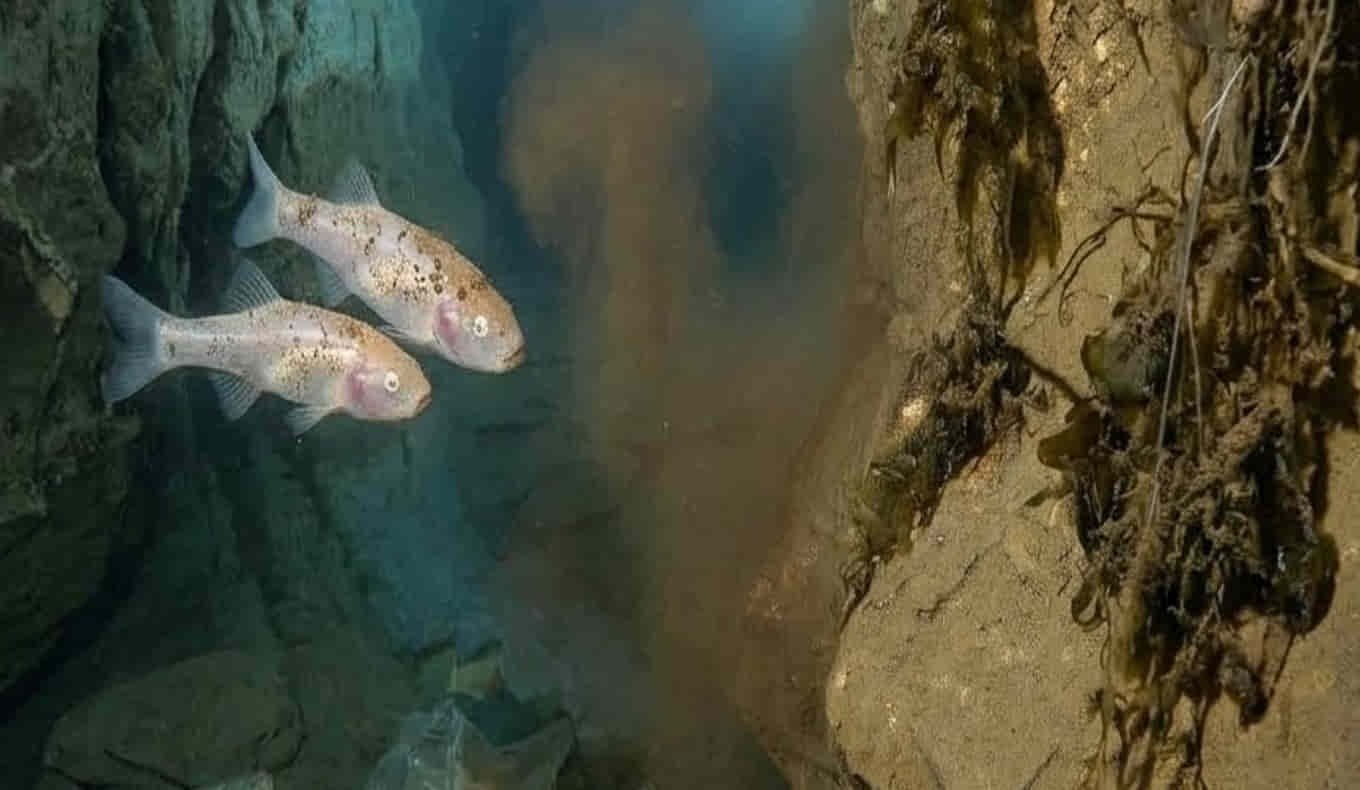
The first surprise came from Redstone Arsenal in Alabama, USA. During routine environmental monitoring, a researcher accidentally fell into a hidden underground pool. The splash disturbed an unknown fish resting beneath a rock. It was not just a new species, but an entirely new genus, later named Demogorgonichthys arcanus, inspired by the frightening “Demogorgon” from the popular series Stranger Things. Living for millions of years in total darkness, this cavefish has no eyes and no body colour.
| “Nature writes some of its most astonishing stories where sunlight has never reached.” |
Its skin is almost transparent, allowing its blood vessels to shine through with pale blue and pink shades. “I do not need eyes,” nature seems to whisper through this fish, “because in my world, darkness is my daylight.” Instead of vision, it depends on highly sensitive touch, smell, taste, and vibrations in the water, much like a person finding their way through a dark room using only their hands.
Thousands of kilometres away, another underground mystery was unfolding beneath the limestone caves of Meghalaya. Scientists discovered Neolissochilus pnar, now recognised as the world’s largest known cavefish. This remarkable species broke a long-standing scientific belief that cavefish must remain small because caves provide very little food. While most cavefish measure only a few centimetres, this giant grows beyond 30 centimetres and can weigh nearly ten times more than other cave-dwelling fish.
Researchers believe seasonal floods carry leaves, insects, and other organic matter into the caves, creating enough food to support this large predator. In ecological terms, this is an excellent example of resource availability influencing body size, proving that evolution sometimes bends its own rules when the environment provides unexpected opportunities. It is a reminder that “exceptions are the windows through which science discovers new truths.”
At the molecular and evolutionary level, both discoveries demonstrate remarkable examples of regressive evolution and adaptive evolution. Over millions of years, natural selection favoured individuals that stopped investing energy in unnecessary organs such as eyes and skin pigments. Instead, that biological energy was redirected towards enhancing mechanoreceptors, chemoreceptors, and the lateral line system, enabling these fish to detect tiny water movements, dissolved chemicals, and nearby prey with extraordinary precision.
The loss of vision is not a weakness but an evolutionary trade-off, where energy conservation increases survival in nutrient-poor environments. In Neolissochilus pnar, ecological carrying capacity and trophic dynamics appear sufficient to sustain an unusually large apex predator, challenging previous models of cave ecosystem productivity.
These remarkable discoveries remind us that evolution is like an artist with an endless imagination, painting masterpieces even where sunlight never reaches. From a secret military cave in America to the hidden limestone labyrinths of Northeast India, nature continues to surprise scientists with creatures that seem impossible until they are found. Every unexplored cave is a sealed chapter in Earth’s history, waiting for someone curious enough to turn the page. As scientists continue exploring the underground world, one lesson becomes clear, the greatest mysteries are often hiding not among the stars above us, but beneath the ground we walk on every day.


