Fresh meat may look lifeless, but inside it, a silent race against time has already begun. Think of fresh meat as a bustling city filled with water, where billions of tiny microbes wait for the perfect moment to invade. Every drop of water is like fuel for these invisible enemies. The moment we start drying the meat, the battlefield changes. Water slowly disappears, bacteria begin to panic, and the meat starts a remarkable transformation. It is like turning a fresh flower into a beautiful dried flower. One loses moisture, the other gains a much longer life. As the meat whispers, “Take away my water, and you give me a second life.” This is why dried meat can stay safe and tasty for months while fresh meat spoils within days.
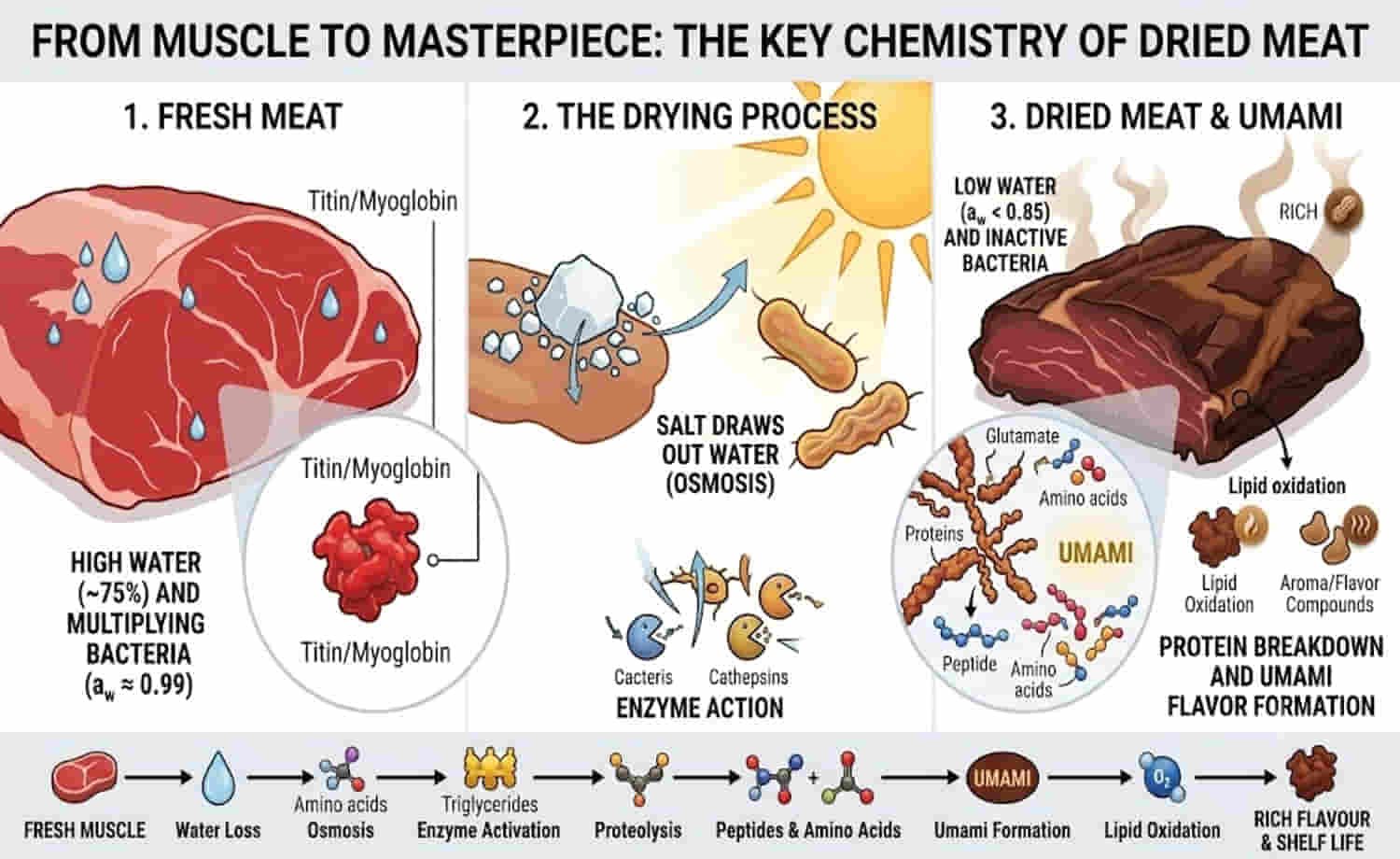
The science behind drying is surprisingly simple. Fresh meat contains nearly 75 percent water, making it an ideal place for bacteria to grow. Bacteria need water just as humans need oxygen. Remove the water, and their survival becomes almost impossible. Salt speeds up this process by creating a high osmotic pressure outside the bacterial cells.
Water rushes out through osmosis, causing the microbes to shrink like grapes turning into raisins. Scientists measure this using Water Activity, abbreviated as aw. Fresh meat has an aw of about 0.99, where bacteria multiply rapidly. Properly dried meat has an aw below 0.85, making it difficult for most harmful bacteria to grow. As the old saying goes, “Prevention is better than cure,” and drying is nature’s own way of protecting food.
| “Nature teaches us that sometimes losing a little is the only way to gain something extraordinary.” |
The story becomes even more fascinating inside the muscle fibres. As water leaves, the muscle cells collapse and release natural enzymes called calpains and cathepsins. These enzymes behave like skilled demolition workers. “Our job is to break down the old walls,” they seem to say. This process, known as proteolysis, cuts large structural proteins such as titin and nebulin into smaller peptides and free amino acids.
One of these amino acids is glutamate, the compound responsible for the rich umami taste that gives dried meat its deep savoury flavour. Without this controlled breakdown, dried meat would become as hard as leather instead of remaining pleasantly chewy. What appears to be destruction is actually the beginning of deliciousness.
While proteins are changing, fats and colour are also undergoing their own chemical makeover. Lipase enzymes break down triglycerides into free fatty acids, which are further converted into aldehydes, ketones, and other volatile aroma compounds through lipid oxidation. These molecules create the nutty, rich aroma that makes cured meat so appealing. However, if oxidation becomes too rapid, the same reaction produces rancid flavours, proving that too much of a good thing can become harmful.
| Nutrient Aspect | Fresh Lean Meat | Dried Lean Meat | Nutritional Impact &Reason |
| Water Content | 72% – 75% | 15% – 25% | Plummets: Water evaporates, causing all other nutrients to concentrate heavily. |
| Calories | ~110 – 130 kcal | ~280 – 350 kcal | Triples: Becomes highly calorie-dense because the heavy water weight is gone. |
| Protein | ~22g – 24g | ~50g – 60g | Massive Increase: Delivers a highly concentrated source of amino acids per gram. |
| Fats | ~1g – 3g | ~4g – 8g | Increases: Fat density rises, though most fat is trimmed beforehand to prevent spoilage. |
| Sodium (Salt) | ~60mg – 80mg | ~1,500mg – 2,200mg | Skyrockets: Added heavily as a curing agent to stop microbial growth. |
| Minerals (Iron/Zinc) | Moderate | High | Concentrated: Crucial bioavailable minerals become dense and easily absorbed. |
| B Vitamins | High | Moderate | Slight Loss: Heat-sensitive vitamins (like B1) can partially degrade during drying. |
At the same time, myoglobin, the pigment responsible for meat’s red colour, undergoes oxidation. Its iron atom changes from the bright red oxygenated form to brown metmyoglobin, giving dried meat its characteristic dark appearance. In biochemical terms, drying is a carefully balanced interaction between enzyme activity, water loss, protein degradation, lipid oxidation, pigment chemistry, and microbial control.
Drying meat is far more than removing water. It is a carefully choreographed performance where enzymes become artists, salt becomes a guardian, and chemistry becomes the chef. What begins as ordinary muscle slowly transforms into a flavour-rich, long-lasting masterpiece. In the kitchen, every dried piece of meat reminds us that science does not simply preserve food, it preserves flavour, tradition, and time itself.