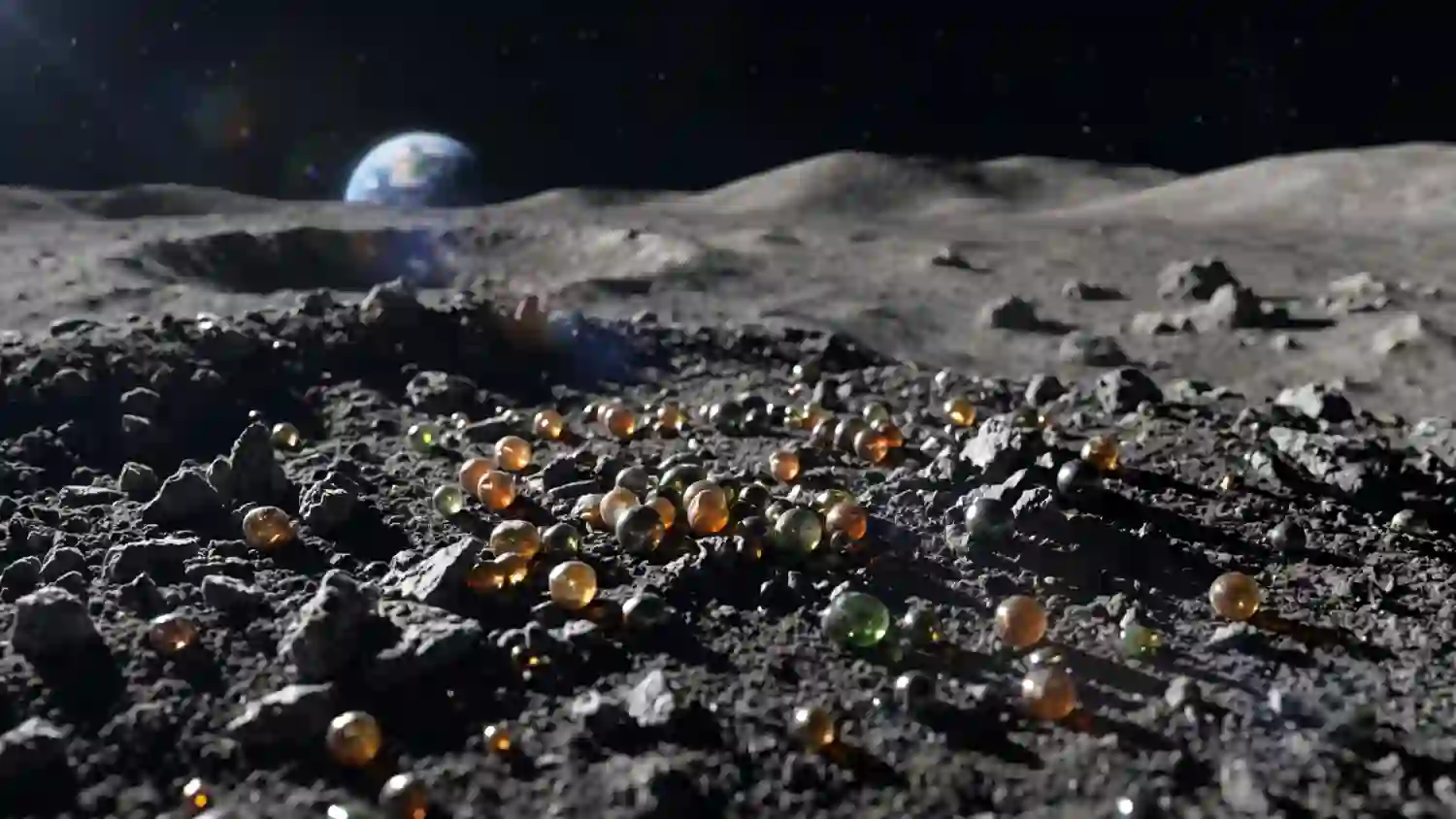
The Moon may look like a silent, lifeless world today, but its soil contains clues to a far more dynamic past. Hidden inside tiny glass particles brought back from the lunar surface, scientists have discovered an unusual form of metallic iron that could help reconstruct the history of the Moon’s long-lost magnetic field. The discovery comes from samples collected by China’s Chang’e-6 mission, which returned the first-ever lunar material from the Moon’s far side in 2024. By examining microscopic particles in the samples, researchers identified a form of iron known as face-centred cubic gamma iron, or γ-Fe. Although this structure is familiar to materials scientists, it had not previously been identified in natural lunar samples.
Iron can arrange its atoms in different crystal structures, and those arrangements influence how it behaves. Gamma iron normally remains stable only at high temperatures. As it cools, it typically transforms into another structure called alpha iron. Yet they found that γ-Fe had survived inside tiny particles embedded in impact glass. This glass forms when meteorite impacts generate intense heat, melting lunar material that subsequently cools.
The team suggests that the extreme conditions created by impacts, rapid cooling, trace amounts of carbon and other elements, and protection from the surrounding glass may have helped preserve the unusual iron structure. Using advanced electron microscopy and magnetic imaging techniques, they also investigated how the particles responded to magnetic fields. Some larger nanoparticles formed a stable magnetic configuration known as a single-vortex state, suggesting that they could retain a consistent magnetic signal.

Could iron preserve the Moon’s lost magnetism?
Today, the Moon does not generate a global magnetic field like Earth does. However, lunar rocks and soil preserve traces of ancient magnetism. Scientists believe the early Moon once had a magnetic field generated by movements of molten metal inside its core, although its strength and history remain subjects of research.
Magnetic minerals can act like tiny records of the conditions in which they formed. If γ-Fe particles preserve reliable magnetic information, they may be able to use them to investigate the Moon’s ancient magnetic environment and the impacts that shaped its surface. There is an important limitation, however.
Demonstrating that these particles can maintain a stable magnetic state does not automatically establish that they record the Moon’s original magnetic field accurately. Scientists must determine when the particles formed, whether their signals reflect ancient conditions, and how later impacts may have altered them.
The finding, published in Proceedings of the National Academy of Sciences, expands the range of magnetic materials known in lunar samples. Sometimes, understanding a world’s history does not require a giant rock or a spectacular crater. It may begin with a microscopic grain that has preserved a clue for billions of years.