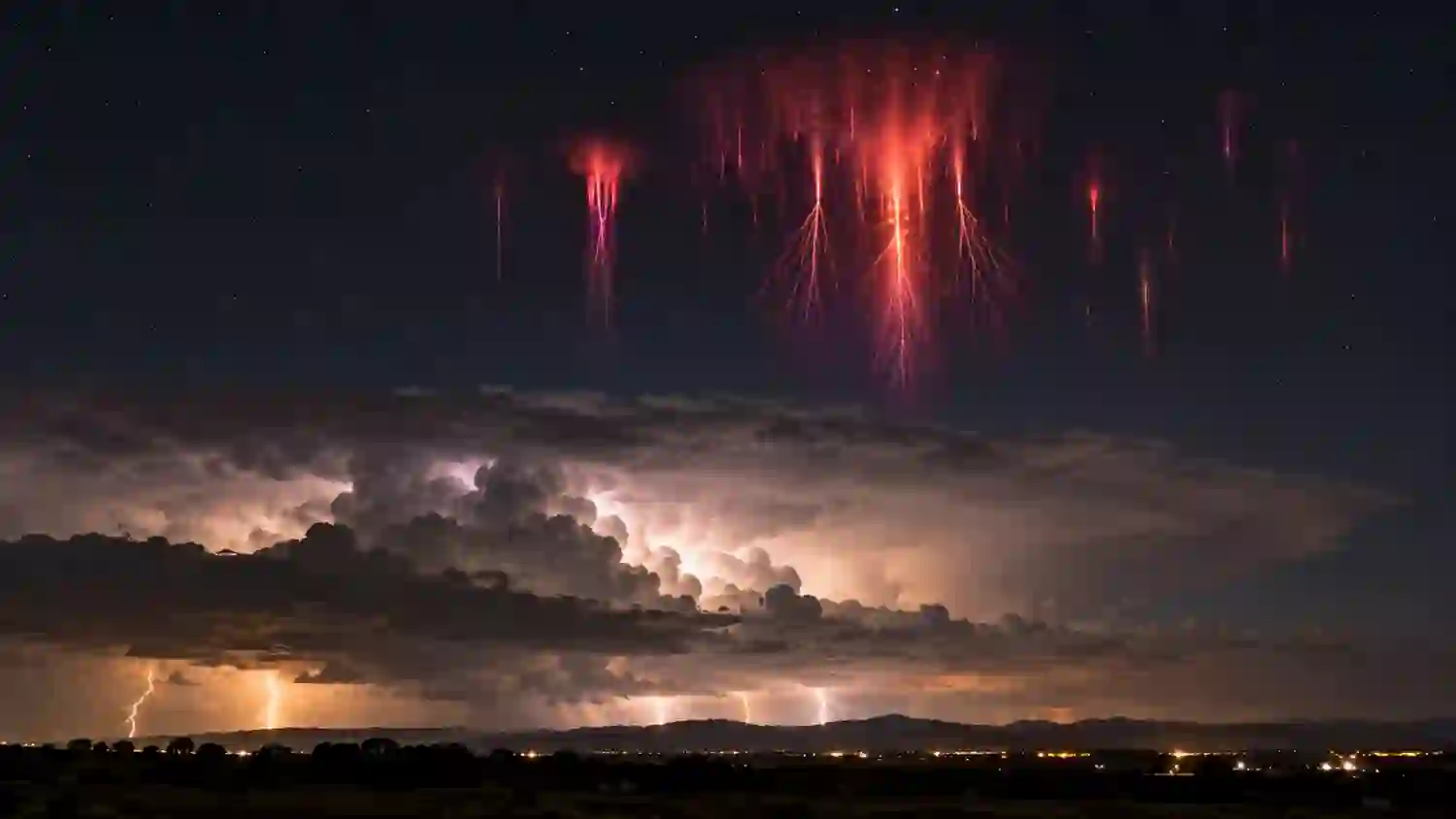
Imagine watching a thunderstorm at night when, for a fraction of a second, an enormous red shape flashes above the clouds. It resembles a glowing jellyfish or a tree made of crimson light. This is not science fiction. It is a red sprite, one of the most spectacular and elusive electrical phenomena in Earth’s atmosphere.
Unlike ordinary lightning, red sprites occur high above thunderstorms, typically around 50–90 kilometres above Earth’s surface, in a region called the mesosphere. They can extend across several kilometres and usually last only a few milliseconds, making them difficult to observe with the naked eye. Scientists first photographed them accidentally in 1989 while testing a low-light camera.
But what causes lightning to appear so far above a storm?

The process begins with powerful lightning discharges within a thunderstorm or between a cloud and the ground. Certain discharges rapidly redistribute electrical charge, producing a strong electric field that extends upward into the thinner atmosphere. This field accelerates electrons, which collide with molecules in the surrounding air and transfer energy to them.
The red glow comes primarily from excited nitrogen molecules. When these molecules release the energy they have absorbed, they emit light. At lower altitudes, sprites may also develop faint bluish tendrils, creating their distinctive branching or jellyfish-like appearance. Researchers model these structures as rapidly propagating electrical streamers thin channels of ionized gas.
Red sprites are not the only electrical events above thunderstorms. Blue jets shoot upward from storm clouds into the stratosphere, while elves appear as enormous, rapidly expanding rings of light high in the atmosphere. Elves are produced when electromagnetic pulses from lightning interact with the lower ionosphere. These phenomena belong to a family known as transient luminous events, or TLEs.
Why do scientists care about these fleeting flashes? They provide a rare opportunity to study how thunderstorms interact with the upper atmosphere. Their electrical discharges may influence atmospheric chemistry and help researchers understand how energy moves between different atmospheric layers. Instruments aboard spacecraft, including the International Space Station, can observe these events using specialised cameras and other detectors.
Despite decades of research, scientists are still investigating exactly how sprites begin, why their shapes vary and under what conditions they occur.
The next time you imagine lightning, think beyond the storm clouds. Earth’s atmosphere is electrically active far above the weather we experience on the ground. For a few milliseconds, a thunderstorm can illuminate the edge of space and reveal a spectacular connection between weather and the near-space environment.