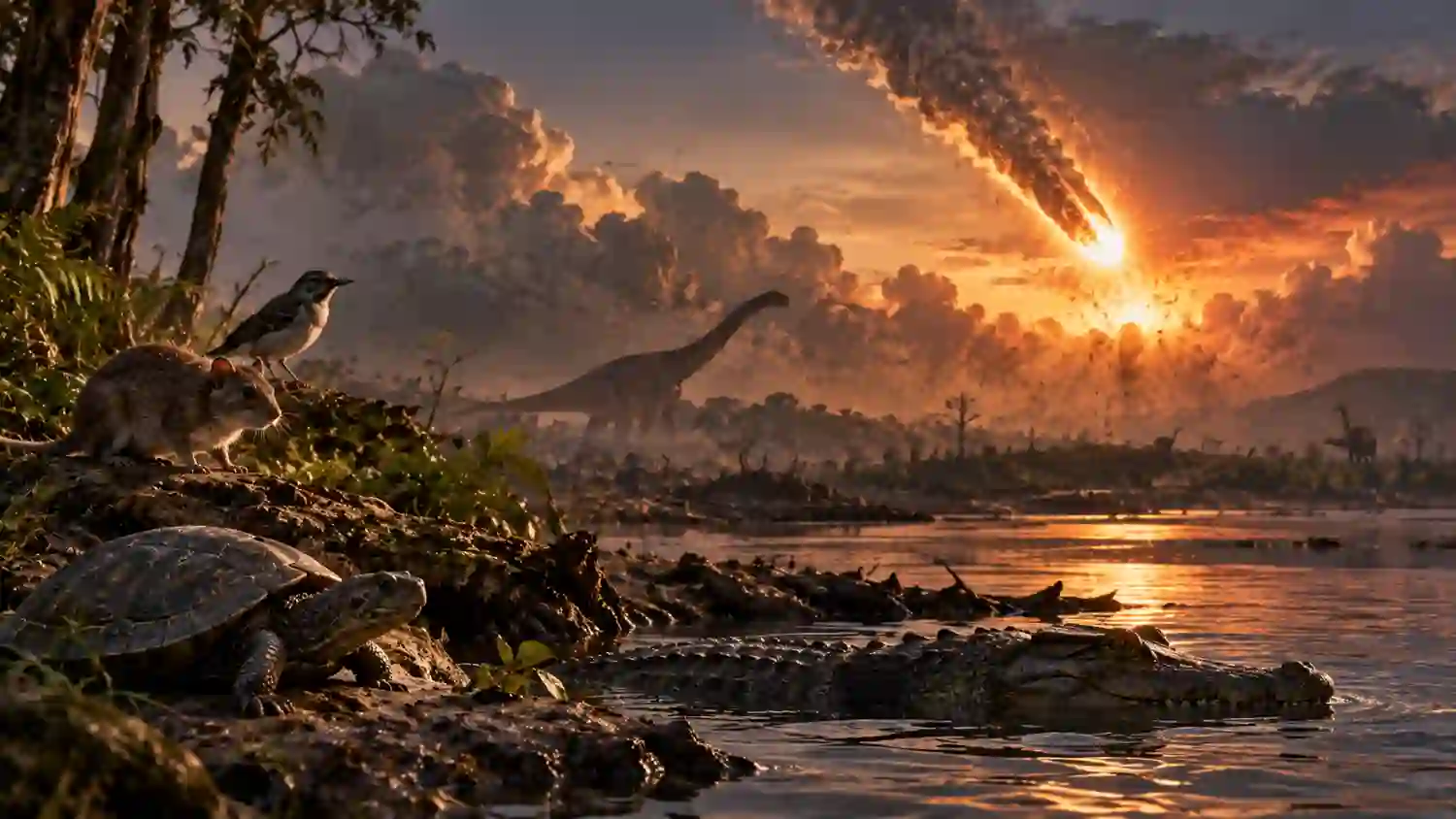
Sixty-six million years ago, an asteroid struck the region now known as Mexico’s Yucatán Peninsula, triggering one of the most devastating mass extinctions in Earth’s history. Non-avian dinosaurs disappeared, along with numerous marine reptiles and other organisms. Yet crocodiles, turtles, mammals, birds and several other animal groups survived. Why did some lineages endure while others vanished?
The answer was not simply strength or intelligence. Survival depended on a combination of ecology, physiology, habitat and chance.
The asteroid impact released enormous amounts of dust and aerosols into the atmosphere, reducing sunlight and disrupting photosynthesis. As plants and algae declined, food webs began to collapse. Herbivores lost their food sources, and predators were affected as their prey disappeared. Wildfires, environmental disturbances and rapid climate changes added to the devastation.
One important advantage appears to have been access to alternative food sources. Small mammals that could consume insects, seeds, underground plant material or other available resources may have been better positioned to survive when ecosystems became unstable. Seeds can remain available after above-ground vegetation is damaged, while detritus the dead organic material accumulating in ecosystems can continue supporting food webs even when photosynthesis declines.
Body size may also have mattered. Smaller animals generally require less total food than large-bodied animals, potentially making survival easier during prolonged food shortages. Many small mammals could shelter in burrows or other protected environments, although the importance of these behaviours varied among species. Researchers examining ancient food webs have found that small vertebrates, including mammals, were already diversifying ecologically before the extinction, potentially contributing to their survival.
Freshwater habitats may have offered another advantage. Rivers, lakes and wetlands can retain organic matter and support food chains based on detritus rather than depending entirely on living plants. This may help explain why crocodilians, turtles and some freshwater organisms survived comparatively well. However, freshwater ecosystems were not immune: extinction and ecological disruption still occurred within them.
Birds present a particularly interesting case. They are the only living dinosaur lineage, meaning that dinosaurs did not disappear completely. Modern birds descend from the avian dinosaurs that survived the extinction. Research suggests that the survival of early bird lineages was selective, with ecological characteristics such as diet and habitat likely influencing their fate. Most other dinosaur groups disappeared, but a branch of small, feathered theropods continued evolving.
Mammals also suffered severe losses. One fossil-based study of North American mammals estimated that only four of 59 recorded species survived across the boundary, demonstrating that survival was far from guaranteed. Widespread and relatively common species tended to fare better than rare ones.
The extinction therefore did not reward a single perfect adaptation. Instead, it favoured organisms that happened to possess combinations of traits suited to a radically transformed world. After the catastrophe, surviving lineages gradually diversified into ecological opportunities left behind by extinct species.
The lesson is striking: evolution does not always favour the strongest organisms. Sometimes, survival depends on being small enough, flexible enough, or fortunate enough to endure a world that has suddenly changed.