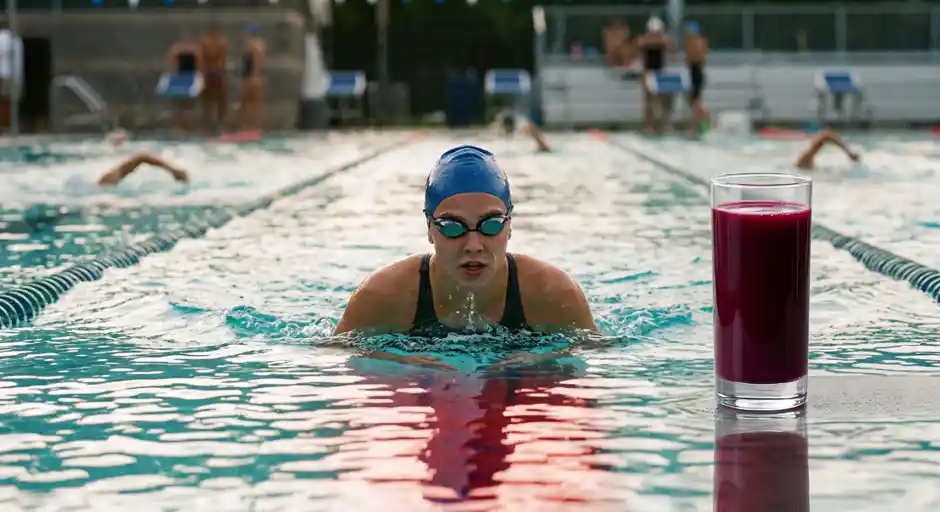
A glass of beetroot juice before a race might make swimming feel a little easier. That is the conclusion emerging from a new systematic review and meta-analysis published in Scientific Reports. Researchers brought together evidence from randomized studies investigating whether beetroot juice or dietary nitrate supplements could improve swimming performance. The results produced an interesting split between how hard swimming feels and what the stopwatch records.
Why beetroot juice?
Beetroot is naturally rich in nitrate. Once consumed, dietary nitrate can contribute to the production of nitric oxide, a molecule involved in blood-vessel function and circulation. Previous research in sports such as cycling and running has suggested that nitrate supplementation may improve exercise efficiency under some conditions. That has made beetroot juice a popular supplement among athletes. But swimming is different. The body is working against water resistance, breathing is restricted by the need to coordinate strokes and breaths, and races can range from short, highly anaerobic sprints to longer aerobic efforts. So an effect seen in running or cycling does not automatically translate to the pool.

What did the new study find?
They searched the scientific literature for controlled trials involving beetroot juice or nitrate supplementation in swimmers. Twelve studies met the review criteria, while nine studies involving 120 swimmers provided enough comparable data for the main meta-analysis. The participants included competitive, university-level and elite swimmers, with both men and women represented. When it came to actual swimming times, the result was remarkably unexciting. Beetroot juice or nitrate supplementation did not significantly improve time-trial performance. This remained true when they separated the races into maximum sprints, prolonged sprints and middle-distance efforts. There was also no significant difference in post-exercise blood lactate levels. But something did change. Across seven studies involving 100 swimmers, supplementation was associated with a small reduction in perceived exertion, meaning participants tended to report that the exercise felt slightly less difficult. The effect was statistically significant, although there was considerable variation between studies.
Feeling better doesn’t necessarily mean going faster. This distinction is important. Imagine two swimmers completing the same demanding workout. One reports that the effort felt slightly easier, but both finish in almost exactly the same time. The first swimmer may have experienced a perceptual benefit, but that does not necessarily translate into a measurable performance advantage. And that appears to be what the current evidence suggests.
They rated the certainty of evidence for swimming performance as low, partly because the available studies were relatively small and had methodological limitations. The authors also noted that the reduction in perceived exertion varied between studies, making its practical importance uncertain. An earlier controlled study illustrates the same problem. In 18 competitive swimmers, a single dose of beetroot juice containing 400 mg of nitrate did not significantly improve performance during repeated 100-m maximal efforts, although some measures suggested a possible improvement in exercise tolerance toward the end of the test. So, for now, beetroot juice does not appear to be a magic shortcut to faster swimming. It may make a hard session feel slightly easier, but the stopwatch still has the final word.
Sources