Plants cannot run away from insects, pathogens or environmental threats. Instead, they have evolved an extraordinary chemical arsenal.
Among these molecules are compounds capable of interfering with cell division, damaging DNA, altering metabolism and triggering programmed cell death. Remarkably, some of these same properties make certain plant molecules useful against cancer cells.
But plants did not evolve these chemicals specifically to treat cancer.
Plants are chemical factories
Plants produce thousands of secondary metabolites molecules that are not necessarily required for basic survival but can help organisms compete, communicate or defend themselves.
Alkaloids, terpenoids, flavonoids and polyphenols are among the major groups. These compounds can deter herbivores, inhibit microbes or protect plants from environmental stress.
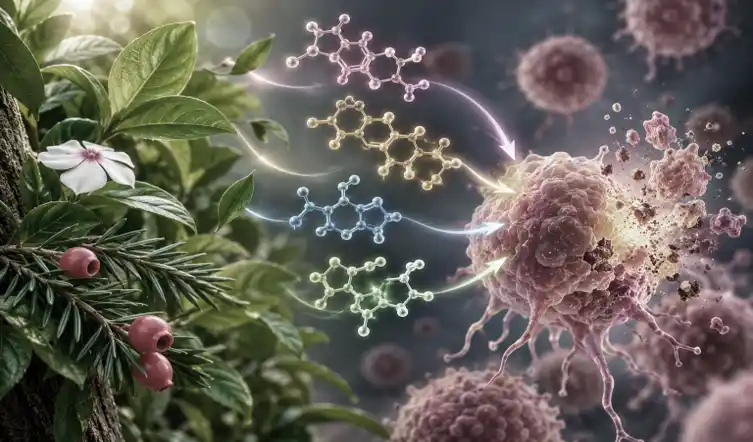
When scientists study them in human cells, however, some interact with biological pathways that cancer cells depend upon. Recent reviews show that plant-derived compounds can influence processes including apoptosis, cell-cycle progression, angiogenesis and signalling pathways such as PI3K/Akt, MAPK and NF-κB.
Some became real cancer medicines
One of the clearest examples is paclitaxel, originally isolated from the Pacific yew (Taxus brevifolia). It interferes with microtubules the cellular structures required for chromosome movement during cell division. By disrupting this process, paclitaxel can prevent rapidly dividing cancer cells from completing mitosis.
Another example is vincristine, derived from the Madagascar periwinkle (Catharanthus roseus). Like paclitaxel, it targets microtubules, but in a different way, interfering with their formation and ultimately disrupting cell division. Vincristine remains an important component of treatment for several cancers.
Camptothecin, first isolated from Camptotheca acuminata, provided the chemical foundation for drugs such as irinotecan and topotecan. These compounds target topoisomerase I, an enzyme cancer cells need to manage DNA during replication.
These examples reveal something important: a plant compound does not need to be inherently “toxic to cancer” to become a drug. Scientists can identify a biological activity, understand its mechanism and chemically modify the molecule to make it more useful and controllable.
Why don’t all plant compounds become medicines?
Because promising activity in a laboratory does not automatically translate into an effective treatment.
Many phytochemicals have poor absorption, low bioavailability, rapid metabolism or insufficient concentrations reaching tumors. Others can affect healthy cells as well as cancer cells. Recent research continues to highlight the large gap between promising laboratory findings and successful clinical translation.
That is why scientists increasingly use medicinal chemistry, structural biology, biotechnology and nanotechnology to transform natural molecules into safer and more effective drugs.
Plants therefore represent more than traditional sources of remedies.
They are enormous natural chemical libraries, shaped by millions of years of evolution.
And occasionally, hidden inside one of those molecules is a structure capable of revealing an entirely new way to fight cancer.
Sources