An experimental pill shrank stubborn bowel cancers in mice by cutting off a supply line the tumour could not live without.
About one in five bowel cancers carries the same genetic fault. It jams the cell’s growth switch permanently on, and for years it has been one of the most frustrating targets in cancer medicine. Drugs built to press that switch back up do exist. Most have been either too weak to help much or too rough on the patient to keep taking.
So a team in Shanghai stopped attacking the fault. They went after its groceries instead.

The sticky note that keeps proteins alive
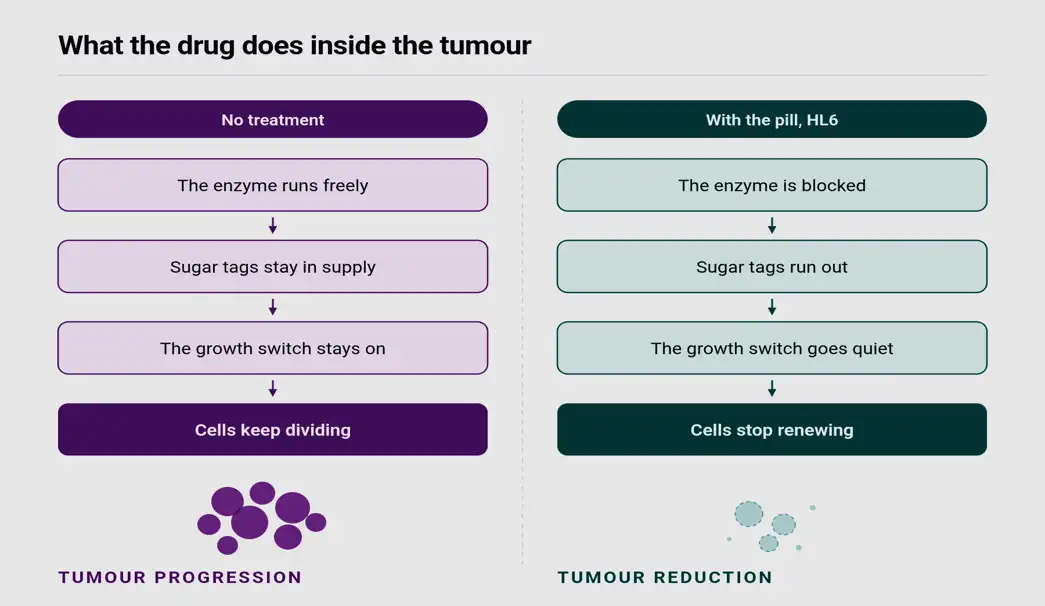
Cells use a small sugar tag as a sticky note that says keep this alive. Proteins wearing one survive. Proteins without one get marked as rubbish and shredded. It is ordinary housekeeping, going on in every cell in your body right now.
What the researchers found is that tumours with this particular fault are unusually greedy for those tags. One of the proteins holding their growth switch on needs a fresh sticky note to stay in one piece. Take the sugar away and the protein falls apart. The switch falls off the wall with it.
Healthy cells cope, because they keep a spare route open. The tumours, busy growing, had let theirs go.
Cut the supply, and only the greedy cells starve.
What happened in the mice
The team built a compound called HL6 to shut down the enzyme that keeps the sugar supply running, and gave it to mice once a day by mouth. It is roughly fifty times stronger at the job than the closest existing drug, an arthritis medicine that happens to hit the same enzyme.
They ran three tests, each more realistic than the last. Tumour cells under the skin shrank. Tumours placed in the bowel itself, where a bowel cancer actually lives, shrank by nearly 87 per cent. Then came the test that mattered: surgeons took fresh tumour tissue from two patients, one with the fault and one without, and grew both in mice.
In the tumours with the fault, HL6 held growth back by 81.75 per cent. In the tumours without it, the same dose managed 37.09 per cent. That gap is the whole argument of the paper.
The mice also stayed well. After 24 days of daily dosing they had not lost weight, and their organs looked normal under the microscope.
Why this could matter later
- A test could pick the patient. The fault already shows up on standard tumour gene panels, so doctors would know in advance who stands to benefit and who does not.
- Gentler side effects. The drug removes a supply line only the mutated cells lean on, instead of shutting down a growth pathway healthy tissue also needs. That is what sank earlier attempts.
- Fewer relapses, in theory. It hit the stem-like cells that survive chemotherapy and seed a comeback months or years later.
- It may travel. The same sugar tags control proteins throughout the body, so the trick could work in other cancers carrying the same fault.
- Others can check it. The gene data and the atom-by-atom structure of the drug locked onto its target are both public, so rival labs can try to knock the finding down.
The catch
No human being has taken HL6. Mice are not people, and cancer research is littered with compounds that looked brilliant in a cage and did nothing in a clinic. The patient tissue came from a small number of donors, and the researchers openly admit one link in their chain is described rather than fully explained: they still do not know exactly what destroys the protein once its sticky note is gone.
What they have is a real target, a strong molecule and a clear reason to keep going. For a mutation that has defeated a decade of drug design, that is not nothing.
References:
Liang, J., Liu, X., Ni, Z., Zhang, S., He, X., Wang, L., Huang, Y., Xu, Z., Xu, Z., Qian, J., Lu, L., Abuduaini, N., Tian, J., Zeng, M., Wang, Q., Sun, J., Xie, Q., Wang, Y., Lu, W., Feng, B., Han, B., & Huang, J. (2026). DHODH is a synthetic lethal target in PIK3CA-mutant colorectal cancer. Cell Reports, 45, 117719. https://doi.org/10.1016/j.celrep.2026.117719
Finan, C., Gaulton, A., Kruger, F. A., Lumbers, R. T., Shah, T., Engmann, J., Galver, L., Kelley, R., Karlsson, A., & Santos, R. (2017). The druggable genome and support for target identification and validation in drug development. Science Translational Medicine, 9(383), eaag1166. https://doi.org/10.1126/scitranslmed.aag1166
Ilic, N., Birsoy, K., Aguirre, A. J., Kory, N., Pacold, M. E., Singh, S., Moody, S. E., DeAngelo, J. D., Spardy, N. A., & Freinkman, E. (2017). PIK3CA mutant tumors depend on oxoglutarate dehydrogenase. Proceedings of the National Academy of Sciences, 114(17), E3434–E3443. https://doi.org/10.1073/pnas.1617922114
Juric, D., Rodon, J., Tabernero, J., Janku, F., Burris, H. A., Schellens, J. H. M., Middleton, M. R., Berlin, J., Schuler, M., & Gil-Martin, M. (2018). Phosphatidylinositol 3-kinase α–selective inhibition with alpelisib (BYL719) in PIK3CA-altered solid tumors: Results from the first-in-human study. Journal of Clinical Oncology, 36(13), 1291–1299. https://doi.org/10.1200/JCO.2017.72.7107
Sykes, D. B., Kfoury, Y. S., Mercier, F. E., Wawer, M. J., Law, J. M., Haynes, M. K., Lewis, T. A., Schajnovitz, A., Jain, E., & Lee, D. (2016). Inhibition of dihydroorotate dehydrogenase overcomes differentiation blockade in acute myeloid leukemia. Cell, 167(1), 171–186.e15. https://doi.org/10.1016/j.cell.2016.08.057
Yang, X., & Qian, K. (2017). Protein O-GlcNAcylation: Emerging mechanisms and functions. Nature Reviews Molecular Cell Biology, 18(7), 452–465. https://doi.org/10.1038/nrm.2017.22
Yin, S., Liu, L., Brobbey, C., Palanisamy, V., Ball, L. E., Olsen, S. K., Ostrowski, M. C., & Gan, W. (2021). PRMT5-mediated arginine methylation activates AKT kinase to govern tumorigenesis. Nature Communications, 12, 3444. https://doi.org/10.1038/s41467-021-23833-2