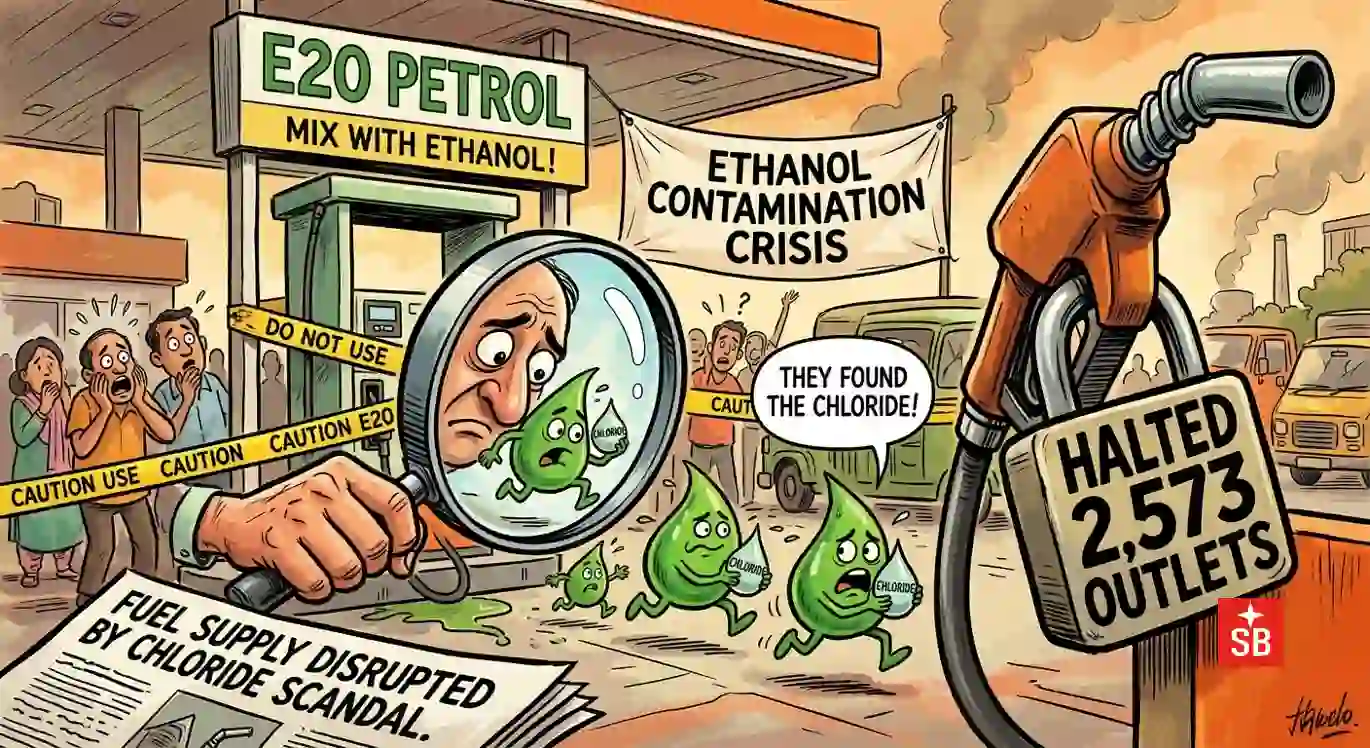
India’s Ministry of Petroleum and Natural Gas has stopped petrol sales at 2,573 retail outlets nationwide as part of an intensified quality-control campaign, following alarming allegations of chloride contamination in E20 ethanol-blended petrol.
The Numbers Behind the Crackdown
As of August 25, 2026, sales were suspended at outlets run by all three major state oil marketing companies (OMCs). Indian Oil Corporation (IOCL) bears the brunt with 1,257 halted pumps, followed by Hindustan Petroleum Corporation (HPCL) at 915, and Bharat Petroleum Corporation (BPCL) at 401.
The scale of the response is massive: mandatory water-ingress testing of underground fuel tanks is now being conducted 8 to 12 times a day at nearly 89,000 dealerships nationwide. A dedicated audit prioritizing older stations has already covered 84,687 fuel outlets, while automated monitoring probes are actively running at 85,649 locations, with faulty units being repaired on a priority basis. On the chemical testing front, OMCs have carried out 7,296 sulphur tests and 1,079 chloride tests on ethanol-carrying tankers, plus 151 chloride tests on their own storage tanks.
What Triggered the Panic
The controversy traces back to a July 28 letter from the Society of Indian Automobile Manufacturers (SIAM) to the petroleum ministry, warning of a sharp rise in failures of fuel injectors, fuel pumps, and EGR valves in vehicles. SIAM attributed the damage to corrosion and wear from elevated chloride levels in E20 fuel, with samples from vehicle tanks reportedly showing chloride concentrations as high as 500 mg/kg, and retail samples up to 350 mg/kg. The letter also flagged excess moisture in fuel and warned that water contamination could cause ethanol and petrol to separate, potentially stranding vehicles on the road.
Within days, SIAM withdrew the letter, saying the figures “needed further verification”, but not before the letter leaked and a Reuters investigation into automakers’ internal testing data kept the issue in the spotlight.
Government Pushes Back on the Scarier Numbers
Crucially, the Government’s own testing paints a very different picture. Ethanol samples from 80 distilleries and OMC terminals came back with chloride levels below the 3 ppm procurement ceiling. Of more than 1,000 retail samples examined, the first 160 analyzed also showed chloride levels between 0 and 3 ppm — with only a handful of isolated cases (reports cite two to four) flagged for elevated readings, prompting localized supply suspensions pending corrective action.
Officials say claims of contamination reaching around 500 ppm were not validated by government testing.
A Regulatory Gray Zone
Part of the confusion stems from a genuine gap in India’s rules: while industry procurement specifications cap chloride at 3 ppm, the Bureau of Indian Standards has no specific statutory chloride limit for finished ethanol-blended petrol sold at the pump, leaving room for dispute over what counts as “contaminated.”
The Bigger Picture
The crackdown lands at a sensitive moment for India’s clean-energy push, as the rollout of E20 petrol blended with 20% ethanol was accelerated ahead of schedule. For now, authorities frame the suspensions as routine quality enforcement rather than evidence of a systemic fuel crisis, even as scrutiny of the world’s largest ethanol-blending program intensifies.