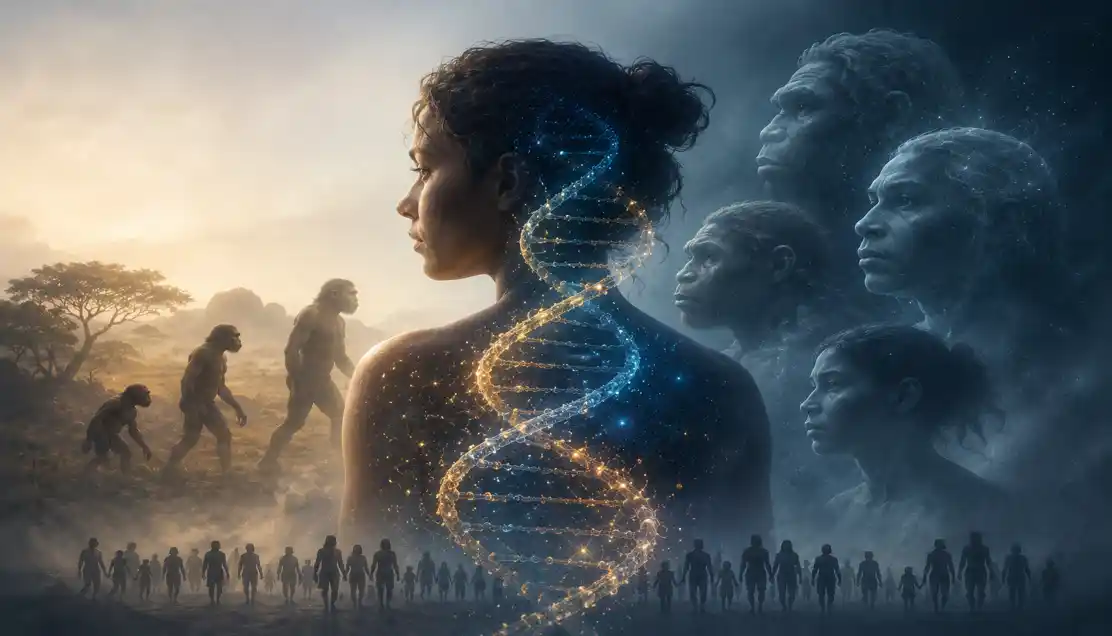
What if part of your DNA came from an ancient human relative that scientists have never actually found?
It sounds like science fiction, but researchers are discovering that the human genome contains traces of “ghost” populations extinct human lineages that left genetic footprints in our ancestors even though no confirmed fossil or complete genome from these groups has been identified.
The idea of ghost DNA is not new. Scientists already know that modern humans interbred with Neanderthals and Denisovans, and fragments of their DNA remain in people living today. But some genetic sequences found in modern human genomes cannot be easily explained by either group. These unexplained patterns suggest that other archaic human populations may also have contributed to our genetic history.
A major development came in July 2026, when researchers from the University of California, Berkeley, reported a new computational method called TRACE. Instead of requiring DNA from an ancient fossil, TRACE reconstructs the genealogical relationships between DNA segments in modern human genomes. By identifying stretches of DNA whose ancestry appears unusually ancient, researchers can detect signals of archaic interbreeding even when the original population has left no recoverable DNA.
The study identified evidence for a previously unknown ghost lineage that appears to have interbred with the ancestors of modern humans before the major expansion of Homo sapiens out of Africa. Remarkably, the researchers estimate that each modern person may carry roughly 0.5–1% of their genome from this lineage.
The researchers also found evidence for an even older “super-archaic” lineage. This ancestry appears to have entered Denisovans from a population that diverged from our evolutionary lineage roughly 1.8 million years ago, with a small amount eventually reaching some modern human populations through Denisovan ancestry.
But who were these mysterious ancestors?
Scientists don’t know yet. Possible candidates include ancient Homo populations that lived in Africa or Eurasia hundreds of thousands to more than a million years ago, but there is currently no direct fossil or genome evidence allowing researchers to give these ghost populations a definite identity.
Why does this matter?
It changes the way we picture human evolution. Instead of a simple family tree in which one human species replaced another, our evolutionary history increasingly looks like a complex web of migration, separation, and interbreeding.
Ghost DNA is therefore more than a genetic mystery. It is evidence that human evolution involved encounters with populations that have disappeared but whose genetic legacy may still be living inside us.
The most fascinating part is that scientists are now learning how to uncover ancient human history without having the ancient human itself.
Sources: