What if a coral on the brink of death could recover simply by touching a healthy neighbour? In a laboratory experiment, scientists have demonstrated a surprisingly effective way to help severely bleached corals regain their health. The secret lies in an unexpected partnership: healthy corals can transfer the microscopic algae that provide their bleached counterparts with the energy needed to survive. The study, led by researchers at Stanford University and published in Science Advances in October 2026, recorded complete recovery within seven weeks, the fastest documented recovery of this kind, according to the researchers.
Corals may look like colourful underwater plants, but they are animals that depend heavily on microscopic algae living inside their tissues. These algae, known as symbionts, use photosynthesis to produce energy-rich compounds that help nourish their coral hosts. When ocean temperatures rise beyond what corals can tolerate, this partnership breaks down. Corals expel their algae, losing both their colour and a major source of nutrition. This process, called coral bleaching, leaves them weakened and vulnerable to starvation and disease. Even when they survive, natural recovery can take months or years. The research team began investigating a possible solution after observing that a bleached coral fragment appeared to regain its colour where it accidentally touched a healthy fragment from the same colony.
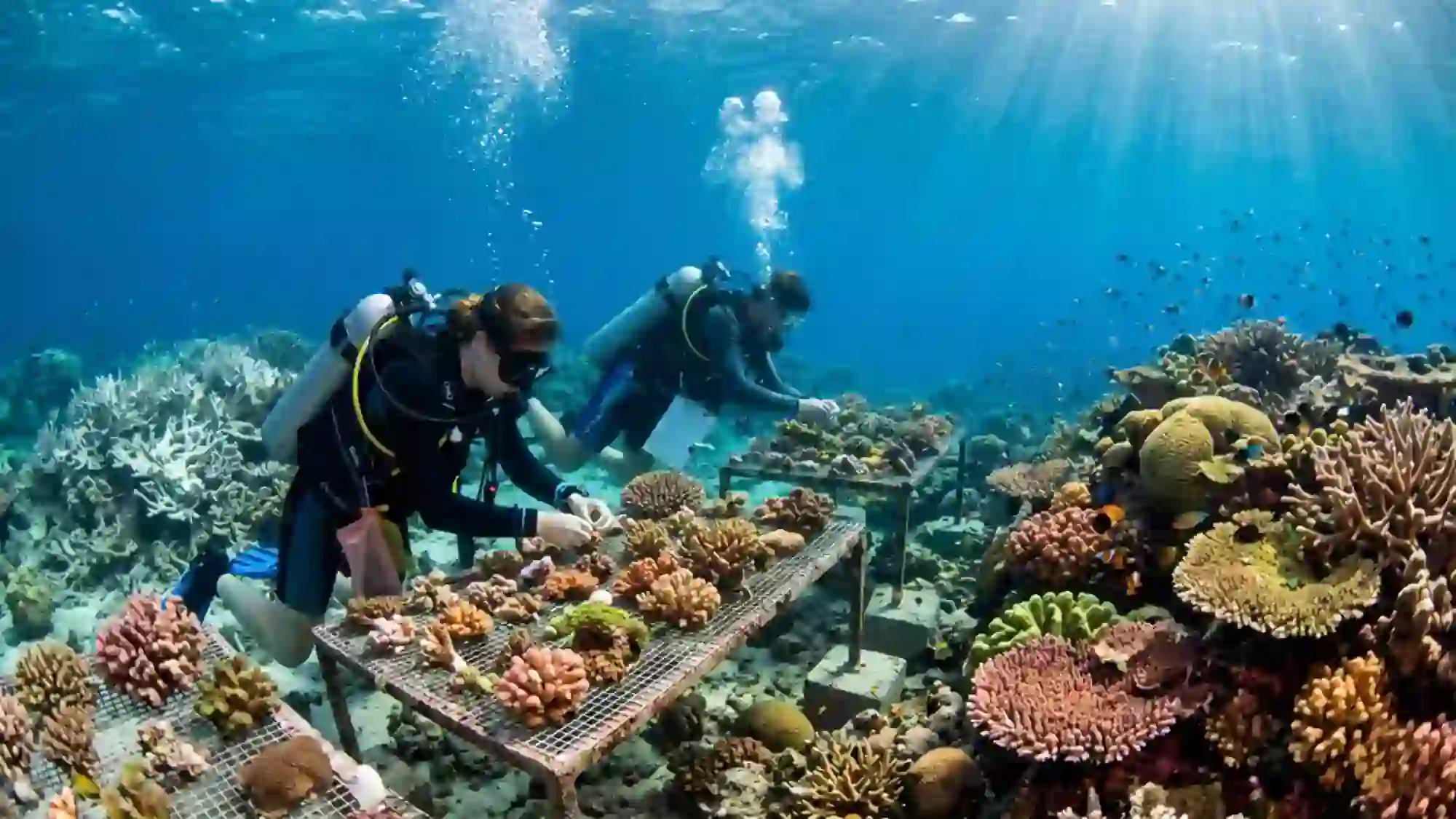
To test this observation, researchers assembled 10 pairs of coral fragments from the same coral animal. Each pair contained one healthy fragment and one bleached fragment. Five pairs were placed in direct contact, while the remaining pairs were kept just a few millimetres apart. The difference was striking. Bleached fragments that touched healthy counterparts recovered fully within seven weeks, while those kept apart died during the experiment. Using powerful microscopy, the researchers discovered that the tissues of genetically identical coral fragments could fuse, creating tiny channels through which materials could pass. Beneficial algae began moving from healthy to bleached fragments within three days, accompanied by nutrients that supported recovery. Even more surprisingly, the corals did not need to remain connected indefinitely. In some experiments, just five days of contact provided enough algae to set recovery in motion. Once inside the bleached coral, the algae multiplied rapidly, doubling approximately every four days during the second week, around ten times faster than rates observed in wild corals.
Could this save coral reefs? The findings offer a promising new direction for coral restoration. Instead of accepting severely bleached corals as lost causes, researchers may be able to develop methods that restore their beneficial algae before prolonged starvation causes irreversible damage. However, there is a major limitation: the demonstrated technique requires healthy, genetically identical coral fragments. Finding suitable partners for every bleached coral across a vast reef would be impractical. The experiment was also conducted under controlled laboratory conditions, so its effectiveness in the open ocean remains uncertain. They are now exploring whether algae could be collected from healthy corals and delivered directly to bleached ones, eliminating the need for physical contact. As marine heat waves become more frequent, helping corals recover quickly could become an important part of reef conservation. This discovery does not remove the underlying threat of warming oceans, but it reveals a remarkable natural recovery mechanism that scientists may one day learn to use at a much larger scale.
Sources:
Jewett, K. (2026, October 14). Stanford scientists discover a way to reverse coral bleaching at record speed. Stanford Doerr School of Sustainability. https://sustainability.stanford.edu/news/stanford-scientists-discover-way-reverse-coral-bleaching-record-speed/