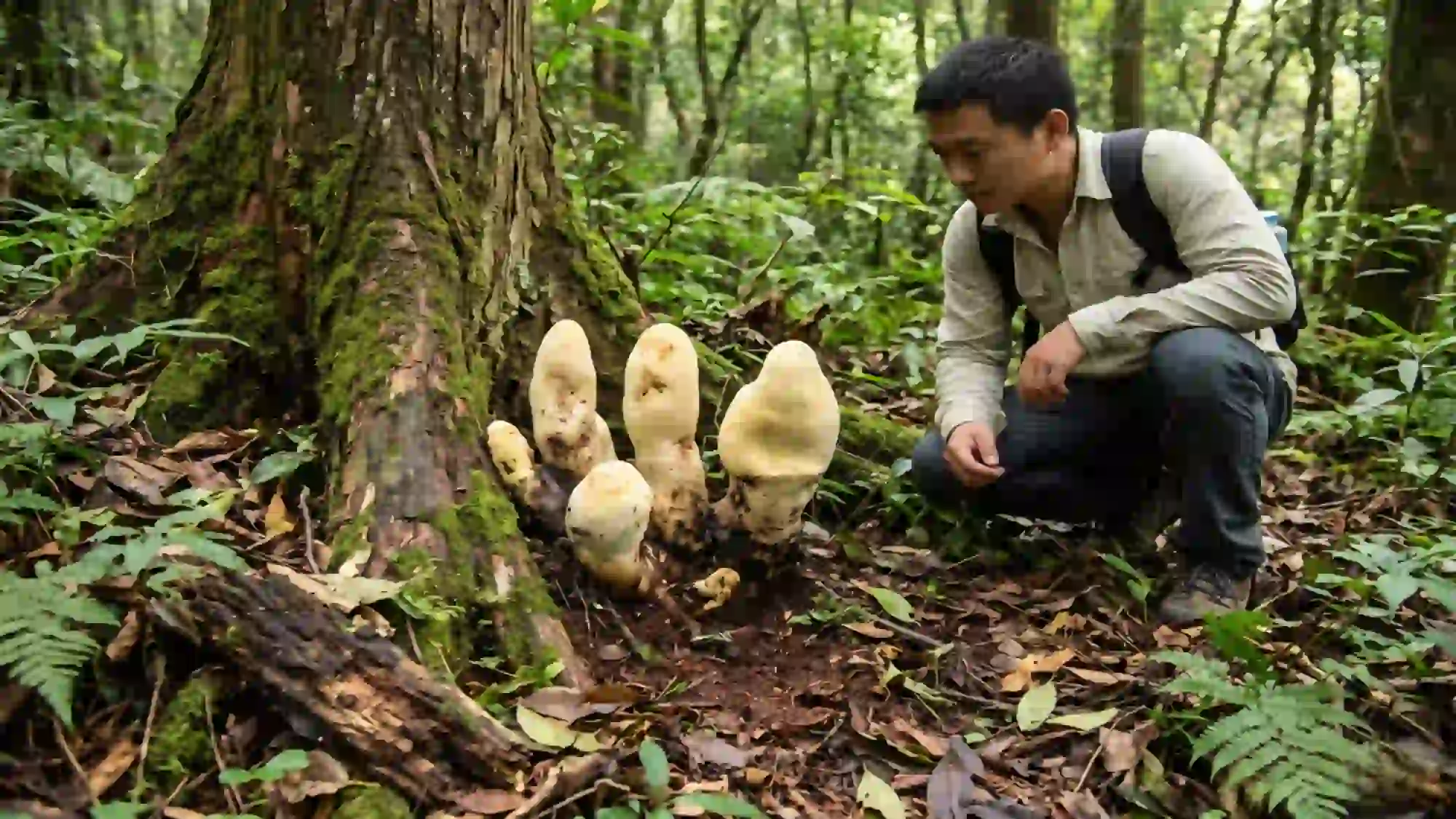
Deep in the forests of southwestern China, scientists have discovered a fungus that looks as extraordinary as its name suggests. Dianjunus rex, nicknamed “D-Rex,” produces pale, upright structures that can reach 50 centimetres in height and weigh as much as 2.2 kilograms. But its remarkable size is only part of the story. Genetic analyses suggest that its previously unknown fungal family traces its evolutionary origins to around 65 million years ago, close to the mass extinction that wiped out the non-avian dinosaurs. The discovery, published in Frontiers in Fungal Biology in September 2026, introduces a new species, genus and family of fungi, expanding scientists’ understanding of fungal diversity and evolution.
Researchers discovered D-Rex during surveys in Yunnan Province, China, where specimens were found growing around woody roots, including those of Chinese cork oak. Its massive reproductive structures, known as stromata, emerge from the ground or near tree roots. Unlike familiar mushrooms, which belong to several different fungal groups, D-Rex is an ascomycete. Members of this group produce spores inside microscopic, sac-like structures called asci. These spores allow the fungus to reproduce and spread into new environments. To determine whether the specimens belonged to a known species, they examined their physical characteristics, studied their spores under microscopes and compared DNA sequences from multiple genetic regions. They also conducted genome-wide analyses. The results consistently placed the fungus on a distinct evolutionary branch within the order Xylariales. Its differences from known relatives were substantial enough for the researchers to establish a new family, Dianjunaceae, with Dianjunus rex as its representative species.
They used molecular-clock analysis to estimate when the new family diverged from its closest known relatives. Their central estimate was approximately 65 million years ago, during the early Paleocene, shortly after the Cretaceous–Paleogene mass extinction around 66 million years ago. That extinction transformed ecosystems worldwide. The loss of enormous numbers of plants and animals altered forests and left substantial quantities of dead organic material behind. The researchers propose that such environmental changes may have created new opportunities for fungi that grow on or decompose woody material. However, the evolutionary estimate spans roughly 50–80 million years. It therefore cannot establish that the extinction directly caused Dianjunaceae to emerge. The timing suggests an intriguing possibility, rather than proving a cause-and-effect relationship.

Why grow so large? D-Rex’s towering reproductive structures may offer an advantage in dense forests. Rising above surrounding vegetation and debris could help its spores disperse through the air, increasing the chances of reaching suitable places to grow. That strategy also comes with a cost. Producing such large structures requires considerable resources, and researchers have yet to test directly whether their size improves reproductive success. The discovery highlights how much fungal diversity remains undocumented, particularly in biodiverse regions of East Asia. By combining fieldwork, microscopy and genomic analysis, scientists can uncover evolutionary branches that would otherwise remain hidden. D-Rex is not a living relic from the age of dinosaurs. Instead, it is a modern fungus carrying clues to a lineage that may have developed during a period of profound ecological change. Its discovery is a reminder that some of the most interesting evolutionary stories are still unfolding beneath our feet.
Sources
Song J, Yan Z, Pérez-Moreno J, Zhang F, Yang S, Xie T, Su L, Liu J, Wang Y, Liu D, Yang Z, Yang C, Liu W, Shi X, Wan S, Cheewangkoon R, Dai D, Senanayake IC and Yu F (2026) Unearthing a fungal giant: Dianjunaceae fam. nov., a novel Paleocene lineage of Xylariales harboring Dianjunus rex gen. et sp. nov. Front. Fungal Biol. 7:1940464. doi: 10.3389/ffunb.2026.1940464