What if one of the most abundant resources on Earth could help us build cheaper batteries? Seawater contains enormous quantities of dissolved sodium, an element that scientists are increasingly exploring as an alternative to lithium in rechargeable energy-storage systems.
The idea is not simply to fill a battery with ocean water. Instead, researchers are designing specialised electrochemical devices that use sodium ions from saltwater or incorporate materials derived from ordinary sea salt. Two related technologies are attracting particular attention: sodium-ion batteries and seawater batteries.
Why Look Beyond Lithium?

Lithium-ion batteries power smartphones, laptops and electric vehicles, but their production depends on extracting and processing particular mineral resources. Sodium is much more abundant in Earth’s crust and oceans, making it an attractive alternative for applications where cost and resource availability matter.
Sodium-ion batteries work on a principle similar to lithium-ion batteries. During charging and discharging, sodium ions move between electrodes through an electrolyte, while electrons travel through an external circuit to deliver electrical energy.
However, sodium ions are larger than lithium ions. This means scientists must carefully design electrode materials that can accommodate sodium without losing performance over repeated charging cycles. Sodium-ion batteries are therefore not identical to lithium-ion batteries, and their energy density and performance depend on the materials used.
What Makes a Seawater Battery Different?
A seawater battery takes the concept further by using seawater directly as part of the electrochemical system.
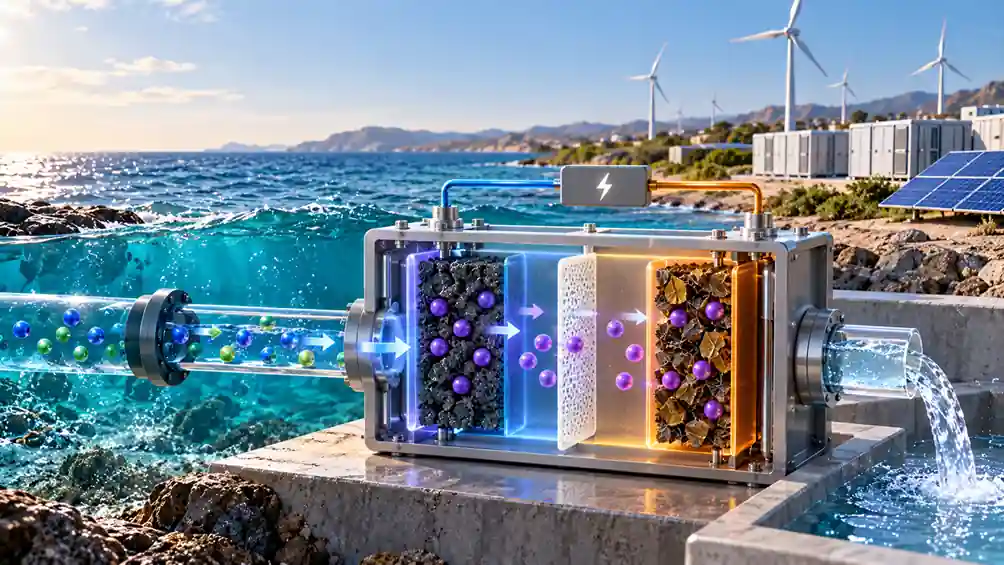
In one design, charging drives sodium ions from seawater through a selective solid electrolyte, where they are stored in the battery’s negative electrode. During discharge, the electrochemical reactions reverse, allowing the battery to release stored energy.

A key challenge is preventing unwanted reactions. Seawater contains chloride and other dissolved ions that can cause corrosion, interfere with electrode chemistry or damage battery components. Engineers must therefore develop selective membranes, stable electrodes and protective materials that allow the desired reactions to occur efficiently.
Researchers are investigating these systems for coastal energy storage, marine equipment and renewable-energy applications. Their potential is particularly interesting where access to abundant seawater could simplify the supply of raw materials.
Could One Battery Also Produce Fresh Water?
An especially promising development is the combination of energy storage and desalination.
Some experimental battery systems selectively remove sodium and chloride ions from saltwater. Depending on the design, this process can reduce salinity while storing or releasing electrical energy.
A 2026 review in Nature Reviews Clean Technology also discusses how seawater batteries could potentially be integrated with desalination, carbon capture and resource recovery. These functions have been demonstrated in different configurations, but combining them efficiently in one durable, commercially practical system remains a challenge.
Are Saltwater Batteries the Future?
Not necessarily for every application. Researchers still need to improve energy density, electrode durability, charging efficiency, corrosion resistance and manufacturing costs. Seawater batteries also require specialised components; abundant saltwater alone does not make a battery inexpensive or environmentally harmless.
Nevertheless, the technology could be valuable for stationary energy storage, coastal infrastructure and systems designed to operate alongside renewable energy. The breakthrough is not that seawater can magically become electricity. It is that its abundant sodium ions may help us store electricity using alternative materials and perhaps combine energy storage with fresh-water production.
Sources:
Kim, D., Kim, Y., & Passerini, S. (2026). Seawater batteries for energy storage, desalination and carbon sequestration. Nature Reviews Clean Technology, 2, 290–304. https://doi.org/10.1038/s44359-026-00158-1
Choi, M. C., Seo, H., Yeon, J.-M., Heo, B., Choi, S.-Y., Na, B. T., Park, S., Ravichandran, M., Britton-Gray, F., Cheong, J. Y., Kim, Y., & Kim, Y. (2025). Critical advances in seawater battery technology: From system architecture to anode materials. Korean Journal of Chemical Engineering, 42(7), 1411–1425. https://doi.org/10.1007/s11814-025-00419-y