What if you could destroy a tumour without cutting into the body, burning it or using ionising radiation?
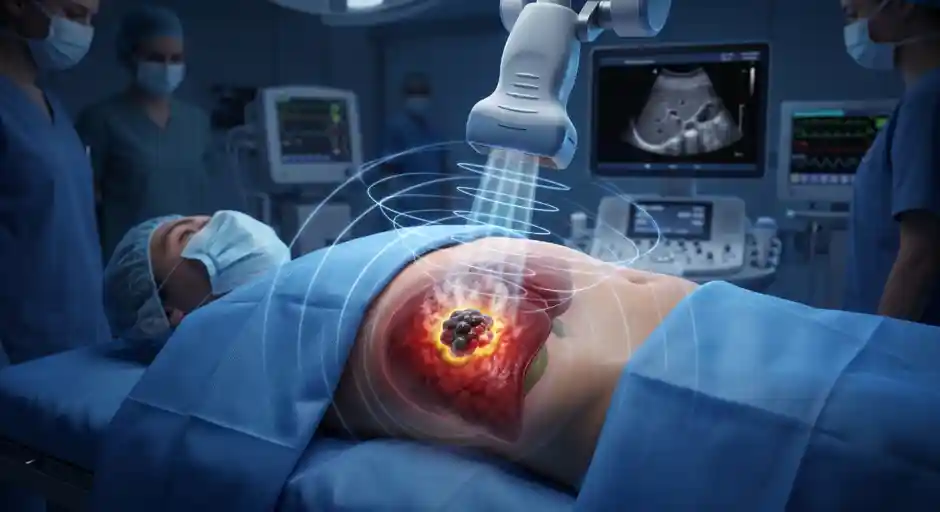
A technology called histotripsy is making that possibility real for certain liver tumours. The treatment uses precisely focused ultrasound pulses to mechanically destroy targeted tissue. In the United States, the FDA has authorised the Edison System for the non-invasive destruction of liver tumours, including unresectable tumours. But this isn’t simply a stronger version of an ultrasound scan. The system concentrates sound energy inside the tumour. When the acoustic pulses reach the target, they generate microscopic bubbles. These bubbles rapidly expand and collapse, creating mechanical forces that disrupt the tumour tissue at a microscopic level.
Unlike some existing ablation techniques, histotripsy is designed to destroy tissue without relying primarily on heat. The FDA classifies the Edison System as a focused-ultrasound system for non-thermal, mechanical tissue ablation. And because the sound waves can be focused from outside the body, the procedure does not require an incision or a needle to reach the tumour. The treating physician uses imaging to identify and plan the target, while the system delivers the acoustic pulses to the selected region.
The idea is particularly interesting for liver tumours that may be difficult to remove surgically. In the clinical study, researchers tested the system in patients with unresectable liver tumours. The study involved 44 participants across sites in the United States and Europe and evaluated whether the system could achieve effective tumour ablation while maintaining an acceptable safety profile. The FDA has not approved histotripsy as a replacement for chemotherapy, radiation or surgery, nor has it established that the technology improves cancer survival. HistoSonics itself states that the FDA has not evaluated the system for cancer treatment outcomes such as local tumour progression or overall survival. That distinction matters because destroying a tumour is not necessarily the same thing as curing cancer. Patients can have microscopic disease elsewhere in the body, and different cancers require different treatment strategies.
Histotripsy is therefore better understood as a new local tumour-destruction technology, rather than a universal replacement for conventional cancer treatment. Still, the underlying idea is remarkable. Instead of cutting a tumour out, heating it until it dies or exposing it to radiation, physicians can focus sound energy on a precise location and use microscopic bubbles to physically tear the tissue apart. The future of cancer treatment may not always involve attacking cells with drugs or radiation.
Sometimes, scientists may simply shake the tumour apart.
Sources: