When a new memory is formed, some connections between brain cells become stronger. A protein called CaMKIIα is one of the key molecules involved in this process, and scientists have now watched individual CaMKIIα complexes organize themselves into chain-like structures.
The discovery offers a closer look at what happens inside a synapse, the tiny junction where one neuron communicates with another. CaMKIIα is found in large amounts at these connections. It normally exists as a ring-shaped complex called a holoenzyme, made up of about 12 protein subunits. When calcium levels rise inside a neuron, the calcium-binding protein calmodulin activates CaMKIIα, allowing it to help modify other proteins involved in strengthening synaptic connections.
But activation may do more than simply switch the protein’s activity on.
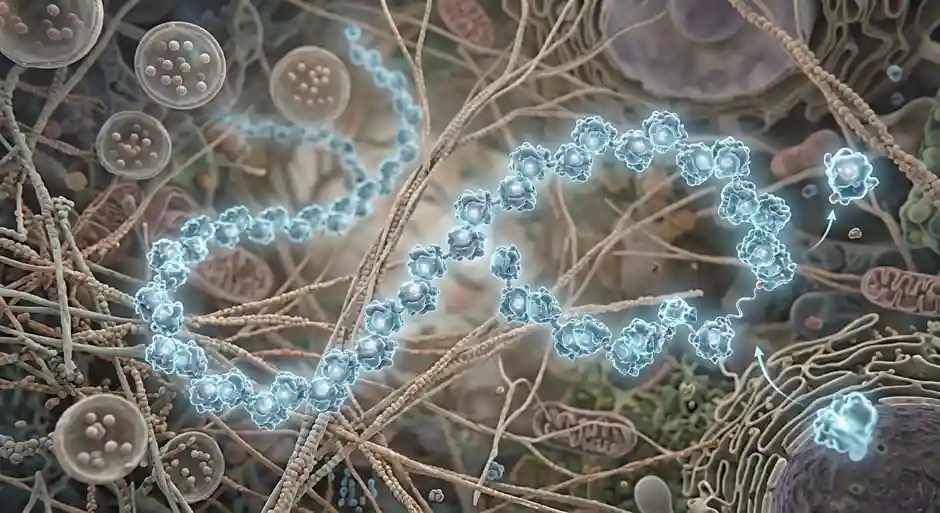
Researchers from Kanazawa University and other Japanese institutions used high-speed atomic force microscopy, which can track individual molecules at very high resolution, to watch CaMKIIα complexes interact. Under freely moving conditions, the complexes mostly remained separate. More than 95% appeared as individual particles. The researchers then recreated two features of the environment inside a synapse: high molecular crowding and restricted movement. Under these conditions, CaMKIIα complexes began connecting to one another through their kinase domains, forming stable chains containing several holoenzymes.
When the researchers activated CaMKIIα, these chains grew larger. Activation causes part of the protein to move outward, increasing the distance between neighboring complexes by about four nanometres. A chemical modification called autophosphorylation also helped stabilize the larger structures. The team also examined a P212L mutation in CaMKIIα that is associated with neurodevelopmental disorders. Unlike the normal protein, the mutated version formed extensive clusters even without activation, suggesting that the mutation alters how the protein normally controls its organization. Importantly, the experiments were performed using purified proteins in a controlled system rather than inside living neurons. The researchers therefore still need to determine whether the same chain-like structures form inside actual synapses.
Still, the finding adds another layer to our understanding of memory: a protein involved in strengthening synapses may not simply become more active during learning, it may also reorganize itself into larger molecular assemblies that help shape how those connections function.
Source: