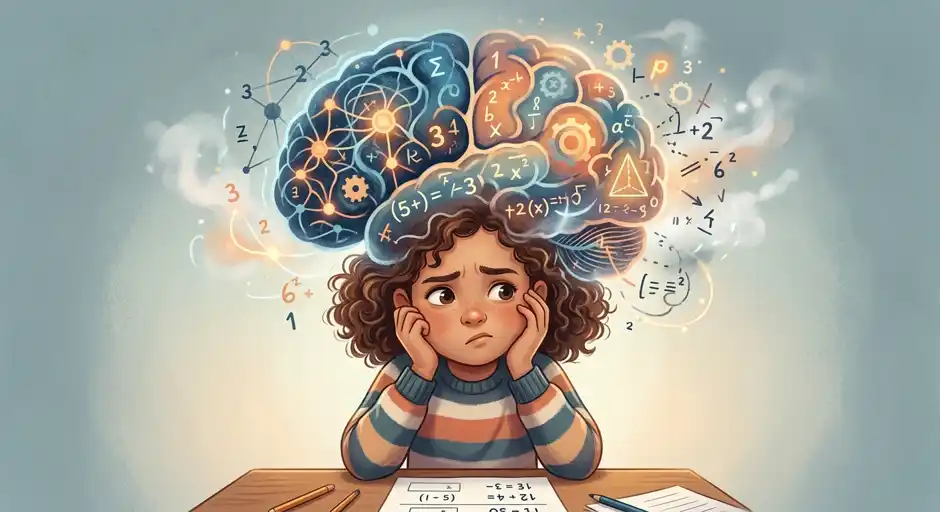
For some children, struggling with math is not simply a matter of not knowing the right answer. They may also have difficulty deciding how to approach a problem, when to change strategies and how to adjust after making a mistake.
A new study has found that these differences in problem-solving are linked to distinct patterns of brain activity in children with developmental dyscalculia, a learning disorder that causes persistent difficulties with mathematics. Researchers from Stanford University studied 68 children between 8 and 10 years old. The children completed mathematical tasks while researchers examined both their problem-solving behavior and brain activity.
They found that children with developmental dyscalculia were less efficient at using different strategies to solve problems. They took longer to switch from one strategy to another and were less responsive to changes in how difficult a problem was. They also showed less improvement in choosing the most appropriate strategy as they continued working. That suggests the difficulty may involve more than basic numerical skills.
Solving a problem requires the brain to keep track of what is happening, decide whether a strategy is working and change course when necessary. These abilities rely on cognitive control, a set of mental processes involved in directing attention, working with information and adapting behavior. It was found that activity within a brain system involved in these processes could distinguish children with developmental dyscalculia from children who were more proficient at using mathematical strategies. Importantly, patterns of brain activity were also able to predict how well children performed tasks such as counting and switching between problem-solving strategies.
However, this does not mean that a brain scan can currently diagnose dyscalculia or determine whether an individual child will struggle with mathematics. The study involved a relatively small group of children, and the researchers describe dyscalculia as involving multiple cognitive and neural processes rather than a single brain abnormality. The findings instead point toward a broader way of understanding mathematical learning. Sometimes, the challenge may not be knowing more math, but knowing when to stop, rethink a strategy and try another way.
Source: