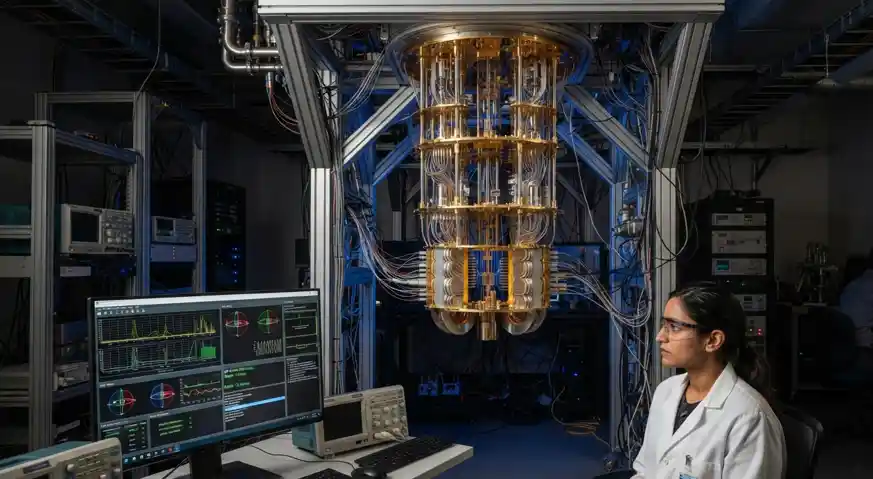
Quantum computers are often hyped as the “next big leap” in computing, but they have a fragility problem that traditional computers never had to deal with. A team at Bengaluru’s Raman Research Institute (RRI) has just demonstrated a clever trick to help fix it, and the core idea comes down to one word: timing.
First, the Basics: Why Quantum Computers Are So Different
Your laptop stores and processes information as bits: simple switches that are either a 0 or a 1. Quantum computers instead use qubits, which exploit strange quantum properties like superposition (existing in a mix of 0 and 1 at once) and entanglement (where two particles become linked, so that acting on one instantly affects the other, even if they’re physically far apart). This is what gives quantum computers their theoretical power. For certain problems, they could vastly outperform even the world’s fastest supercomputers. But it also makes them incredibly delicate.

The Problem: Quantum Information “Forgets” Itself
Entangled qubits don’t stay entangled forever. Left alone, they interact with their surrounding environment: heat, vibration, electromagnetic noise, and gradually lose their special quantum properties, what physicists call decoherence.
Sometimes this decay is gradual, sometimes it isn’t. Entanglement can vanish suddenly, well before the underlying decay process is even complete, an effect physicists evocatively call “entanglement sudden death.” This is one of the single biggest obstacles to building reliable, large-scale quantum computers: your calculation can lose its quantum advantage before you’re even done computing.
The RRI Experiment: A Well-Timed “Flip”
A team at RRI’s Quantum Information and Computing (QuIC) lab, led by Prof. Urbasi Sinha, working with collaborators from the University of Calgary and Louisiana State University, set out to see if this “sudden death” could be delayed or avoided entirely. Here’s the elegant part of their setup: they used pairs of entangled photons (particles of light), using the photons’ polarization (the orientation in which light waves oscillate) to stand in for a simple two-level quantum system (an “excited” state and a “ground” state). Left alone, these states naturally decay from excited to ground, weakening the entanglement between the photon pair along the way.
Instead of just letting that decay happen, the team applied a single, precisely-timed “flip” operation, essentially swapping the excited and ground state populations at just the right moment using an optical device called a waveplate. The striking result: it wasn’t just what operation they applied that mattered: it was exactly when they applied it. Depending on the timing:

- The entanglement’s “sudden death” could be delayed.
- In some cases, it could be avoided altogether.
As lead scientist Saumya Ranjan Behera put it, the point in the decay process at which the single flip operation is applied determines whether the sudden death is avoided, delayed, or even hastened. In other words, timing itself became a tool for controlling a quantum system, not just a background detail of the experiment.
An Unexpected Theoretical Bonus
Interestingly, the experimental results didn’t neatly match either of the two standard textbook models physicists use to describe how quantum systems lose information to their environment. Rather than being an error, the team’s theorists eventually realized the experiment sat exactly on a curve connecting both existing models, and found a “tuning parameter” that lets a single experimental setup represent both noise models, and everything in between. What first looked like a complication turned into one of the more interesting theoretical findings of the study.
Why This Matters
To be clear: this isn’t a full fix for decoherence, and it doesn’t replace existing quantum error-correction techniques. Researchers describe it as a proof-of-concept, offering a complementary tool. But if fragile entangled states can be nudged to survive a little longer with something as simple as a well-timed operation, it could feed into the broader toolbox scientists are building to make quantum hardware more stable and reliable, a challenge every major quantum computing effort worldwide is racing to solve.
The study was partly funded by the Department of Science and Technology’s National Quantum Mission, India’s flagship program to build domestic quantum computing capability.
References
Behera, S. R., Sen, K., Roy, A. S., Ray, S., Singh, A., Rau, A. R. P., & Sinha, U. (2026). Temporal steering of entanglement decay with single-shot control. Physical Review A. https://doi.org/10.1103/84n3-bcz8
Raman Research Institute. (2026, September 7). Scientists uncover a way to outsmart quantum entanglement loss with a single move. https://www.rri.res.in/highlights/scientists-uncover-way-outsmart-quantum-entanglement-loss-single-move