
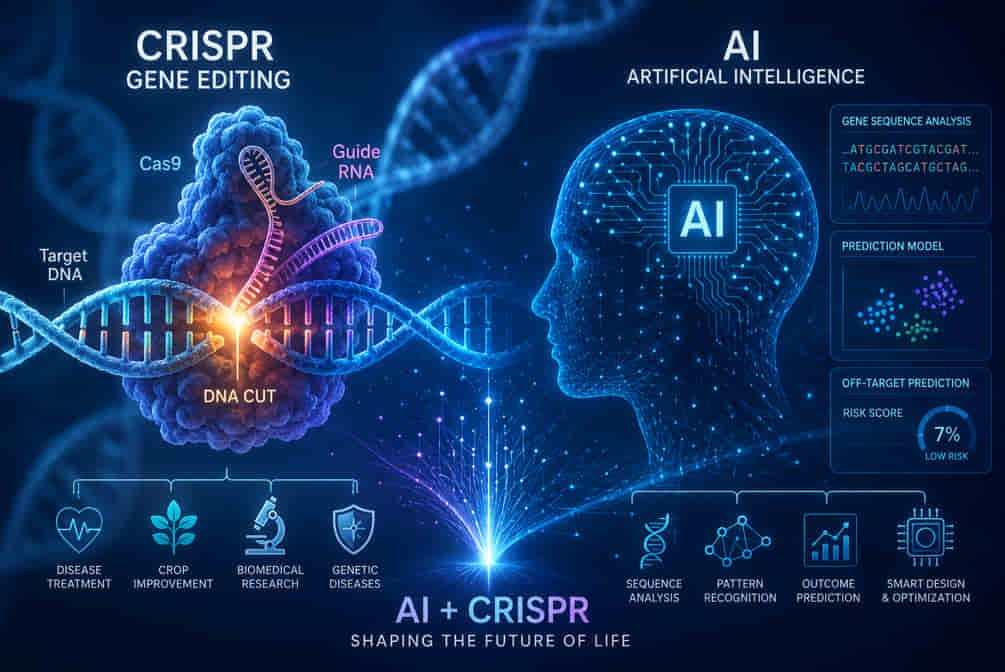
Imagine trying to fix a single spelling mistake in a book with millions of letters. One wrong move could change the meaning of an entire chapter. That is exactly the challenge scientists face while editing our DNA. For years, CRISPR has been called the “molecular scissors” of biology because it can cut DNA at specific locations. But even the sharpest scissors can sometimes slip. Now, Artificial Intelligence (AI) has entered the laboratory like a wise navigator saying, “Don’t worry, I’ll help you find the exact destination.” Together, AI and CRISPR are turning gene editing from a game of chance into a science of precision. As the old proverb says, “Measure twice, cut once.” In modern biology, AI is helping scientists do exactly that.
CRISPR, which stands for Clustered Regularly Interspaced Short Palindromic Repeats, is a revolutionary gene-editing technology adapted from a natural defence system found in bacteria. It works with an enzyme, usually Cas9, and a small guide RNA that acts like an address label. The guide RNA leads Cas9 to a specific DNA sequence, where the enzyme cuts the DNA. Scientists can then remove, replace, or repair faulty genes that cause inherited diseases.
However, sometimes the guide RNA mistakes a similar DNA sequence for the real target. This “wrong address delivery” creates off-target effects, which may introduce unwanted mutations. AI acts like a smart GPS that studies millions of previous editing experiments and predicts which guide RNA will reach the correct destination safely and accurately. Instead of asking, “Should we try this?” researchers can now ask AI, “Which path has the highest chance of success?”
Different AI models are trained for different CRISPR tasks. Deep learning algorithms analyze enormous genomic datasets to predict editing efficiency, identify off-target sites, and estimate the final editing outcome before any laboratory experiment begins. Beyond the original CRISPR-Cas9 system, newer technologies such as Base Editors and Prime Editors make far more delicate genetic changes without creating large DNA breaks.
| “True progress begins when human curiosity joins hands with intelligent technology to rewrite the impossible.” |
If CRISPR is like using scissors, Base Editing is like changing a single letter with a pencil, while Prime Editing works like a “find and replace” function in a word processor. AI helps choose the best editing strategy for every genetic problem, reducing trial-and-error experiments, saving valuable time, and lowering research costs. As CRISPR proudly says, “I can cut,” AI replies, “And I can show you exactly where.”
Scientists recently trained a large AI language model using information from over one million naturally occurring CRISPR systems found in bacteria. Instead of simply analysing existing proteins, the AI designed an entirely new gene-editing protein called OpenCRISPR-1. Surprisingly, this synthetic protein successfully edited human DNA even though it closely resembled no naturally occurring CRISPR protein.
This marks the first successful demonstration of an AI-designed, non-natural gene-editing system functioning inside human cells. Computational biology, structural bioinformatics, protein language models, and machine learning are now converging to create next-generation genome engineering platforms. These innovations could improve therapies for inherited disorders such as sickle cell disease, cystic fibrosis, muscular dystrophy, and several forms of inherited blindness. In many ways, AI is no longer just assisting biology, it is becoming biology’s creative partner.
| Gene -editing job | What it needs to figure out | AI architecture used | Example models |
| Picking a good guide RNA | “Will this guide cut where I want?” | Convolutional neural networks (CNNs) good at spotting patterns in sequence data | DeepCRISPR, DeepSpCas9 |
| Avoiding wrong cuts | “Could this guide also cut somewhere else by mistake?” | Recurrent networks (RNN, LSTM, GRU) -good at reading sequences step-by-step, like sentences | CRISPR-Net, CRISPR-DIPOFF |
| Ranking risk across the genome | “How risky is this guide overall?” | Gradient-boosted decision trees (XGBoost) – good at combining many small clues into one score | XGBoost off-target classifiers |
| Adapting to a new organism with little data | “Can I reuse what I learned elsewhere?” | Transfer learning -retrains a model on a small new dataset instead of starting over | crisprHAL |
| Predicting base-editing precision | “Will it edit cleanly, or hit nearby letters too?” | Attention-based deep learning — learns which parts of the sequence matter most | BE-Hive, BE-DICT |
| Predicting prime-editing success | “Will the cell’s own repair machinery undo my edit?” | Deep learning trained on cell-repair behavior, not just DNA sequence | PRIDICT2.0, ePRIDICT |
| Designing brand-new editing proteins | “Can AI invent a working protein that doesn’t exist in nature?” | Protein language models + structure prediction -write and fold new proteins the way a chatbot writes sentences | ProGen2, ProteinMPNN, AlphaFold2/3 |
The future of medicine may not belong only to better tools, but to smarter ones. CRISPR gave scientists the molecular scissors. AI is teaching them when to cut, where to cut, and when not to cut. Together, they are transforming gene editing from a promising invention into a finely tuned engineering masterpiece. Like a skilled surgeon guided by the brightest map, science is moving steadily towards safer, faster, and more personalized genetic medicine.
Source:
Kim, M. G., Go, M. J., Kang, S. H., Jeong, S. H., & Lim, K. (2025). Revolutionizing CRISPR technology with artificial intelligence. Experimental & Molecular Medicine, 57(7), 1419-1431.


