
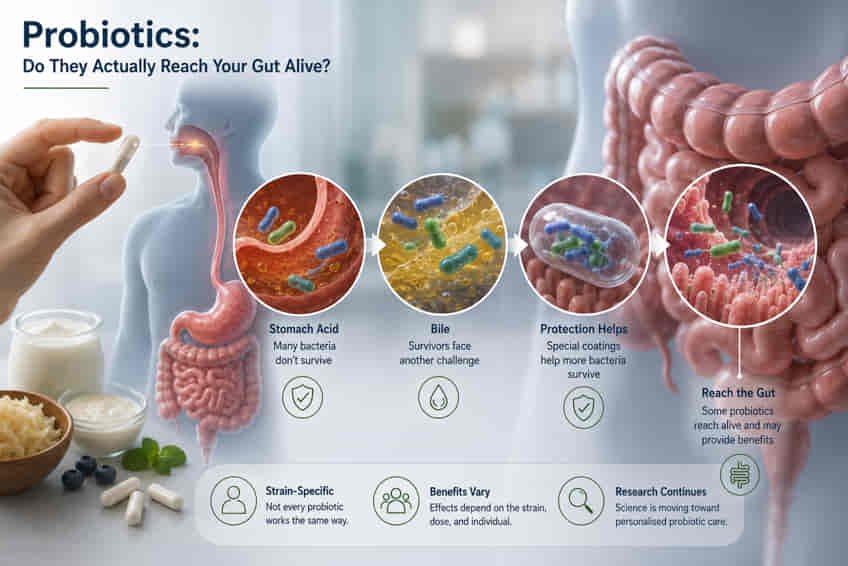
Walk into any pharmacy or supermarket today, and you’ll see colourful bottles of probiotic capsules, drinks, and yoghurts promising a happier tummy and better digestion. But have you ever wondered, “Do these tiny ‘good bacteria’ really make it all the way to the gut alive?” Imagine sending a group of brave travellers on a difficult journey. Before they reach their destination, they must cross a river, climb a mountain, and survive a storm. Only the strongest travellers complete the trip. Probiotics face a similar adventure inside your body.
If these tiny bacteria could talk, they might say, “Wish us luck, we’re entering one of the toughest places on Earth!” The good news is that many of them do survive. The bad news? Not every probiotic is strong enough for the journey. As the old proverb says, “The proof of the pudding is in the eating.” Likewise, the real value of a probiotic lies not in the label but in whether it reaches your gut alive and does its job.
The journey begins the moment you swallow a probiotic. The first obstacle is the stomach, which contains powerful hydrochloric acid. Think of the stomach as the body’s security guard. It checks everything that enters and destroys harmful germs before they can cause trouble. Unfortunately, this security guard cannot always tell the difference between good and bad bacteria. Many probiotics are destroyed here. Those that survive must then pass through bile, a digestive fluid released into the small intestine. Bile helps digest fats, but it can also damage bacterial cells.
| “Good health isn’t about winning one big battle—it’s about millions of tiny helpers quietly doing their job every single day. Sometimes, the smallest passengers make the biggest difference.” |
Only the toughest bacteria continue the journey. Some probiotic species, especially Lactobacillus and Bifidobacterium, are naturally stronger and better equipped to survive these harsh conditions. To give them an extra helping hand, scientists also use special protective coatings and delayed-release capsules that act like a raincoat or armour, protecting the bacteria until they safely reach the intestine.
From a biological point of view, reaching the intestine is only half the battle. Most probiotics do not permanently settle in the gut like new neighbours moving into a colony. Instead, they are more like friendly visitors who stay for a while, help with the cleaning, and then quietly leave. During their stay, they may improve digestion, compete with harmful microbes, strengthen the intestinal barrier, and support the immune system. However, different probiotic strains perform different jobs. One strain may help reduce antibiotic-associated diarrhoea, while another may support people with irritable bowel syndrome (IBS), and a third may have no effect at all for the same condition. This is why scientists say probiotics are strain-specific. Simply seeing the word “probiotic” on a product does not guarantee that it will benefit everyone in the same way.
From an advanced scientific perspective, probiotic survival depends on several important factors, including acid tolerance, bile salt resistance, adhesion to intestinal epithelial cells, metabolic activity, and interaction with the host microbiome. Modern formulations use technologies such as microencapsulation, enteric-coated capsules, and controlled-release delivery systems to improve bacterial viability during gastrointestinal transit. Even after surviving, most probiotic strains show only transient colonisation, meaning they influence the gut microbiota temporarily rather than becoming permanent residents. Their benefits arise through multiple mechanisms, including the production of short-chain fatty acids (SCFAs), competition with pathogenic microbes, modulation of immune responses, and maintenance of intestinal barrier integrity.
Researchers are now moving towards personalised probiotics, where specific strains are selected based on an individual’s gut microbiome, health condition, and genetic background. Until then, experts agree that probiotics are helpful tools, not magic bullets. A balanced diet rich in fibre, fruits, vegetables, whole grains, yoghurt, and fermented foods remains the strongest foundation for a healthy gut. After all, a healthy gut is like a well-tended garden, it flourishes not because of one special seed, but because it is cared for every single day.


