
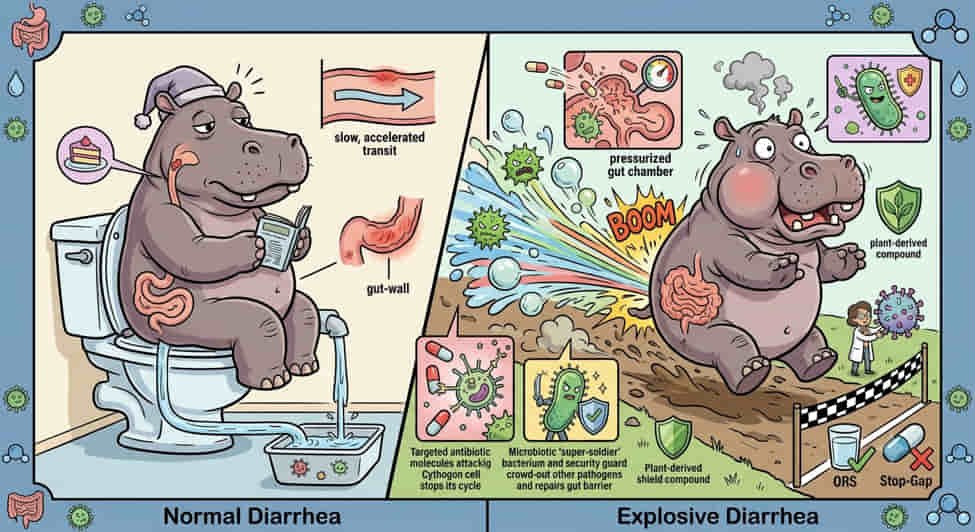
Imagine you are travelling to work or enjoying a family dinner when, without warning, your stomach starts cramping. Within minutes, you are desperately searching for the nearest washroom. Most of us simply call this “food poisoning” or a “bad stomach.” But not all diarrhea is the same. Sometimes it is a slow leak, while at other times it feels like a dam has suddenly burst open. Doctors often refer to the second type as explosive diarrhea because it is accompanied by an urgent, forceful release of watery stool, usually with loud gas and severe cramps.
If your gut could speak, it would probably shout, “Danger detected! Everybody out!” It may sound dramatic, but this is actually your intestine trying to protect you. As the old saying goes, “A stitch in time saves nine.” Understanding why your gut behaves differently can help you respond wisely instead of panicking.
To understand the difference, think of your intestine as a long water pipeline. Normally, food moves slowly through this pipe while the large intestine quietly absorbs water, leaving behind a soft, formed stool. During ordinary diarrhea, the intestine becomes mildly irritated due to spoiled food, stress, mild viral infections, or certain medicines. As a result, food moves too quickly, and there is not enough time to absorb water. The stool therefore becomes loose and watery, but the pressure inside the intestine remains relatively low. Explosive diarrhea is a completely different story.
Harmful bacteria, viruses, or parasites release toxins that make the intestinal cells pump huge amounts of water and salts into the gut. At the same time, these microbes produce gases such as hydrogen, methane, and carbon dioxide. Imagine inflating a balloon while filling it with water. Sooner or later, the pressure becomes too great. When the muscles around the anus relax, the trapped gas pushes the watery stool out with great force. It is less like turning on a tap and more like opening a pressure cooker.
| “Your gut is not just a food pipe, it is a highly trained security force. Most days it quietly keeps the peace, but when danger enters, it can launch an emergency evacuation at full speed.” |
From a biological point of view, regular diarrhea is often caused by increased intestinal motility or reduced absorption of water from the colon. Explosive diarrhea, however, usually involves active secretion of electrolytes and water into the intestinal lumen. This process is triggered by pathogens such as enterotoxigenic Escherichia coli, Vibrio cholerae, Rotavirus, Norovirus, or parasites like Cyclospora. Many of these organisms produce toxins that activate chloride channels such as the CFTR channel in intestinal epithelial cells. As chloride ions move into the gut, sodium and water follow by osmosis, producing large volumes of watery stool. Simultaneously, bacterial fermentation generates gases that increase pressure inside the bowel.
Scientists are now developing better treatments beyond simply stopping diarrhea. Researchers have identified helpful probiotics such as Lactobacillus rhamnosus GG and Saccharomyces boulardii, which act like friendly neighbours saying, “Don’t worry, we’ll keep the troublemakers away.” These beneficial microbes strengthen the intestinal barrier, compete with harmful pathogens, and may shorten the duration of illness. New research is also exploring plant-derived polyphenols and improved medicines against stubborn parasites like Cyclospora, while vaccines against Norovirus are moving steadily through clinical trials.
From an advanced scientific perspective, acute infectious diarrhea represents a complex interaction between microbial virulence factors, epithelial ion transport, immune signalling, and the intestinal microbiome. Secretory diarrhea results from dysregulated cyclic AMP, cyclic GMP, or intracellular calcium signalling pathways that stimulate chloride secretion while inhibiting sodium absorption. This creates a powerful osmotic gradient, driving rapid fluid loss into the intestinal lumen. The accompanying dehydration can quickly lead to electrolyte imbalances, including hyponatraemia and hypokalaemia, especially in children and older adults. This is why the greatest danger is often not the infection itself but the loss of water and essential salts.
Oral Rehydration Solution, or ORS, remains one of medicine’s greatest success stories because it uses the sodium-glucose co-transporter (SGLT1) to maximise water absorption even when diarrhea is severe. However, medicines such as loperamide should be used cautiously, especially when fever or bloody diarrhea is present, because slowing the bowel may trap invasive pathogens inside. Seek medical care immediately if diarrhea lasts longer than 48 hours, is accompanied by persistent vomiting, high fever, blood in the stool, severe dehydration, or confusion. In the end, your intestine is not trying to make your life miserable. It is fighting a microscopic war on your behalf, proving once again that sometimes the body’s most uncomfortable responses are actually its smartest survival strategies.


