
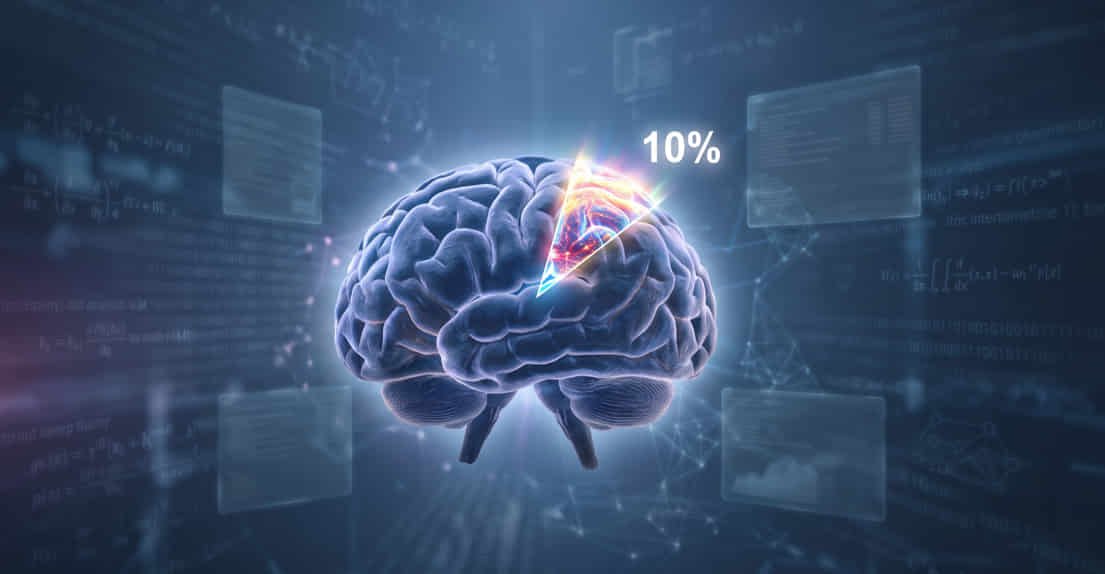
“Imagine what humans could achieve if we used 100% of our brains.”
It’s a claim that appears in motivational talks, movies, and on social media. But is there really a hidden 90% of the brain waiting to be unlocked?
The short answer is no.
Your brain is one of the most energy-hungry organs in the body. Although it makes up only about 2% of your body weight, it uses around 20% of your body’s energy. It wouldn’t make sense for the body to spend so much energy maintaining brain tissue that serves no purpose.
So why does it seem like we aren’t using all of it?
The brain is divided into different regions, each responsible for specific tasks. For example, the occipital lobe processes visual information, the temporal lobe helps us hear sounds and form memories, the parietal lobe processes touch and spatial awareness, and the frontal lobe is involved in decision-making, planning, movement, and problem-solving. Other specialised areas, such as Broca’s area and Wernicke’s area, play key roles in producing and understanding language. These regions aren’t all active at the same time because they don’t need to be. Just as every employee in an office isn’t performing the same task simultaneously, different parts of the brain become more active depending on what you’re doing.
Another clue comes from injury and medicine. If large portions of the brain were truly unused, damage to those areas shouldn’t matter. But doctors know that injuries to almost any part of the brain can affect movement, speech, memory, vision, emotions, or personality. This tells us that nearly every region has an important role.
The brain is always working, even when you’re resting or asleep. Rather than using only 10% of it, we use different parts for different tasks, constantly switching between networks to help us think, move, feel, and learn.


