
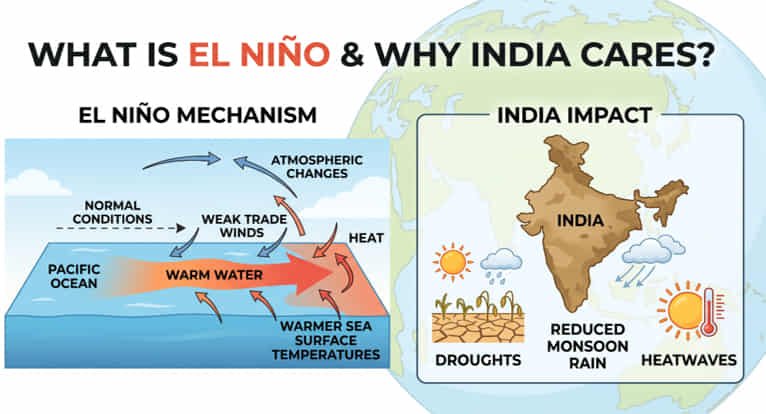
At first glance, it seems impossible that a change in the Pacific Ocean could affect rainfall in India. However, the Earth’s oceans and atmosphere are constantly connected.
Every year, steady winds blow across the Pacific Ocean, pushing warm surface water towards Asia and Australia. This allows colder, nutrient-rich water to rise near the west coast of South America, helping keep the ocean in balance.
Think of the Pacific Ocean as a giant engine that helps drive the Earth’s weather. In most years, this engine operates in a predictable way, with winds pushing warm water westward. Every few years, however, the engine changes gears. The winds weaken, warm water spreads eastward, and weather patterns around the world begin to shift. This change in the Pacific Ocean’s temperature is known as El Niño.
For India, El Niño often means a weaker southwest monsoon. Rainfall may become less consistent and more uneven. Some regions may receive below-average rainfall, while others experience short bursts of heavy rain followed by long dry spells.
The effects are not the same across the country. Northwest and central India are more likely to experience lower rainfall and hotter conditions. Southern and peninsular India may also receive less rainfall in some years. Northeastern India can experience below-average rainfall as well, although local weather systems continue to play an important role. Even within the same monsoon season, one city may experience flooding while another faces dry conditions.
However, El Niño does not act alone. Another climate pattern, called the Indian Ocean Dipole (IOD), measures the difference in sea surface temperatures between the western and eastern parts of the Indian Ocean. These temperature differences influence wind patterns and rainfall across India, sometimes weakening or strengthening the effects of El Niño. This is why meteorologists do not rely on El Niño alone when predicting the monsoon.
El Niño is a reminder that the Earth’s oceans and atmosphere are deeply interconnected. A relatively small rise in ocean temperature in one part of the world can influence rainfall, agriculture, water availability, and daily life thousands of kilometres away.


