
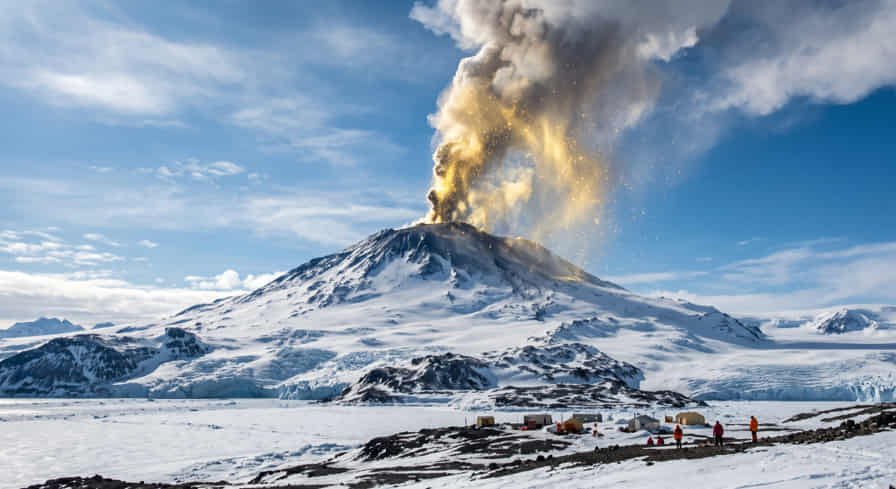
When we think of volcanic eruptions, we usually imagine glowing lava, thick clouds of ash, and rivers of molten rock—not gold. Yet deep in Antarctica, Mount Erebus, one of the world’s southernmost active volcanoes, does something truly extraordinary. Along with steam and volcanic gases, it releases tiny crystals of real gold into the atmosphere.
Scientists estimate that Mount Erebus emits about 80 grams of crystalline gold every day. Over the course of a year, that amounts to nearly 29 kilograms (about 64 pounds) of gold, worth more than US$2 million at current market prices. At first, this may sound like an incredible source of wealth. However, there is a catch: the gold particles are far too small to be collected economically.
The volcano does not eject gold nuggets or glittering flakes. Instead, it produces microscopic crystals, each measuring up to 60 micrometres across—about the width of a human hair. These tiny particles are so light that they are swept high into the atmosphere by hot volcanic gases. Powerful Antarctic winds then carry them across vast distances. In fact, scientists have detected traces of volcanic gold in snow samples collected as far as 1,000 kilometres away from Mount Erebus.
So, where does this unusual gold come from?
The answer lies deep beneath the volcano. Molten rock, or magma, naturally contains tiny amounts of dissolved metals, including gold. As the magma rises toward the surface, pressure decreases, allowing dissolved gases to escape—much like bubbles fizzing out of a freshly opened soft drink. These hot volcanic gases carry minute quantities of gold. As they cool while rising through the volcano’s vent, the gold crystallises into microscopic particles before being released into the air.
Although the amount of gold sounds impressive, the particles are far too dispersed and too tiny to recover. Instead of making anyone rich, they provide scientists with valuable clues about the hidden chemical processes occurring deep inside the Earth. By studying these microscopic crystals, researchers can better understand how magma behaves, how volcanic gases transport metals, and how volcanoes release elements into the atmosphere.
Mount Erebus reminds us that even one of the coldest places on Earth can hide some of nature’s most surprising treasures.


