
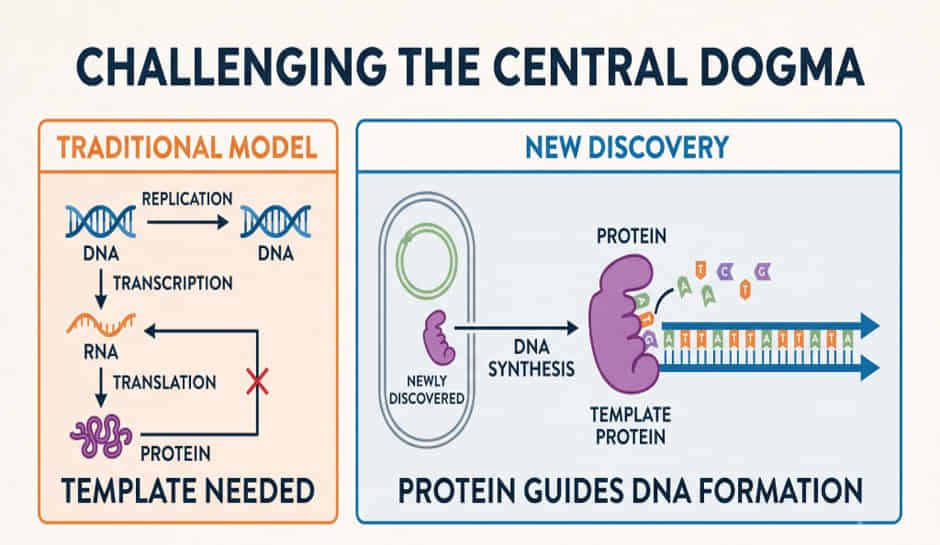
For decades, biology students have learned one of the most fundamental ideas in life science: the Central Dogma. Proposed by Francis Crick in 1958, it explains how genetic information normally flows inside living cells: DNA → RNA → Protein. In simple terms, DNA stores the genetic instructions, RNA carries those instructions, and proteins perform most of the work that keeps cells alive.
One of the key principles behind this concept is that information does not normally flow from proteins back to DNA. Once genetic information has been translated into a protein, it is generally considered a one-way journey.
However, a recent study has revealed an unexpected exception that has caught the attention of scientists around the world.
While studying bacteria, researchers discovered a remarkable defence system in which a protein helps build a DNA strand without using an existing DNA or RNA template. Instead of copying genetic information from another nucleic acid molecule, the protein itself guides the formation of a simple, repeating DNA sequence. This is the first time scientists have observed a naturally occurring protein-directed DNA synthesis mechanism.
At first glance, this sounds like it overturns everything we know about the Central Dogma. But does it?
The answer is no.
The newly discovered system does not allow proteins to translate their own amino acid sequence back into DNA. In other words, proteins are not “writing themselves” back into the genetic code or reversing the normal flow of genetic information. Instead, the protein acts as a highly specialised guide that directs the production of one specific DNA pattern. This DNA is then used as part of a bacterial defence system to help protect the cell against invading viruses known as bacteriophages.
Rather than disproving the Central Dogma, this discovery shows that biology is often more creative than our textbooks suggest. The Central Dogma still accurately describes how genetic information is expressed in almost all living organisms. What this new finding reveals is that nature sometimes develops specialised mechanisms that do not fit neatly into our traditional models.
As scientists continue to explore the microscopic world, discoveries like this remind us that science is always evolving. Even long-established ideas can gain new layers of understanding, making biology not only more complex but also far more fascinating than we once imagined.


