
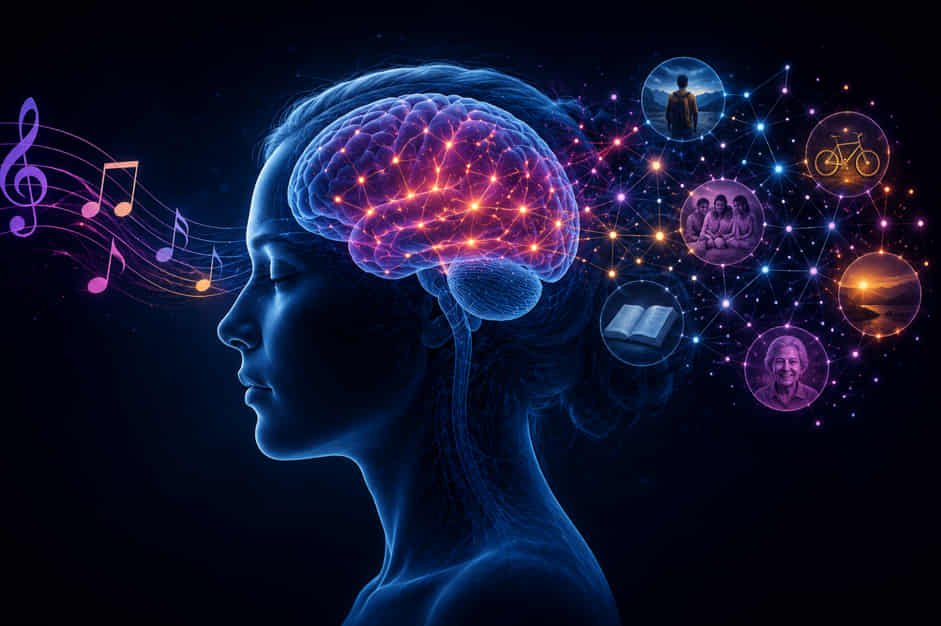
Have you ever heard an old song and instantly remembered a place, a person, or a special moment from years ago? Maybe a childhood melody reminded you of school, or a favourite song brought back memories of a family celebration. This happens because music and memory are deeply connected in the brain. But does listening to music actually improve your memory? The answer is: it depends.
When you listen to music, your brain doesn’t just process sound. It activates several regions at the same time, including those responsible for hearing, emotions, attention, movement, and memory. This widespread brain activity is one reason music can have such a powerful effect on how we remember experiences.
One of the strongest links between music and memory comes through emotion. Events that make us feel happy, excited, sad, or nostalgic are usually remembered more clearly than ordinary experiences. When a particular song is associated with an emotional event, hearing it again can reactivate those memories, making them feel vivid and surprisingly detailed. That’s why a familiar tune can instantly transport you back in time.
Music can also make learning easier. Scientists have found that information paired with rhythm or melody is often easier to remember than plain spoken words. Think about how effortlessly most people remember the alphabet through the “ABC Song.” Rhythm, repetition, and melody provide the brain with extra cues that make information easier to store and retrieve later. This is why songs, rhymes, and chants are commonly used to teach children numbers, languages, and other concepts.
However, music is not always helpful. If you’re trying to read a difficult passage, solve a complex mathematical problem, or learn new information, especially while listening to songs with lyrics, the music may compete for your attention. Since both language processing and reading rely on similar brain resources, lyrical music can become distracting. In such situations, silence or soft instrumental music may help some people concentrate better, although individual preferences vary.
Researchers are also investigating music as a therapeutic tool for people with memory disorders. Individuals living with Alzheimer’s disease or other forms of dementia may struggle to remember recent events or recognize loved ones, yet they can often recall songs from their youth. While music cannot cure memory loss or stop the disease from progressing, it can trigger forgotten memories, reduce anxiety, improve mood, and encourage communication, enhancing quality of life.
So, can music improve memory? Not in every situation, and not for every person. But by engaging multiple brain regions, strengthening emotional connections, and providing powerful memory cues, music can be an effective tool for learning, remembering, and reconnecting with the past. Sometimes, the right song is more than just entertainment—it becomes the key that unlocks a memory.


