
For nearly a century, fungi have quietly transformed medicine. They gave us penicillin, the antibiotic that revolutionised the treatment of bacterial infections, and statins, the cholesterol-lowering drugs taken by millions of people worldwide. Yet scientists have long suspected that these familiar organisms are hiding far more chemical treasures than we have ever seen.
Now, researchers have developed a powerful new genome-editing tool that could help unlock this hidden potential, revealing previously unknown molecules that may one day become life-saving medicines.
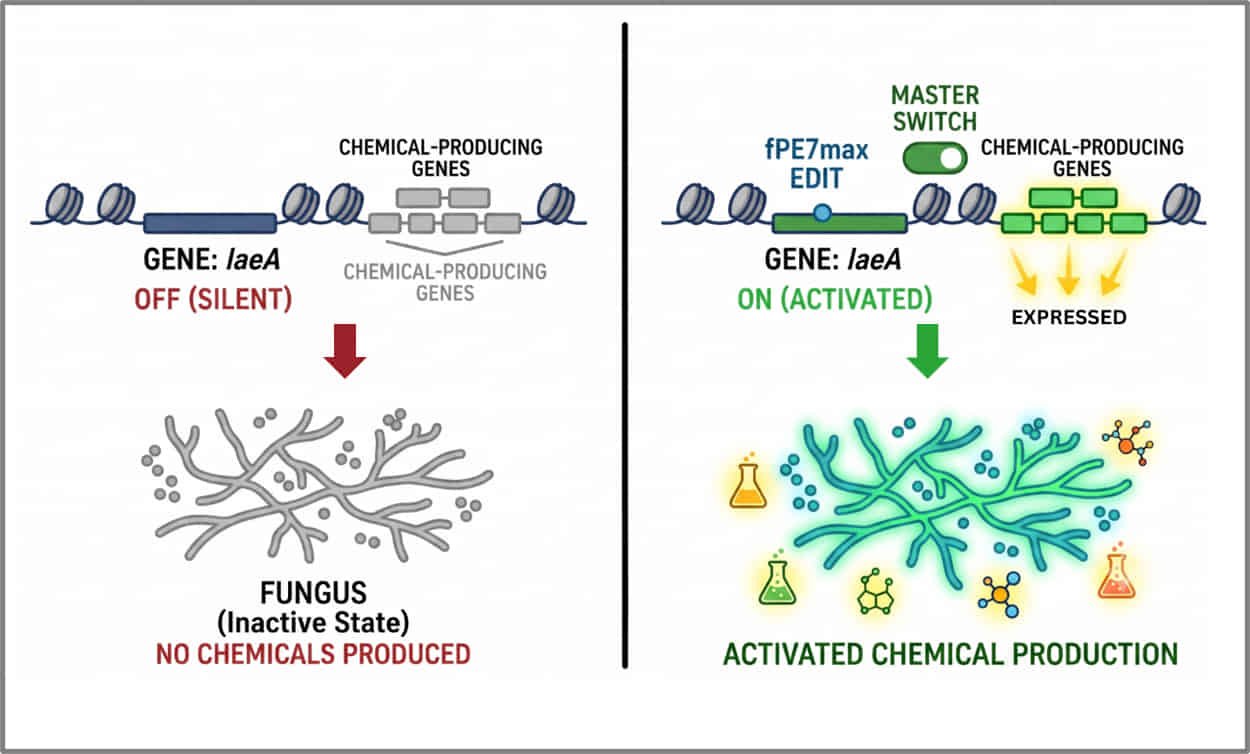
The challenge has never been a lack of chemical diversity. Fungal genomes contain numerous genes capable of producing biologically active compounds. The problem is that most of these genes remain permanently switched off under normal laboratory conditions. Imagine walking into a vast library where thousands of books are locked behind glass. You know valuable information is inside, but you have no way to read it.
A recent study has found a way to open some of those locked books.
The researchers created a genome-editing system called fPE7max, designed specifically for fungi. Unlike conventional methods that can make broad genetic changes, this tool enables precise edits to the fungal genome. Using it, the team activated a gene called laeA, often described as a “master switch” because it controls many of the genes responsible for producing specialised chemicals.
Once this genetic switch was turned on, the fungi began manufacturing compounds they had never produced before under laboratory conditions. Among these newly discovered molecules were several that showed promising anti-cancer activity in early laboratory experiments. Although these findings are still at an early stage and much more research is needed before any medical application, they offer an exciting glimpse into fungi’s untapped pharmaceutical potential.
The breakthrough could also change how scientists search for new drugs. Traditionally, discovering useful fungal compounds has relied largely on luck, screening thousands of fungal species in the hope that one naturally produces a molecule with medicinal value. The new approach shifts that strategy from chance to design. Instead of waiting for fungi to reveal their chemistry, researchers can deliberately activate silent genes and explore compounds that the organisms already possess but rarely express.
Nature has spent millions of years evolving an extraordinary chemical toolkit. Much of it has remained hidden simply because the right genetic switches were never flipped. With tools like fPE7max, scientists may finally be able to explore this vast, unexplored reservoir of natural compounds.
Sometimes, the next breakthrough in medicine isn’t about inventing something new—it’s about uncovering what nature has been keeping secret all along.


