
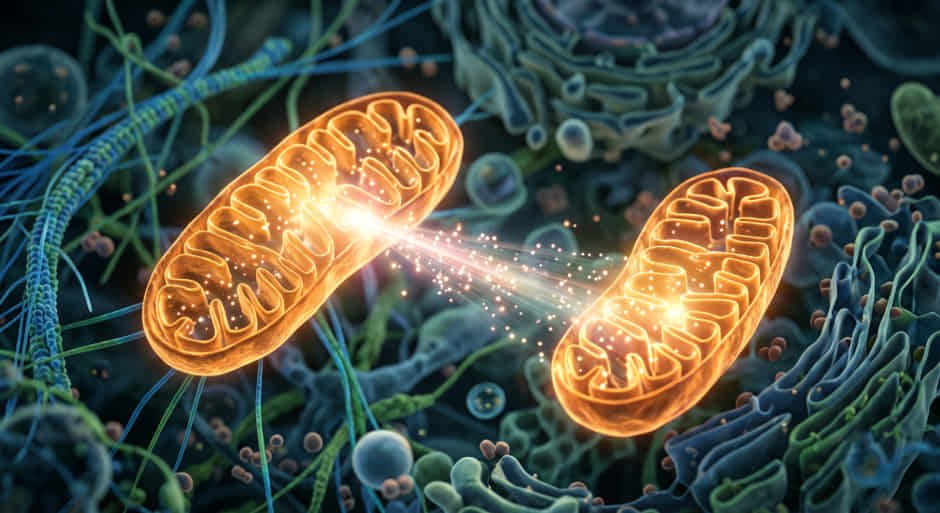
When you switch on your phone, tiny flashes of light carry information that lets you send messages across the world. Surprisingly, scientists now think something similar may be happening inside your own cells, not with visible light, but with incredibly faint flashes that no human eye can see. Every cell in your body contains tiny structures called mitochondria, often described as the cell’s “powerhouses.” Their best-known job is to produce the energy that keeps our muscles moving, our brain thinking, and our organs functioning. Until now, biology textbooks explained that mitochondria communicate mainly through chemical signals, coordinating their activities to keep cells healthy.
But a recent study suggests there may be another language they use, light.
As mitochondria generate energy, they also produce highly reactive molecules known as Reactive Oxygen Species (ROS). These molecules are a natural by-product of metabolism and, in small amounts, help cells carry out important functions. During these chemical reactions, mitochondria also release tiny packets of light called Ultraweak Photon Emissions (UPEs). These photons are millions of times dimmer than the light produced by a firefly or even the glow of a digital watch, making them completely invisible to our eyes. For decades, scientists assumed these faint flashes were simply harmless by-products of cellular metabolism. However, the new research proposes a fascinating possibility: what if these photons are actually signals?
Imagine a group of hikers walking through a dark forest. Instead of shouting to each other, they briefly flash their torches to stay together. Researchers believe mitochondria may use a similar strategy, sending tiny pulses of light that neighbouring mitochondria can detect, helping them synchronize their activity. Rather than replacing chemical signalling, these light flashes could serve as a second communication channel, allowing mitochondria to coordinate their behaviour more efficiently.
The idea is exciting, but it is still a scientific hypothesis supported by early experimental evidence. Researchers have not yet determined exactly how mitochondria might detect these photons or how important this signalling system is inside living cells. More studies will be needed before scientists can confirm that mitochondria truly “talk” using light. If future research supports this discovery, it could transform our understanding of how cells communicate. Mitochondria do much more than produce energy, they also regulate cell growth, immune responses, calcium balance, and programmed cell death. Problems with mitochondrial function have been linked to disorders such as Alzheimer’s disease, Parkinson’s disease, diabetes, cardiovascular diseases, and cancer.
As the proverb says, “The smallest spark can light the greatest fire.” In this case, the tiniest flashes of light inside our cells may reveal an entirely new form of biological communication. Sometimes, nature’s biggest secrets are hidden in signals so faint that we never knew they were there.


