Imagine carrying the entire contents of one of the world’s largest data centres in something smaller than a sugar cube. It may sound like science fiction, but scientists believe nature has already built such a storage device. It’s called DNA.
Every day, humanity generates enormous amounts of digital information, from social media posts and online banking records to scientific data, medical images, and AI models. As this mountain of data continues to grow into the zettabyte era, conventional storage technologies such as hard disk drives (HDDs), magnetic tapes, and solid-state drives are approaching practical limits in storage density, energy consumption, and long-term sustainability.
Ironically, the solution may come from the very molecule that stores the instructions for life itself.
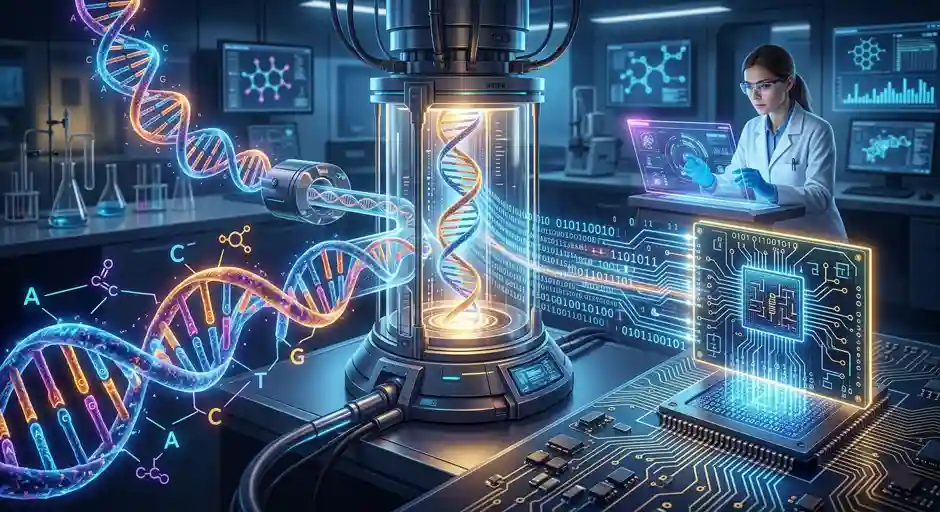
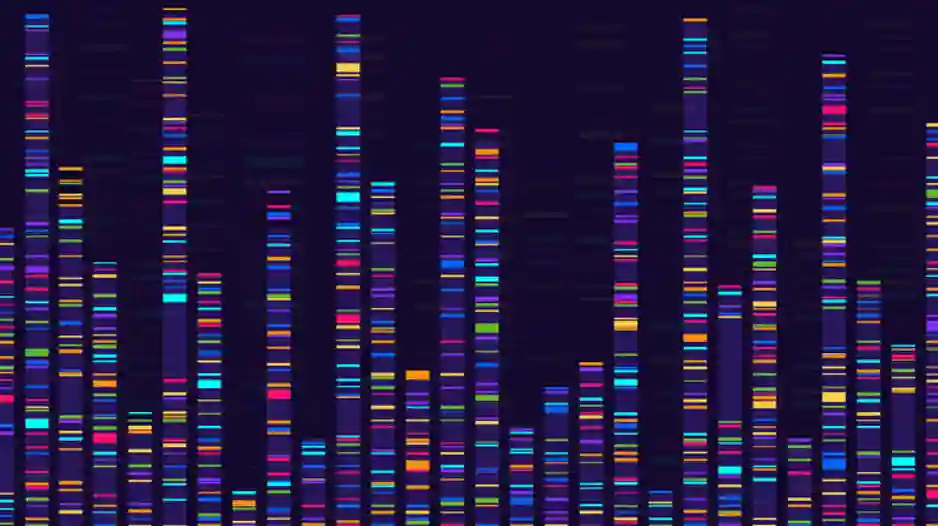
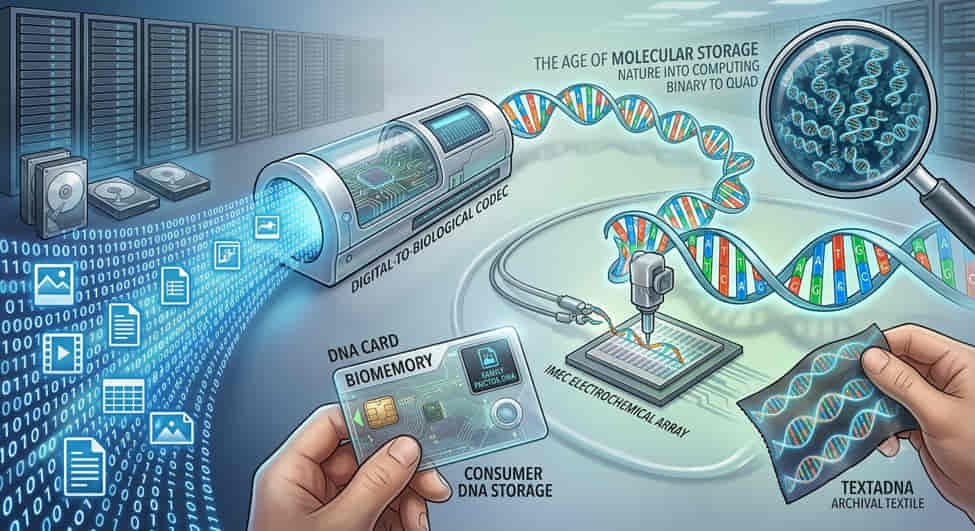
DNA is nature’s original data storage system. For billions of years, it has faithfully preserved genetic information using a simple four-letter alphabet: A, T, G, and C. Scientists have discovered that these four chemical “letters” can be used to encode digital information by converting the familiar binary language of computers, 1s and 0s, into DNA sequences.
The storage capacity is astonishing. Just one gram of DNA could theoretically store hundreds of petabytes of data, enough to hold millions of high-definition movies or vast scientific archives. Compared with today’s data centres, DNA offers an extraordinary increase in storage density.
This vision is no longer confined to research laboratories. Earlier this year, Imec, a global leader in nanoelectronics and semiconductor research, partnered with Atlas Data Storage to develop scalable technologies for writing digital information into DNA using advanced electrochemical chips. Meanwhile, French startup Biomemory has introduced DNA Cards, credit-card-sized storage devices that convert digital files into synthetic DNA sequences, bringing molecular data storage a step closer to real-world applications. Researchers are also exploring concepts such as TextaDNA, in which DNA strands carrying digital information are embedded into polymer fibres, potentially allowing archives to be literally woven into fabrics.
The excitement surrounding DNA storage comes from three remarkable advantages.
First is exceptional storage density. Data centres occupying entire buildings could, in principle, shrink to volumes smaller than a sugar cube.
Second is longevity. When properly protected, DNA can remain stable for thousands of years, eliminating the need to regularly migrate data to new storage media every few years.
Third is sustainability. Unlike conventional storage devices that require continuous electricity to preserve information, DNA consumes virtually no energy while sitting in storage, making it an attractive option for reducing the environmental footprint of digital archives.
Yet DNA storage is far from replacing today’s hard drives.
Writing data into DNA requires chemical synthesis, while reading it back involves DNA sequencing, both of which remain relatively slow and expensive. Scientists must also overcome challenges such as synthesis errors, efficient random access to specific files, and reducing the cost of storing and retrieving each gigabyte of information.
Rather than expecting a single revolutionary breakthrough, many experts believe progress will come through gradual advances in biotechnology, semiconductor engineering, artificial intelligence, and automation. As these fields converge, DNA storage may become practical for preserving massive archives that rarely need to be accessed but must remain secure for decades or even centuries.
For more than forty years, computers have helped scientists understand biology. Now, the relationship may be coming full circle.
As the saying goes, “Nature is the best engineer.” By borrowing the molecule that has safeguarded life’s genetic information for billions of years, we may one day redefine how humanity preserves its digital knowledge. The future of data storage might not be built from silicon alone, it could be written in the language of life itself.