
When doctors have two effective treatments for the same disease, choosing which one to use first isn’t always easy. It’s a bit like standing at a crossroads without a map, you know both roads can lead to the destination, but you don’t know which one offers the smoother journey.
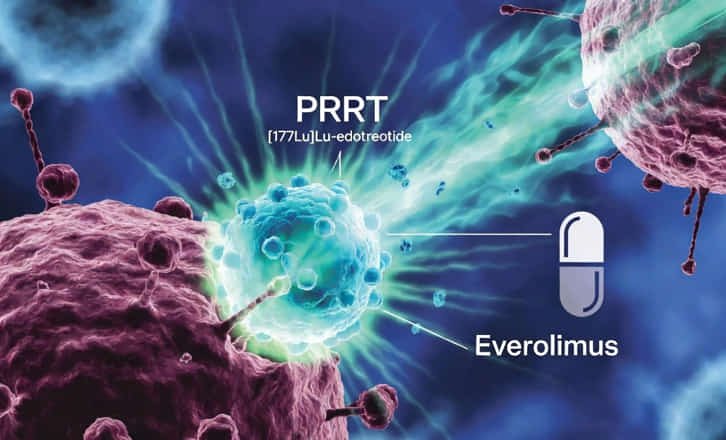
That has long been the challenge for treating gastroenteropancreatic neuroendocrine tumours (GEP-NETs), a rare group of cancers that develop in the stomach, intestines, pancreas, or other digestive organs. When these tumours spread to other parts of the body, doctors commonly rely on two proven therapies, but until now, there has been little evidence showing which should be used first. One treatment is Peptide Receptor Radionuclide Therapy (PRRT) using lutetium-177 edotreotide ([¹⁷⁷Lu]Lu-edotreotide). This treatment works like a guided missile: it attaches to specific receptors on tumour cells and delivers radiation directly to them, minimising damage to most healthy tissues. The second option is everolimus, a targeted drug that blocks a molecular pathway called mTOR, which many cancer cells use to grow and multiply.
A new clinical trial led by Walter T. and colleagues, published in The Lancet, has now provided the first direct comparison between these two treatments. The study included 309 patients with advanced, progressive GEP-NETs. Among them, 207 patients received PRRT, while 102 patients were treated with everolimus.
The results were striking.
Patients treated with PRRT remained free from cancer progression for a median of 23.9 months, compared with 14.1 months for those receiving everolimus. In other words, PRRT delayed tumour growth by nearly 10 additional months, a meaningful improvement for patients living with advanced cancer.
The researchers also compared the safety of the two treatments. Both therapies caused side effects, but serious side effects were considerably less common with PRRT. Severe treatment-related side effects occurred in 18% of patients receiving PRRT, compared with 40% of those treated with everolimus.
The most common side effects of PRRT included diarrhoea, nausea, and fatigue. Patients receiving everolimus most frequently experienced diarrhoea, fatigue, and anaemia, a condition caused by low red blood cell counts. Importantly, no treatment-related deaths occurred in either group, showing that both therapies were generally safe when carefully monitored.
This landmark study provides something doctors have been waiting for: clear evidence to guide treatment decisions. The findings suggest that PRRT not only controls advanced GEP-NETs for longer but also causes fewer severe side effects than everolimus.
As the saying goes, “Knowledge is power.” In medicine, that knowledge can mean choosing the right treatment at the right time. This study marks an important step toward improving care for people with metastatic neuroendocrine tumours and may help shape future treatment guidelines around the world.


