
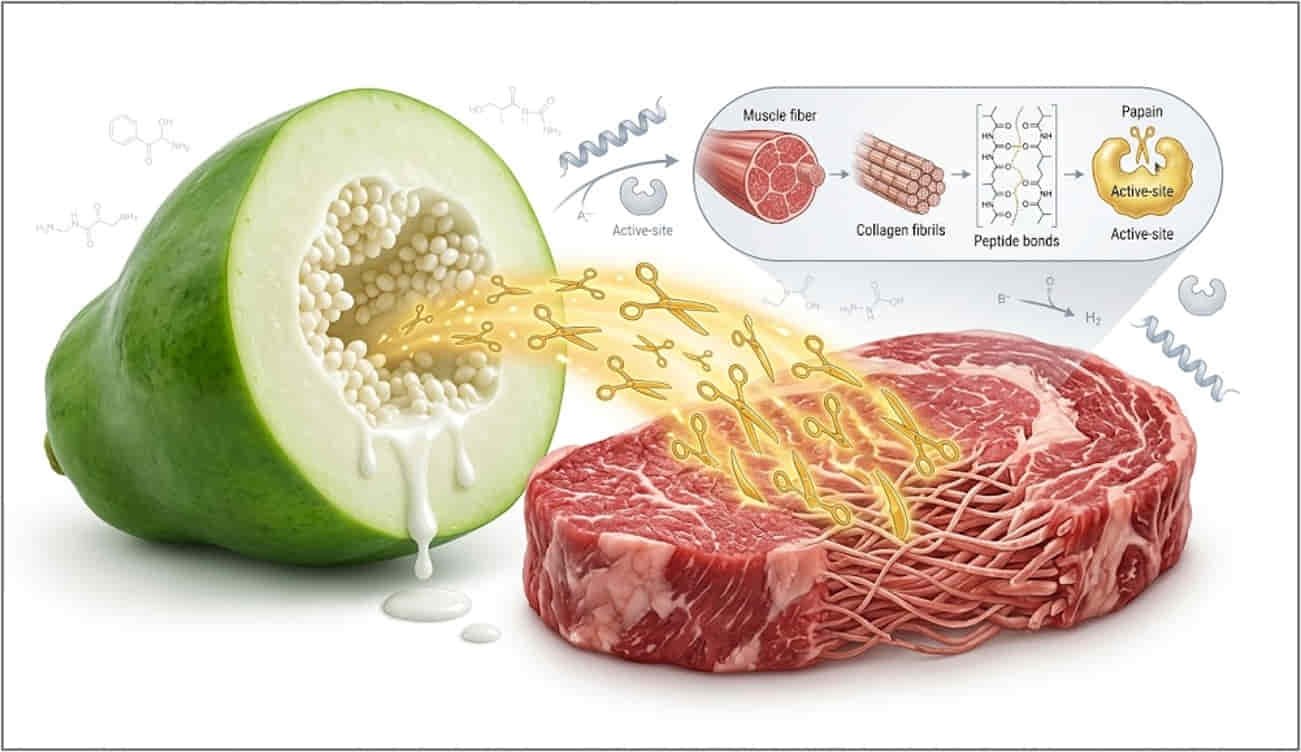
Have you ever wondered why some pieces of meat are so tender they almost melt in your mouth, while others feel like chewing a rubber shoe? The answer lies in a microscopic battle taking place long before the meat reaches the pan or grill. For centuries, people believed that the only way to soften tough meat was through patience, hours of slow cooking over gentle heat. Then nature quietly revealed a shortcut. Hidden inside an ordinary raw green papaya is a remarkable natural substance that works like millions of invisible scissors, cutting through the proteins that make meat tough.
What appears to be a simple fruit is actually carrying a powerful biochemical toolkit. Like a locksmith opening a rusted door without breaking it down, green papaya gently unlocks the structure of meat from within, making it tender while preserving its flavour. It is a perfect reminder that nature often solves problems not with force, but with chemistry.
The secret ingredient is an enzyme called papain, found in abundance in the milky latex of unripe green papaya. Enzymes are biological catalysts, specialized proteins that speed up chemical reactions without being consumed in the process. Think of papain as a highly trained tailor armed with razor-sharp scissors. Instead of cutting fabric, it cuts long chains of proteins. Meat owes its toughness largely to proteins such as collagen, actin, and myosin, which form tightly packed muscle fibres and connective tissues. These proteins are held together by peptide bonds, the molecular “threads” that keep the muscle structure intact.
Papain recognizes these peptide bonds and breaks them apart through a process called proteolysis. As collagen begins to loosen and muscle proteins become less tightly connected, the meat gradually softens. This is why many traditional cuisines around the world, from India to Latin America, have long used green papaya as a natural meat tenderizer, long before scientists understood the chemistry behind it.
| “The best cooks and the best chemists share one secret — they both know that the greatest transformations happen where the eye cannot see. Every delicious meal is, in truth, a masterpiece of molecular science.” |
At the molecular level, papain belongs to the family of cysteine proteases, enzymes that use a reactive cysteine amino acid in their active site to cleave peptide bonds. Unlike heat, which denatures proteins indiscriminately, papain selectively hydrolyses specific protein regions, particularly those found in connective tissue. Imagine a suspension bridge: rather than demolishing the entire bridge with explosives, papain quietly snips the supporting cables one by one until the structure relaxes under its own weight.
This controlled breakdown reduces the mechanical strength of collagen-rich tissues, allowing heat during cooking to penetrate more evenly and convert remaining collagen into gelatin more efficiently. The result is meat that retains more moisture and requires less prolonged cooking to achieve tenderness. Importantly, papain does not “cook” the meat; instead, it performs enzymatic pre-processing, making subsequent thermal cooking far more effective.
From a biochemical perspective, papain demonstrates the extraordinary precision of enzyme kinetics. Its catalytic activity depends on several variables, including enzyme concentration, temperature, pH, substrate accessibility, and incubation time. At room temperature, papain remains active and continues hydrolysing proteins until it is either denatured by sufficient heat or removed from the substrate. This explains why marination time must be carefully controlled. Excessive exposure does not simply make meat more tender, it can over-hydrolyse structural proteins, producing an undesirable soft or mushy texture.
| Cooking Metrics | Without Papaya Paste | With Raw Papaya Paste |
| Internal Meat Structure | Dense, tightly locked proteins | Shattered, relaxed protein matrix |
| Heat Penetration Speed | Very slow, blocked by collagen | Lightning-fast conduction |
| Cooking Time Required | Hours of slow cooking | Minutes on a high-heat grill |
| Moisture Retention | Dry, rubbery if cooked fast | Extremely juicy and tender |
The extent of tenderization varies with the type of meat, its collagen content, and the amount of papain applied; there is no universal “four-hour rule.” Food scientists therefore optimize papain treatment by balancing enzymatic activity with cooking conditions to achieve maximum tenderness without compromising texture. Modern commercial meat tenderizers often contain purified papain or related proteases such as bromelain (from pineapple) and ficin (from figs), illustrating how enzymology has transformed culinary practice into an application of precision biochemistry. In essence, every well-marinated piece of meat is not merely cooked, it is biochemically engineered, proving that the kitchen is one of humanity’s oldest and most fascinating laboratories.


