
For decades, biology textbooks have taught us that all living organisms, from bacteria and plants to elephants and humans, follow essentially the same molecular recipe for building proteins. Think of a ribosome as a 3D printer inside every cell. DNA stores the blueprint, messenger RNA (mRNA) carries the instructions, and the ribosome reads that blueprint one letter at a time, assembling amino acids into proteins that keep every cell alive.
Scientists have long believed that some parts of this protein-making machine were so important that evolution had left them almost untouched for billions of years. These regions of ribosomal RNA (rRNA) were considered biology’s “gold standard”, so reliable that researchers routinely used them as internal controls to check whether their experiments had worked correctly. But as the saying goes, “A crack in the wall can sometimes reveal a hidden doorway.” A surprising discovery in octopuses has revealed that even one of life’s most ancient and trusted molecular machines can still rewrite its own instruction manual.
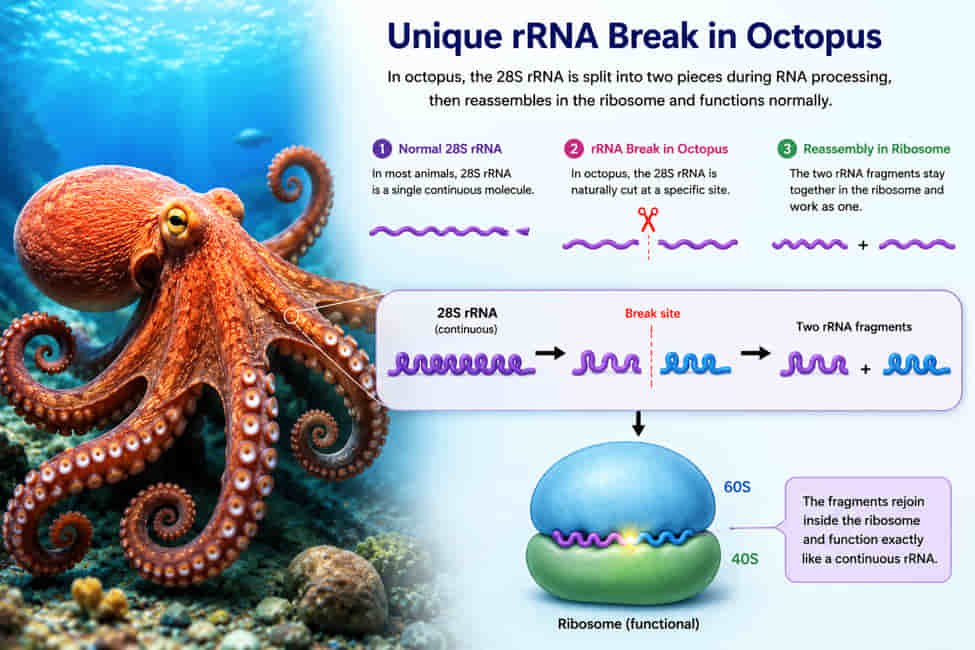
The discovery began not with a grand experiment, but with what appeared to be an ordinary laboratory mistake. While analyzing RNA from the California two-spot octopus (Octopus bimaculoides), a graduate student in Harvard cell biologist Amy Lee’s laboratory noticed something unusual. Instead of seeing the familiar single band of 28S ribosomal RNA on an electrophoresis gel, the sample consistently showed two separate bands.
| “The greatest revolutions in science often begin as mistakes. Sometimes, what looks like a broken machine is actually nature revealing a better design.” |
At first, the researchers suspected that the RNA had degraded during extraction, a common laboratory problem. However, repeated experiments produced the same result. The “error” turned out to be real biology. The octopus naturally possesses a split 28S rRNA, a feature not previously observed in any other animal. It was rather like discovering that a piano has been built in two pieces but still produces perfectly harmonious music. What initially looked like damage was actually an elegant evolutionary innovation.
At the undergraduate level, the finding becomes even more fascinating. Ribosomes contain three functional regions known as the A (Aminoacyl), P (Peptidyl), and E (Exit) sites, which work together like stations on an assembly line. The A-site accepts an incoming transfer RNA (tRNA) carrying an amino acid, the P-site holds the growing protein chain, and the E-site releases the empty tRNA after its job is done. Remarkably, the newly discovered split occurs precisely within the E-site region of the 28S rRNA. Despite this physical break, the ribosome remains fully functional because the two RNA fragments stay tightly associated through extensive tertiary RNA interactions, behaving much like the two halves of a hinged bridge that separate during construction but lock firmly together when in use. Researchers propose that this structural modification subtly alters the neighboring A-site, making it more selective when accepting incoming tRNAs.
In molecular terms, the ribosome may achieve higher translational fidelity, reducing the likelihood of incorrect amino acids being incorporated into newly synthesized proteins. This could minimize protein misfolding and improve the accuracy of cellular protein production.
From a postgraduate perspective, this discovery challenges one of molecular biology’s long-standing assumptions: that highly conserved ribosomal RNA architecture is largely immutable across animal evolution. The split occurs within an expansion segment of the 28S rRNA, demonstrating that even deeply conserved components of the ribosome retain unexpected structural plasticity. Such remodeling may influence ribosomal dynamics, tRNA translocation, decoding fidelity, and allosteric communication between functional centers without compromising translational efficiency. Although the precise evolutionary advantage remains under investigation, enhanced translational accuracy could be particularly valuable in octopuses, whose exceptionally sophisticated nervous systems contain hundreds of millions of neurons, many located within their arms rather than centralized in the brain. Neurons are especially sensitive to protein misfolding because they are long-lived and rarely replaced. Even small improvements in protein quality control could therefore support neuronal function and resilience over an animal’s lifetime.
While this ribosomal innovation does not directly explain octopus intelligence, it expands the emerging concept of specialized ribosomes, the idea that ribosomes themselves can evolve structural adaptations that fine-tune gene expression. Like discovering that every orchestra doesn’t need identical instruments to perform the same symphony, this finding reminds us that evolution can rewrite even life’s oldest molecular rulebooks while preserving the music of life itself.
Source:
Rishav Mitra, Richard Han, Trey J Scott, Anik G Grearson, Jessica A Willi, Christina G Liu, Hyeongju Kim, Michael C. Jewett, Nicholas W Bellono, Amy SY Lee. Evolution of a core ribosomal innovation in octopus. bioRxiv (2026). Preprint. https://doi.org/10.64898/2026.06.25.734654 (BioRxiv)


