
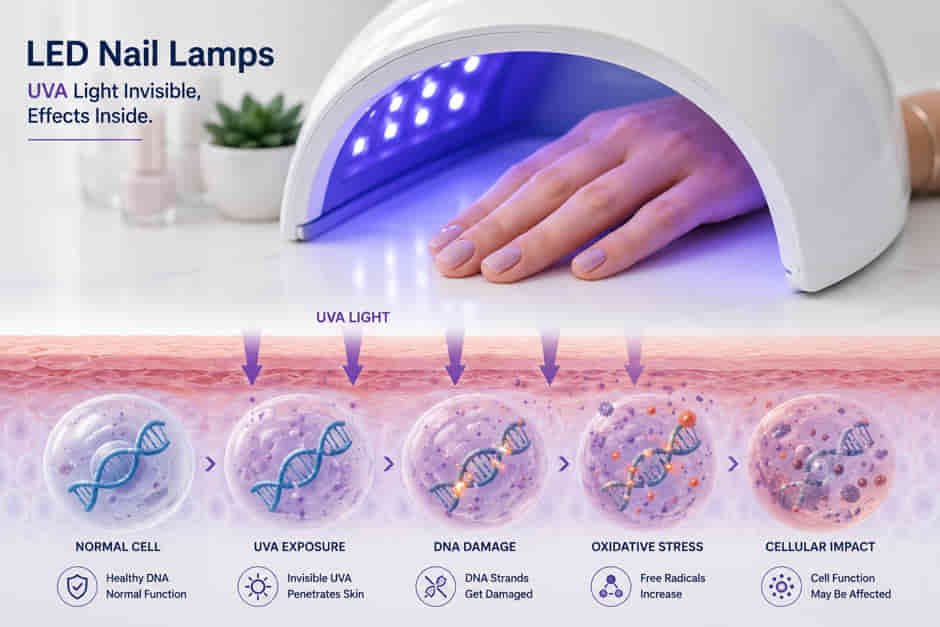
Who doesn’t love a fresh gel manicure that stays glossy for weeks without a single chip? It is quick, neat, and gives your nails a salon-perfect finish. But behind that beautiful shine, scientists are asking an important question: “What is happening beneath the skin?” Think of your skin as the walls of your home and your DNA as the blueprint safely stored inside. Every time you place your hands under an LED nail lamp, tiny invisible rays knock on that wall.
Most of the time, your body repairs the small damage without any trouble. But if those knocks happen again and again over many years, the walls may slowly begin to weaken. As the old saying goes, “Prevention is better than cure.” This does not mean you should stop getting gel manicures, it simply means it is wise to understand what is happening behind the scenes.
Despite the name, LED nail lamps do not produce only visible light. They also emit Ultraviolet A (UVA) light, which helps the gel polish harden within minutes. Imagine the gel polish saying, “I won’t become strong until the UV light wakes me up!” UVA is different from UVB, the type of ultraviolet light that usually causes sunburn. Instead of burning the surface, UVA travels deeper into the skin, rather like water slowly seeping into the cracks of a wall.
Over time, repeated exposure can speed up skin ageing by damaging collagen and may also affect the DNA inside skin cells. Fortunately, our body has a remarkable repair system that constantly fixes most of this damage. However, if DNA damage becomes too frequent or severe, some mistakes may remain, and these errors are called mutations. Scientists therefore advise moderation rather than fear.
Recent laboratory studies have given researchers more reason to investigate. In these experiments, human skin cells exposed directly to UV nail lamps showed increased oxidative stress, DNA damage, and injury to the mitochondria, often called the “powerhouses” of the cell because they produce energy. Imagine free radicals as tiny sparks flying inside a factory. If too many sparks appear, they can damage important machines before the maintenance team can put them out.
| “Beauty should never come at the cost of health. A little shine on your nails is wonderful, but protecting the cells beneath them is even more beautiful.” |
Vitamin-rich antioxidants in our body help fight these free radicals, but repeated UV exposure can increase the workload. Does this mean gel manicures cause cancer? Not necessarily. These laboratory experiments were performed under carefully controlled conditions, which are different from real-life salon visits. At present, there is no strong evidence that occasional gel manicures significantly increase the risk of skin cancer, although scientists agree that the effects of repeated exposure over many years deserve further study.
From a higher scientific perspective, UVA radiation (approximately 340-395 nm) can induce the formation of reactive oxygen species (ROS), leading to oxidative damage of DNA, proteins, lipids, and mitochondrial membranes. Cells normally respond through sophisticated DNA repair mechanisms, including base excision repair (BER) and nucleotide excision repair (NER) pathways. When these repair systems function efficiently, most DNA lesions are corrected before they become permanent mutations.
However, chronic exposure combined with ageing or reduced repair capacity may increase the accumulation of genetic damage. Researchers are therefore studying the long-term effects of repeated UVA exposure from cosmetic devices. Until more evidence becomes available, experts recommend simple precautions: apply a broad-spectrum sunscreen to your hands about 20 minutes before the manicure, wear fingerless UV-protective gloves, choose salons using modern LED lamps, and avoid unnecessary treatments. After all, beauty and safety should go hand in hand. A little care today can help keep both your nails and your skin healthy for years to come.


