
India has taken a giant leap into a new space age. For decades, launching rockets into space was a job only government space agencies could do. But today, a young Indian startup has shown that dreams, determination, and science can fly together. Hyderabad-based Skyroot Aerospace successfully launched Vikram-1, India’s first privately developed orbital-class rocket, from the Satish Dhawan Space Centre, Sriharikota. It is not just a rocket soaring into the sky, it is India’s entrepreneurial spirit taking flight. If the rocket could speak at lift-off, it would proudly say, “Fasten your seatbelts, India.
We are aiming for the stars!” As the proverb says, “Where there is a will, there is a way.” Vikram-1 proves that with vision and hard work, even a startup can touch the edge of space. The mission marks a historic milestone in India’s growing private space sector and demonstrates the success of the country’s space-sector reforms.
Vikram-1 was built for the fast-growing market of small satellites. Think of it as a reliable space taxi that carries passengers safely to their destination, except its passengers are satellites instead of people. The rocket has four stages. The first three use powerful solid-fuel motors to lift it out of Earth’s gravity, while the final stage uses a liquid-fuel Orbital Adjustment Module to place satellites accurately into orbit. It can carry up to 350 kilograms to a 450-kilometre Low Earth Orbit, making it suitable for Earth observation, communication, scientific research, and technology demonstration missions.
Unlike older launch systems that followed fixed schedules, Vikram-1 is designed to provide faster, flexible, and on-demand launches. This is becoming increasingly important because thousands of small satellites are now needed for internet services, weather forecasting, disaster management, farming, navigation, and climate monitoring.
| “Great nations are not built only by giant rockets. They are built by young minds that dare to ask, ‘Why not us?’ Every launch begins long before the countdown, in someone’s dream.” |
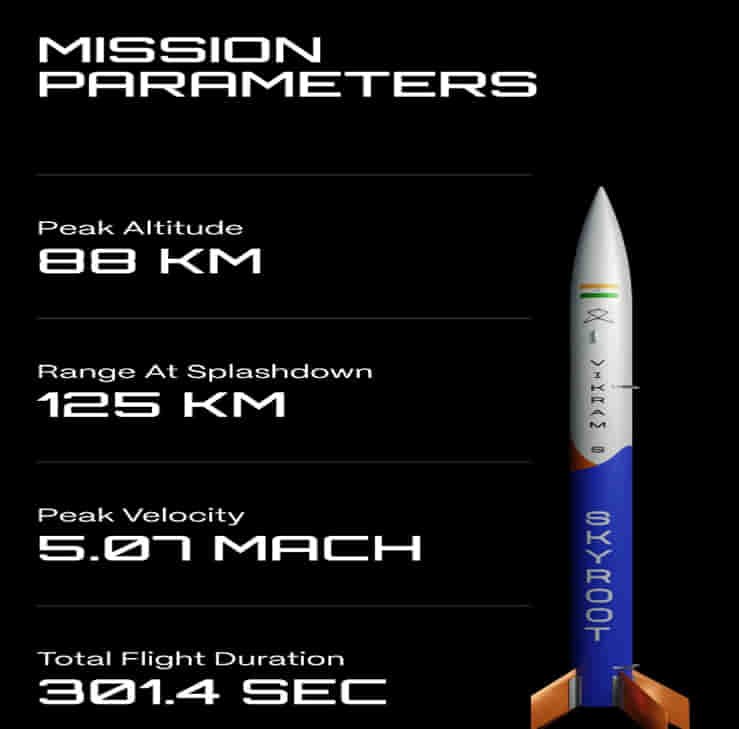
The story behind Vikram-1 is equally inspiring. Skyroot Aerospace was founded in 2018 by former ISRO scientists Pawan Kumar Chandana and Naga Bharath Daka with a bold dream of making access to space as simple and affordable as booking a cab. Their first success came in 2022 with Vikram-S under Mission Prarambh, India’s first privately built suborbital rocket. That mission was like learning to ride a bicycle. Vikram-1 is the moment they entered the Formula One race.
Even more remarkable is the youthful team behind this achievement. The average age of the engineers and scientists is only around 28 years. Their message to young India is loud and clear, “Age is just a number when curiosity becomes your fuel.” The rocket itself showcases advanced engineering, including lightweight carbon-composite structures, high-performance solid rocket motors, and innovative 3D-printed liquid engines that reduce manufacturing time while improving reliability and lowering costs.
From an advanced aerospace perspective, Vikram-1 represents the maturation of India’s commercial launch ecosystem. The vehicle integrates composite airframe technology, high-energy solid propulsion, precision guidance, navigation and control systems, and an orbital adjustment module capable of accurate payload deployment into Low Earth Orbit. Such technologies reduce structural mass while maximising payload efficiency, a key performance metric in modern launch vehicles. The successful mission validates not only propulsion and avionics but also the broader public-private partnership model that has emerged following India’s space-sector reforms.
Supported by investments exceeding US$160 million and backed by global investors, Skyroot has evolved into one of India’s leading space technology companies, positioning the nation as a strong competitor in the rapidly expanding global small-satellite launch market. As satellites become indispensable for communication, Earth observation, defence, navigation, agriculture, and climate science, responsive launch services will become increasingly valuable. Vikram-1 is therefore much more than a successful rocket. It is a symbol of a new India where innovation, entrepreneurship, and scientific excellence work hand in hand. After all, the sky is no longer the limit. For India’s young innovators, it is simply the launch pad for the next great adventure.


