
Imagine writing a message on a beach. Within minutes, the waves wash it away. Now imagine carving the same message into solid rock. It stays for years. A tattoo works in a similar way. Many people think tattoos remain forever because the ink never moves. But the truth is far more fascinating. Your skin is like a house that is constantly being renovated. The outer paint is replaced again and again, yet the strong foundation remains. A tattoo artist doesn’t draw on the “paint.” Instead, the needle places the ink deep inside the skin’s foundation, where time finds it much harder to erase. As the tattoo needle says, “My job is not just to colour your skin, but to hide the colour where it can survive.”
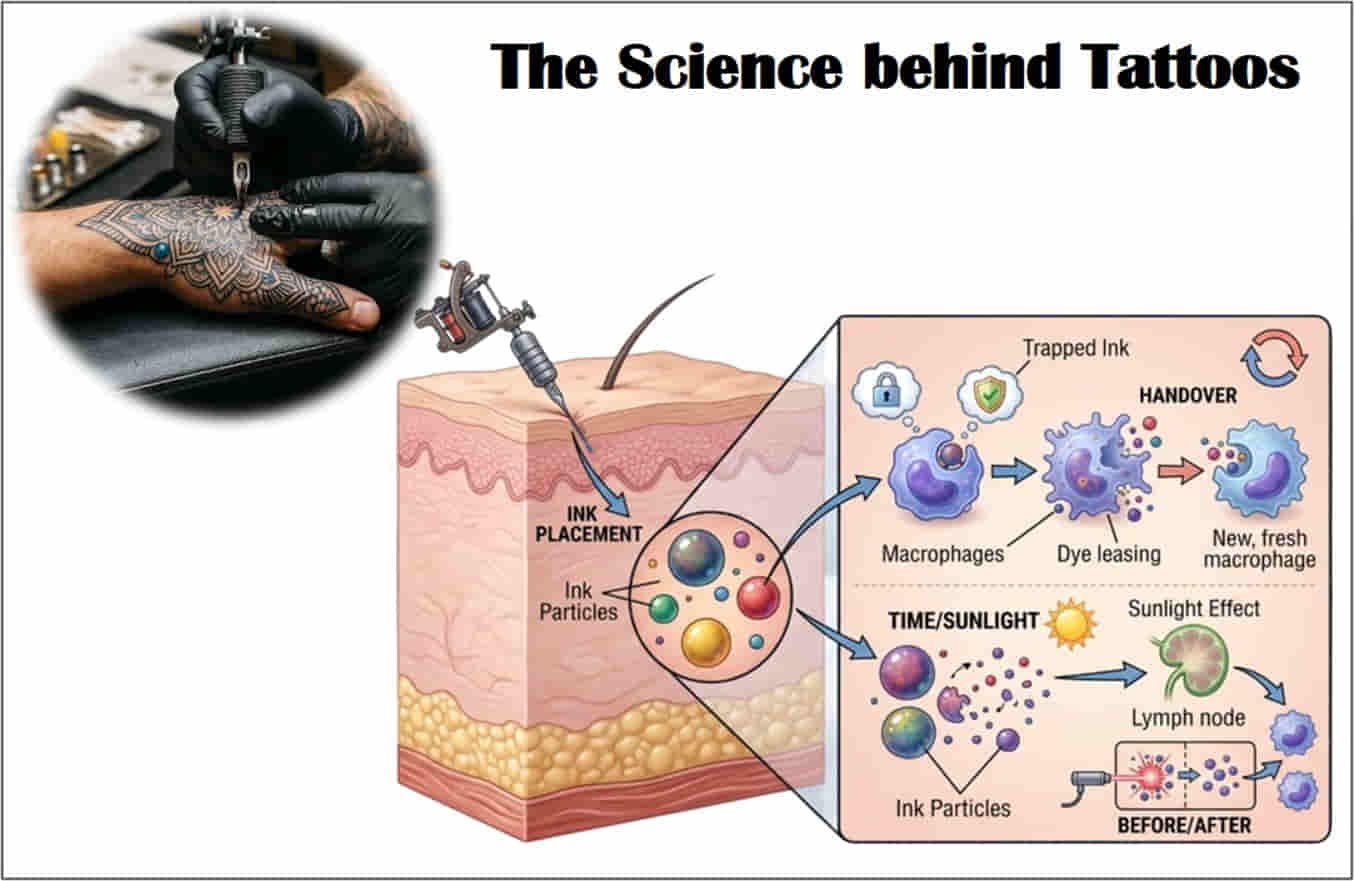
To understand this, let’s look at the biology of your skin. Human skin has three main layers: the epidermis, dermis, and hypodermis. The epidermis is the outer protective layer, and its cells are replaced every three to four weeks. If tattoo ink stayed here, it would disappear just like chalk washed away by rain. During tattooing, thousands of tiny needle punctures carry ink through the epidermis and deposit it into the dermis, a thicker and more stable layer made of collagen, elastin, blood vessels, and nerve endings. Think of the epidermis as a whiteboard that is cleaned every day, while the dermis is like a permanent notice board where important messages are pinned for years.
The real hero of this story is not the ink, but your immune system. The moment the ink enters the dermis, the body treats it as a foreign invader. Immune cells called macrophages rush to the site like security guards responding to an alarm. “We’ve caught the intruder,” they declare. However, the pigment particles are too large to digest completely. Instead of destroying them, the macrophages imprison the ink inside themselves. Even more interesting, when these macrophages eventually die, new macrophages immediately swallow the released pigment. Scientists call this continuous transfer of pigment between immune cells a cellular pigment handover, one of the key reasons tattoos remain visible for decades. This process represents a balance between phagocytosis, immune surveillance, and tissue homeostasis.
| “Some marks fade with time, but the stories written beneath the skin are guarded by science.” |
At the molecular level, tattoo pigments become embedded within the extracellular matrix of the dermis, a dense network of collagen fibres that acts like reinforced concrete around the trapped particles. Most pigments are chemically stable and resist enzymatic degradation, allowing them to remain for many years. However, sunlight slowly breaks down some pigments through photodegradation, while a small fraction is gradually removed through lymphatic drainage, explaining why older tattoos often appear lighter or blurrier. Laser tattoo removal cleverly turns the body’s own immune system into an ally. Short, high-energy laser pulses produce photoacoustic fragmentation, breaking large pigment particles into microscopic pieces. “Now we can carry them away,” the macrophages respond. These smaller fragments are removed through the lymphatic system, but since only some pigment is cleared after each session, several treatments are usually required.
In the end, a tattoo is not permanent because the ink never changes. It lasts because biology and the immune system quietly protect it every single day. Sometimes, the body’s greatest artist is not the tattooist, but the tiny immune cells that unknowingly preserve every line, colour, and memory beneath your skin.


