
When astronomers look deeper into space, they are also looking further back in time. This is because light does not travel instantaneously, it moves at a finite speed. Light from nearby stars takes only a few years to reach Earth, but light from the most distant galaxies can take billions of years. As a result, observing faraway galaxies allows astronomers to see them as they existed billions of years ago, offering a glimpse into the Universe’s distant past.
This is one of the main reasons the James Webb Space Telescope (JWST) was built. Its powerful infrared instruments allow it to detect some of the oldest and faintest galaxies ever observed, helping scientists understand how the first galaxies formed after the Big Bang.
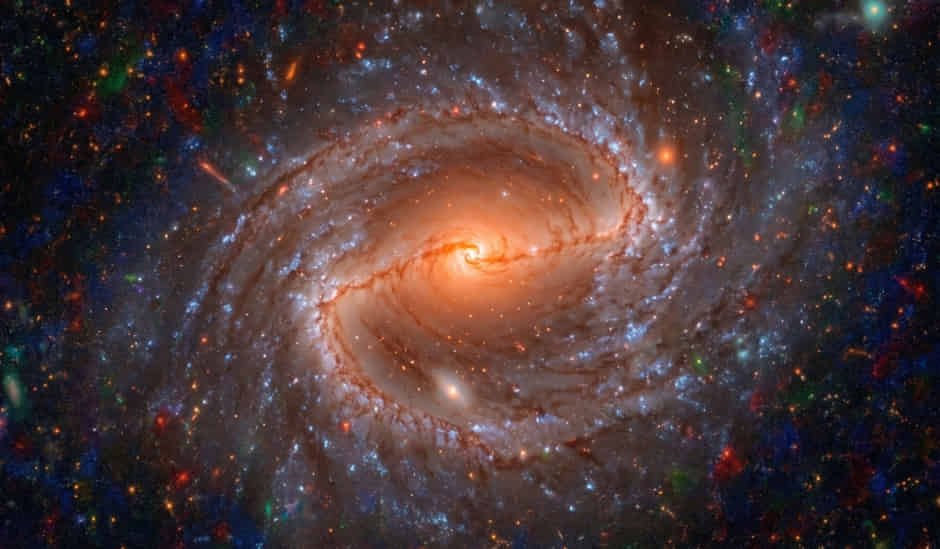
Recently, JWST discovered an enormous barred spiral galaxy called M1149-BSG-z5, which existed only about 1.2 billion years after the Big Bang. What amazed astronomers was not just its impressive size, but how mature and well-organised it already appeared. The finding challenges long-standing ideas about how quickly galaxies could evolve in the early Universe.
A spiral galaxy is characterised by graceful, curved arms that wind around a bright central region, much like our own Milky Way. A barred spiral galaxy has an additional elongated band of stars, known as a stellar bar, stretching across its centre. These bars play an important role in galaxy evolution by funnelling gas toward the central regions, where it can fuel the birth of new stars and feed the galaxy’s central black hole.
For decades, astronomers believed that galaxies in the early Universe were mostly small, chaotic, and irregular in shape. Large, well-defined spiral galaxies were expected to emerge only after billions of years of gradual growth through mergers and internal evolution.
Instead, JWST found a galaxy with sweeping spiral arms, a fully developed central bar, and an astonishingly high rate of star formation, producing enough new stars each year to equal the mass of about 144 Suns. The galaxy also contains surprisingly large amounts of heavy elements such as carbon, oxygen, and iron. Since these elements are forged inside stars and released when they die, their presence indicates that several generations of stars had already formed and completed their life cycles in a relatively short cosmic time. Researchers also found evidence of a supermassive black hole at the galaxy’s centre.
Discoveries like M1149-BSG-z5 are helping astronomers refine their theories of galaxy formation. Rather than evolving slowly over billions of years, some massive, highly organized galaxies may have formed much earlier under the right conditions. Every new observation from JWST is revealing that the young Universe was far more complex than scientists once imagined, and sometimes, a single galaxy is enough to rewrite part of cosmic history.


